
Stocked item: delivered in 1–2 working days in Ho Chi Minh City, Binh Duong and Dong Nai; free delivery for orders from VND 20,000,000; defective items exchanged within 7 days. Shipping & return policy
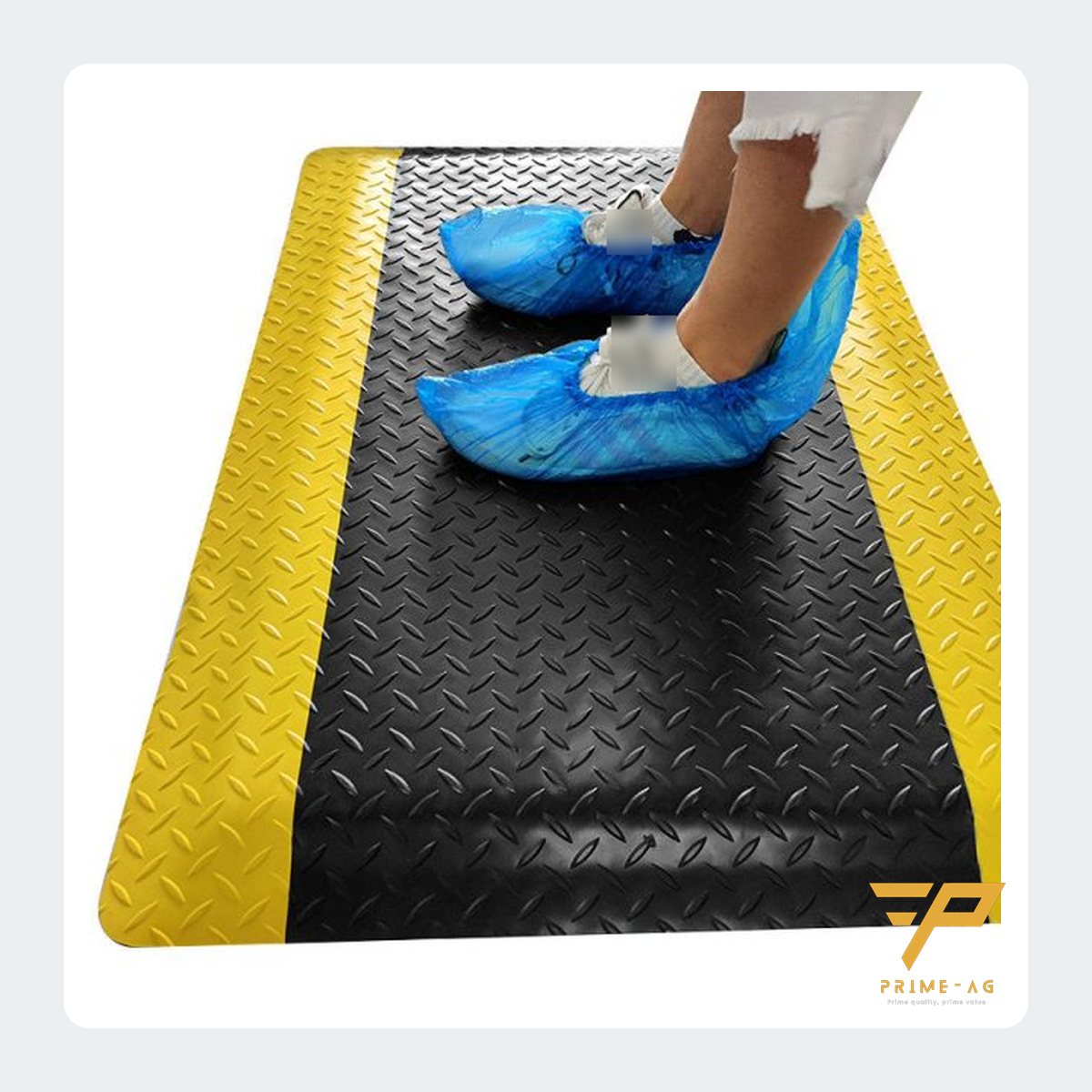
Product code: MF-6914
Anti-fatigue Mats
Common specifications: 600×900×14 and 900×1,500 yellow-black.
Delivery: in stock, delivered within 24–48 hours (Ho Chi Minh City, Binh Duong, Dong Nai); lead time for bulk orders is confirmed with the quotation.
Resilient PU/PVC foam mats for workstations where operators stand for the whole shift (packing, inspection, press machines): they help reduce leg and back fatigue, are slip-resistant, have a yellow-black 45° bevelled warning edge and do not absorb oil or water. The ESD version (black, 10⁶–10⁹ Ω) is for standing positions inside an EPA. Rolls of 900 × 20 m can be cut to the length of the line.
| Item | Value |
|---|---|
| Material | PVC foam / PU surface, bevelled edge |
| Size | 600×900, 900×1,200, 900×1,500, 900×1,800; roll 900 × 20 m |
| Thickness | 11 / 14 / 20 mm |
| Colour | Yellow-black (edge), black, grey |
| ESD | Optional 10⁶–10⁹ Ω; used with grounding snap and ground cord |
| Load | Foot traffic, hand trolleys; no forklifts |
| MOQ | 1 mat |
FAQ
– 14 or 20 mm thick? — 14 mm suits most full-shift standing positions; 20 mm is for cold concrete floors. A mat that is too thick or too soft can increase fatigue — let shift operators try it before equipping the whole line.
– Can it be extended? — Rolls are cut in one piece; separate mats are joined along bevelled edges.
Why does prolonged standing cause fatigue, and how does a mat help?
According to the Canadian Centre for Occupational Health and Safety (CCOHS), standing in itself is not hazardous, but frequent, prolonged standing can cause sore feet, swelling of the legs, varicose veins, muscle fatigue, low back pain, and stiffness in the neck and shoulders. When holding a static standing posture, blood supply to the loaded muscles is reduced, so they tire faster; without opportunities to walk around, blood pools in the legs and feet.
Hard concrete or metal floors make this worse. CCOHS recommends avoiding standing directly on concrete or metal; wood, cork or rubber flooring, or mats, should be used instead. An anti-fatigue mat has moderate resilience, making the leg muscles continuously make small adjustments instead of holding one rigid posture.
Materials and construction
- PVC foam (vinyl foam): PVC is foamed with closed cells to make it thick, light and cushioned without using much material. Flexible PVC needs plasticisers; plasticisers are not chemically bound to the polymer, so they can gradually migrate out over time and make the mat harden. Ordinary PVC begins to deform under heat at around 60 °C.
- PU top layer: abrasion-resistant, cushioned, easy to wipe, fairly oil-resistant; usually applied over a foam core.
- Nitrile rubber (NBR): used in oily areas, press and CNC areas. According to material references, NBR resists mineral oils, vegetable oils, and dilute acids and alkalis better than natural rubber, and works at approximately −40 to 108 °C.
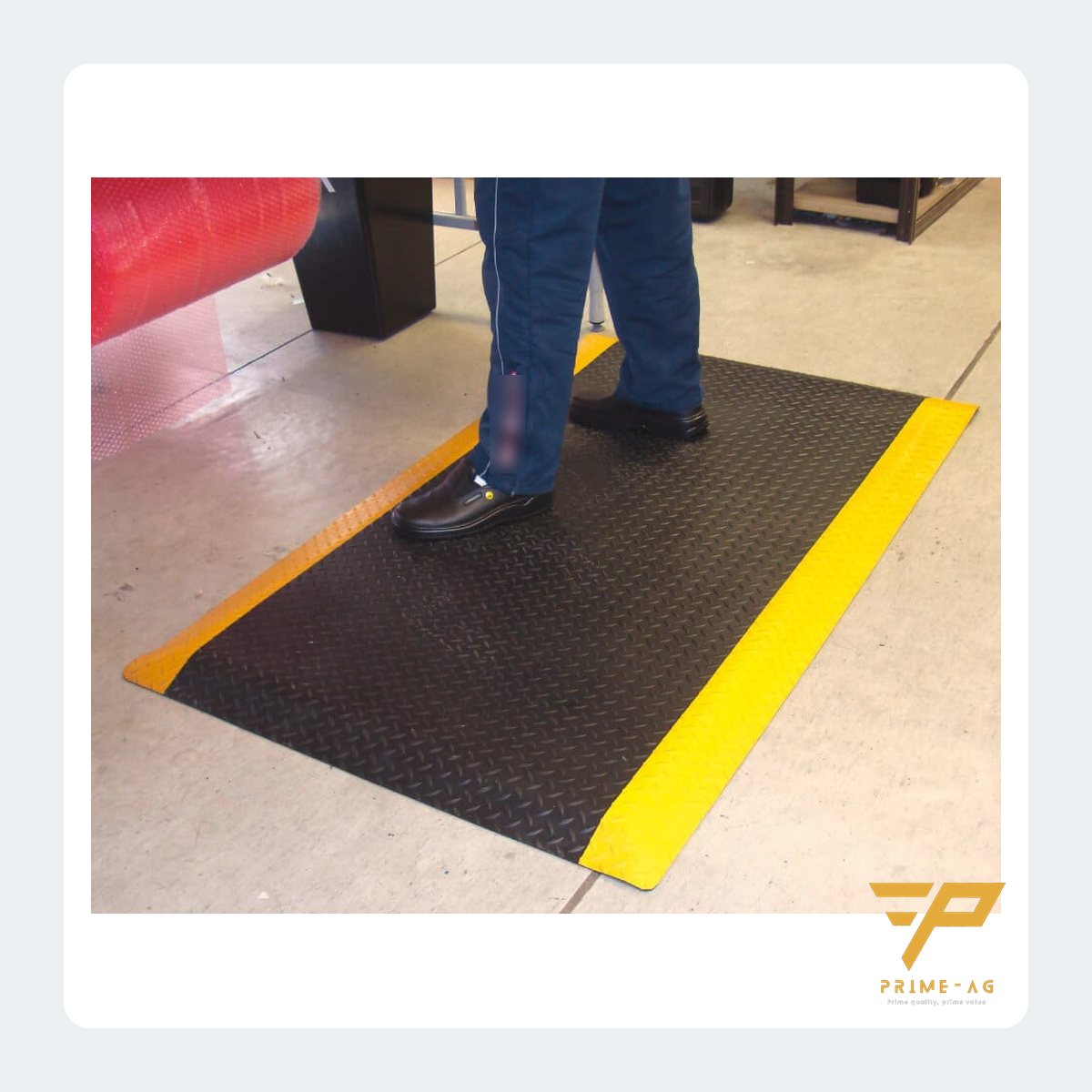
- Bevelled edge: the mat edge is sloped so that feet and hand-trolley wheels pass over it without tripping. CCOHS recommends mats with bevelled edges to reduce the risk of trips and falls. The yellow-black colour on the edge makes the mat edge easy to see.
Choosing the thickness: softer is not necessarily better
CCOHS advises against using overly thick sponge-rubber mats: cushioning that is too soft lets the feet sink in and become unstable, which can increase fatigue and the risk of tripping. A good mat springs back and does not sink deeply where people stand for a long time. When selecting, let workers stand on it for half a shift and ask for their feedback before equipping the whole line.
A mat is only part of the solution. CCOHS recommends combining it with: footwear with arch support and cushioned insoles when standing on hard floors, providing seating to lean or sit on, changing posture, short breaks to walk around, and workbenches at the correct height (precision electronics assembly about 5 cm above elbow height; light line work 5–10 cm below elbow height).
Anti-fatigue mats in an EPA
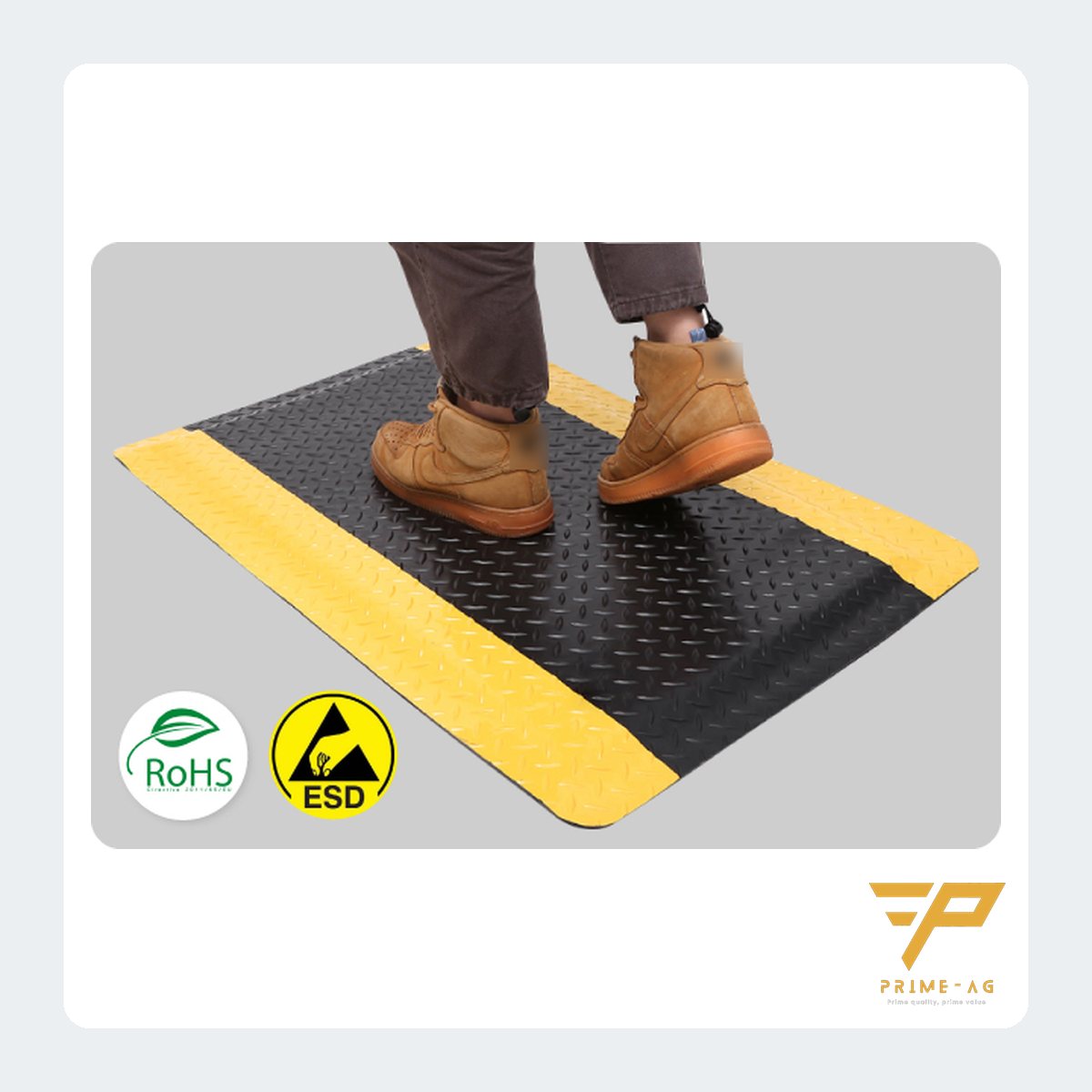
Ordinary PVC and PU mats are insulating materials: a person standing on them cannot dissipate static charge through the floor even when wearing ESD footwear. In an EPA the ESD version must be used and grounded:
- Under ANSI/ESD S20.20, a flooring – footwear system used as the personnel grounding method must achieve a person-to-ground resistance of < 3.5×10⁷ Ω; or < 1×10⁹ Ω together with a body voltage during walking of < 100 V (tested to ANSI/ESD STM97.1 and STM97.2).
- An ESD mat must have a grounding snap and ground cord to the common grounding point; without grounding it is just an ordinary mat.
- Personnel standing on an ESD mat must still wear ESD shoes or heel grounders on both feet; sandals and ordinary rubber-soled shoes are insulating and block the discharge path.
- Check the mat’s resistance to ground periodically according to ESD TR53, and check footwear every day with a footwear tester.
Cleaning, care and service life
- Sweep away dust and metal chips daily; wipe with water and a neutral detergent. Do not use wax- or silicone-containing cleaners on ESD mats — they leave an insulating film.
- Let the underside of the mat and the floor dry completely before laying the mat again, to avoid slipping and mould.
- Replace the mat when it is permanently compressed at the standing position, the surface is cracked, layers are delaminating, or the edges curl up and become a trip hazard.
- PVC foam mats do not withstand hot chips, welding slag or hot oil; use nitrile rubber mats in these areas.
Common mistakes
- Driving forklifts or heavily loaded pallet trucks over the mat — this tears the foam layer and lifts the edges.
- Butting several separate mats together without interlocking edges — the gaps cause tripping.
- Laying ordinary mats in an EPA, or laying ESD mats without grounding them.
- Assuming the thicker the mat the better, without a real trial with shift operators.
Technical references
- CCOHS – Working in a standing position: basic information (mats, flooring, footwear)
- Desco Asia – ANSI/ESD S20.20: flooring – footwear system limits
- ESDA – Fundamentals of ESD, Part 3 (packaging, ANSI/ESD S541, garments, carts)
- Wikipedia – Polyvinyl chloride (flexible PVC, plasticisers, PVC foam)
- Wikipedia – Nitrile rubber (oil resistance, temperature range)
Price: from 483,000 VND (excl. 8% VAT).
REQUEST A QUOTE: send the quantity and specifications you need — PRIMEAG quotes within 30 minutes.
Hotline/Zalo +84 906 108 292 · info@primeag.vn
Written by the PRIMEAG engineering team.
Related guides:Oily, slippery floor around CNC machines in Vietnam: 5…Anti-Fatigue Mats Slippery, Curling or Hardening at Machine Stations:…Stopping Scratches on Painted and Veneer Furniture Panels: Benches,…
Related products:2-Layer ESD Rubber Mat
Updated: 2026-10-24
Giao tận nhà máy TP.HCM, Bình Dương, Đồng Nai, Long An, Tây Ninh · Kèm biên bản đo điện trở ESD theo lô · Hotline 0906 108 292