
Stocked item: delivered in 1–2 working days in Ho Chi Minh City, Binh Duong and Dong Nai; free delivery for orders from VND 20,000,000; defective items exchanged within 7 days. Shipping & return policy
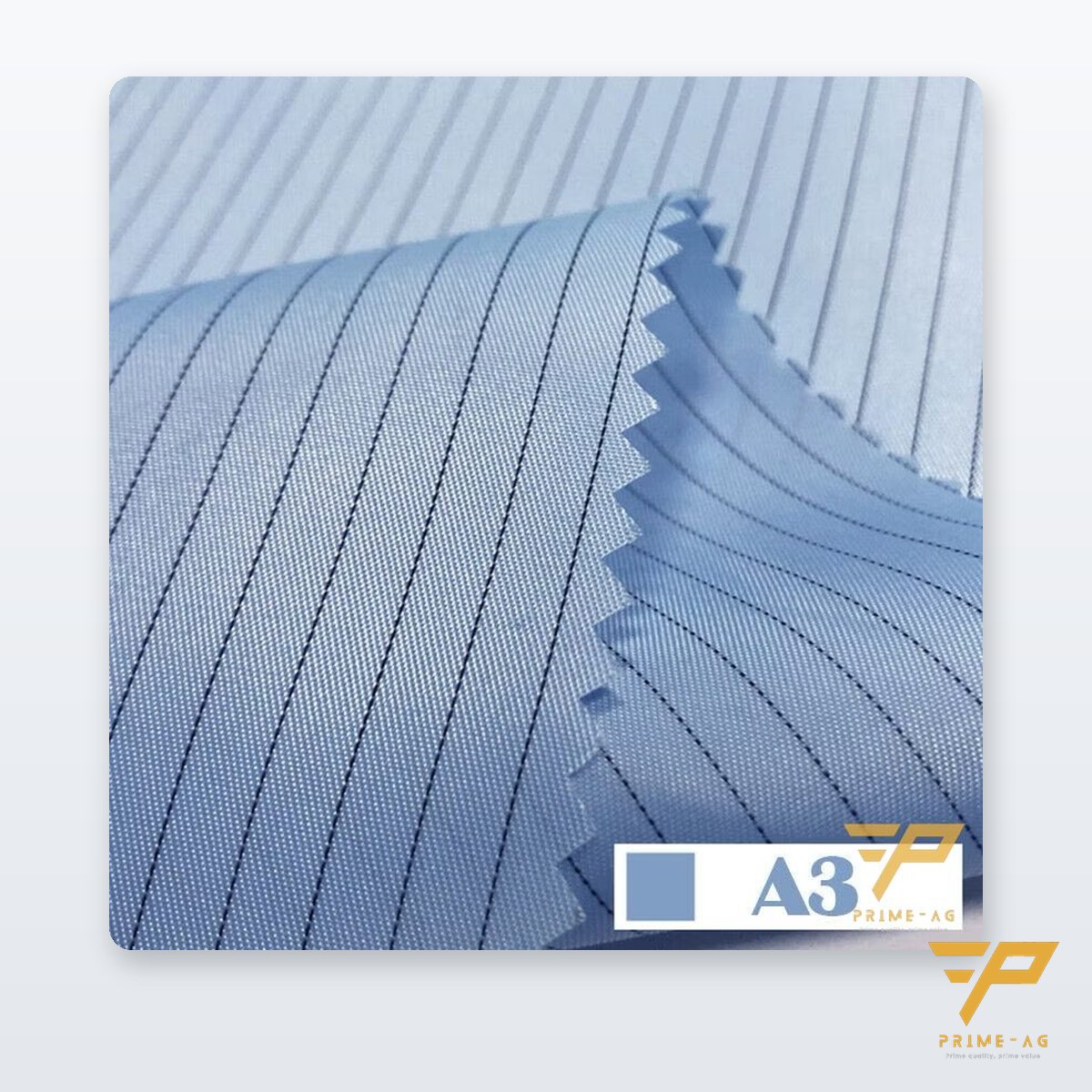
Product code: FB-1500 · Specification: ESD carbon-stripe anti-static fabric (sold by the meter)
ESD Cleanroom Fabric, carbon stripe, 1500 mm width
Also called: “ESD fabric W1500”, “striped cleanroom fabric”, “5 mm carbon fabric” — what is different: sold by the meter from 300 m, resistance report for every roll, delivered to match your sewing schedule.
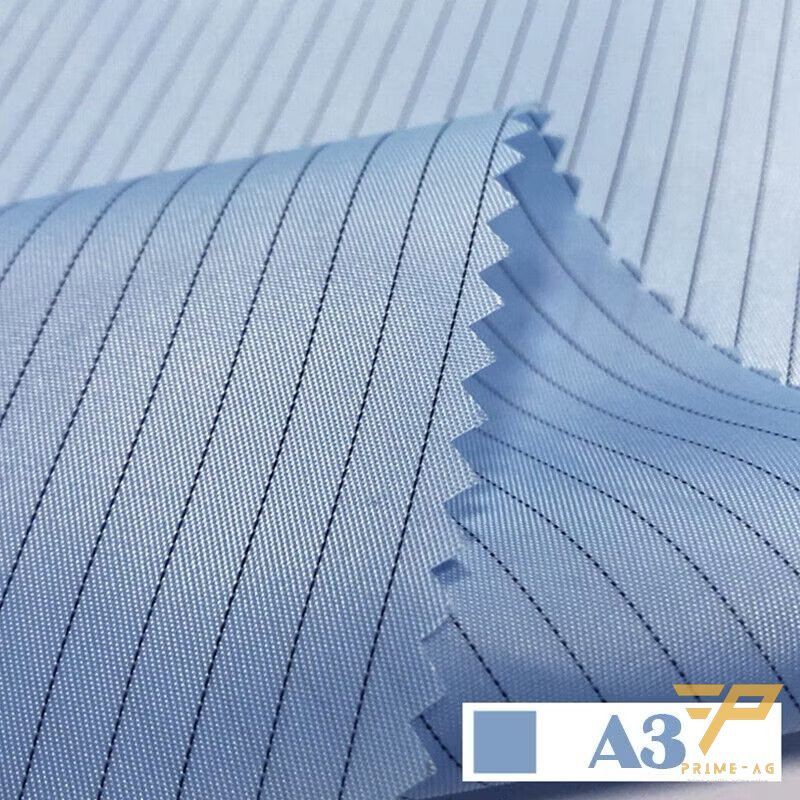
Common specifications: 5 mm stripe, white.
Delivery: in stock, delivered within 24–48 hours (Ho Chi Minh City, Binh Duong, Dong Nai); other colors/weaves made to order in 15–20 days; stock confirmed at quotation.
Woven filament polyester fabric with conductive carbon yarn running warp- and weft-wise in stripes or a grid, used to sew cleanroom coveralls, two-piece garments, hoods and boots. Intended for protective garment sewing workshops, factories that sew their own uniforms, or customers who need to source fabric for large orders. This is an item PRIMEAG can supply in large volumes, which competitors selling only finished garments do not offer.
Company logo printing available on request.
| Item | Value |
|---|---|
| Composition | 98 % polyester + 2 % carbon yarn |
| Weave | 5 mm stripe / 2.5 mm stripe / 5×5 mm grid |
| Width | 1,500 mm (±10) |
| Weight | 98–120 g/m² |
| Surface resistance | 10⁶ – 10⁹ Ω (IEC 61340-4-9) |
| After washing | Stays ≤ 10⁹ Ω after 50 washes at 60 °C |
| Particles / lint | Suitable for ISO 5–8 cleanrooms depending on weave; reference test method IEST-RP-CC003 |
| Color | White, blue, light blue, pink, yellow (on request) |
| Packing | 100 m rolls, PE-wrapped |
| MOQ | 300 m/color; price tiers 300 / 3,000 / 15,000 m |
Choose by cleanroom class
– ISO 7–8, electronics assembly → 5 mm stripe (low cost, most common).
– ISO 5–6, semiconductor/optics → 5×5 grid (high carbon density, low lint).
– Need softness for hoods, cloths → thin 2.5 mm stripe.
Documents: resistance report per roll, composition CoA, RoHS; free A4 fabric swatch.
Repeat orders: delivered to match your sewing schedule (split lots), price held for 6 months for blanket orders ≥5,000 m.
FAQ
– Stripe or grid ESD fabric – which is better? — The grid has carbon yarn in both directions, so it dissipates charge more evenly and lasts longer; stripe is cheaper and sufficient for ISO 7–8.
– How many washes before ESD fabric loses its anti-static property? — The carbon yarn does not wash out, but fabric wear raises the resistance; check periodically and replace when >10¹¹ Ω or after ~100 washes.
– Can you dye to a custom color? — Yes, from 3,000 m/color, 20–25 days.
– Do you also supply garment patterns? — PRIMEAG can introduce a partner sewing workshop or supply finished garments (CA-1P/CA-2P).
Fabric construction: polyester base + conductive yarn
The fabric has two components with separate functions:
- Polyester filament (continuous) base yarn: makes up most of the weight, gives strength, has few fiber ends so it sheds little lint, and withstands hot washing well.
- Conductive yarn (about 2 %): synthetic yarn containing conductive carbon, woven at even spacing in stripes or a grid. Conductive textiles in general get their conductivity by coating or blending conductive materials (carbon, metal) into the base fiber.
The key difference from fabrics given an “anti-static finish” with chemical coatings: when conductivity is inside the yarn itself, the effect does not wash off. Conductive yarn maker KB Seiren (Japan) describes this effect as semi-permanent, not reduced by washing, abrasion or folding — while noting that real performance also depends on yarn blending, fabric structure and processing conditions, so testing before use is necessary.
Stripe or grid: different paths for the charge
| Type | Conductive yarn layout | Characteristics | Applications |
|---|---|---|---|
| 5 mm stripe | One direction, 5 mm spacing | Low cost, common; conducts well along the stripe | Smocks, two-piece suits, EPA, ISO 7–8 |
| 2.5 mm stripe | One direction, double density | Thin and soft, higher carbon density | Hoods, higher-grade coveralls |
| 5×5 mm grid | Two directions, crossing into squares | Charge spreads evenly in all directions | ISO 5–6 coveralls, semiconductor, optics |
How is fabric resistance measured?
- Test methods for garments: IEC 61340-4-9 and ANSI/ESD STM2.1 — measuring resistance between two points on the fabric/garment.
- With striped fabric, the result depends on electrode orientation: along the stripes, the electrodes touch the same carbon yarn; across them, the charge has to pass through the base fabric between stripes. When comparing lots, keep the same direction, the same electrodes and the same humidity conditions.
- Humidity strongly affects results: fabric measured in a humid room may pass but fail in the dry season. Measure under stable conditions and compare with the per-roll report supplied by PRIMEAG.
Cleanliness: how is cleanroom fabric evaluated?
IEST-RP-CC003 (Institute of Environmental Sciences and Technology, USA) is a recommended practice for cleanroom garment systems, covering fabric types, fabric test methods, garment design and garment configuration by cleanliness class. It is a guidance document, not a pass/fail certificate; specific particle and lint requirements should be agreed based on the user plant’s test methods and limits.
Notes for sewing workshops
- Cut all pieces in the same stripe direction so performance is uniform across the whole garment.
- Seams are where the conductive yarn is cut. For groundable garments, design so the panels stay electrically connected (conductive thread, conductive tape across seams).
- Cut edges must be overlocked or bound so they do not fray; use polyester filament thread.
- Zippers should have a cover flap; limit fusible interlining, which tends to delaminate after repeated washing.
Storage and common mistakes
- Keep rolls in their original PE wrap until cutting, in a dry, clean place away from sunlight; write the roll number on the cutting sheet for traceability to the test report.
- Mistakes: accepting fabric that has not been tested roll by roll; mixing fabric lots with different resistance in the same order; pre-treating the fabric with fabric conditioner or softener before sewing.
Certificates and test reports
- RoHS 10 substances — SGS Guangzhou, report no. CANEC23003355205 (24/05/2023): ESD fabric: Pass – all 10 substances ND. Download PDF
Applicant/manufacturer details on the report are masked to protect the supply chain; the full version is provided to customers on request. See all: PRIMEAG product certificates and test reports.
Technical references
- Wikipedia – Conductive textile
- KB Seiren – Belltron, conductive anti-static yarn
- ESDA – Fundamentals of ESD, Part 6: ESD Standards (STM2.1, TR2.0-01)
- IEST – IEST-RP-CC003: Garment System Considerations for Cleanrooms
- Wikipedia – Antistatic device (antistatic garments)
Price: from 17,000 VND (excl. 8% VAT).
REQUEST A QUOTE: send meters, weave, color and schedule — PRIMEAG quotes within 30 minutes and sends a fabric swatch + resistance report within 2 days.
Hotline/Zalo +84 906 108 292 · info@primeag.vn
Written by the PRIMEAG engineering team.
Related guides:Safety Glasses Fogging or Scratched Within Weeks: Anti-Fog, Cleaning,…ESD Cart Failing Resistance Test After a Few Months:…
Related products:ESD SmocksESD Shirts and Shirt-Cap SetsDisposable Non-Woven Shoe CoversCleanroom Head Covers and Shoe Covers
Updated: 2026-10-24
Giao tận nhà máy TP.HCM, Bình Dương, Đồng Nai, Long An, Tây Ninh · Kèm biên bản đo điện trở ESD theo lô · Hotline 0906 108 292