
An ESD cart that passed at delivery but reads above 1×10⁹ Ω a few months later is usually failing because of a dirty shelf surface, ESD casters fouled with adhesive or worn, a broken drag chain, a waxed floor, or a loose shelf-to-frame connection. PRIMEAG recommends measuring each segment separately to isolate the fault, cleaning first, and replacing casters or shelf surfaces only if the re-test still fails.
At acceptance, the whole batch of carts was below the limit. At the next periodic check, several carts may get a red tag: the discharge path from the shelf surface to the floor has broken somewhere.
- Limit: cart to ground < 1×10⁹ Ω per ANSI/ESD S20.20.
- Isolate the fault: measure shelf–frame, frame–caster and cart–floor separately.
- Order of action: wipe, remove adhesive, tighten joints first; replace parts later.
- Main discharge path: conductive casters; a drag chain is only secondary.
Five common failure points, checked in order
1. Dirty or covered shelf surface
Protective PE film not peeled off, labels, or plastic bags covering the ESD laminate; oil and dust also push resistance up. Remove everything, wipe with IPA, and do not use cleaners containing silicone.
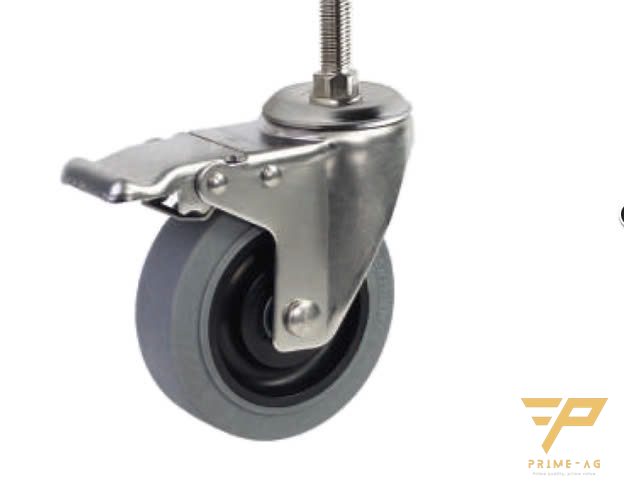
2. ESD casters fouled with adhesive or dust, conductive layer worn
Each caster touches the floor over only about 1 cm². Adhesive or thread wound around the axle is enough to cut the discharge path. Replacing a failed caster with a standard PU caster of the same size also leaves the cart ungrounded.
3. Drag chain broken or not touching the floor
Drag chains often break, curl up or hang too high. Their floor contact area is too small, so they are only a backup.
4. Floor is not an ESD floor, or is waxed
ESD casters running on ordinary epoxy have no path to ground. Standard wax or urethane-based gloss coatings on an ESD floor also form an insulating film.
5. Loose shelf-to-frame connection
The ABS coating on the pipe is insulating, so the ESD surface must be connected to a metal joint or a bonding wire. Vibration over floor thresholds loosens bolts and opens the connection. On anodized aluminum frames, the surface oxide layer does not conduct, so a separate ground wire must be added.
Measure segment by segment to find the fault
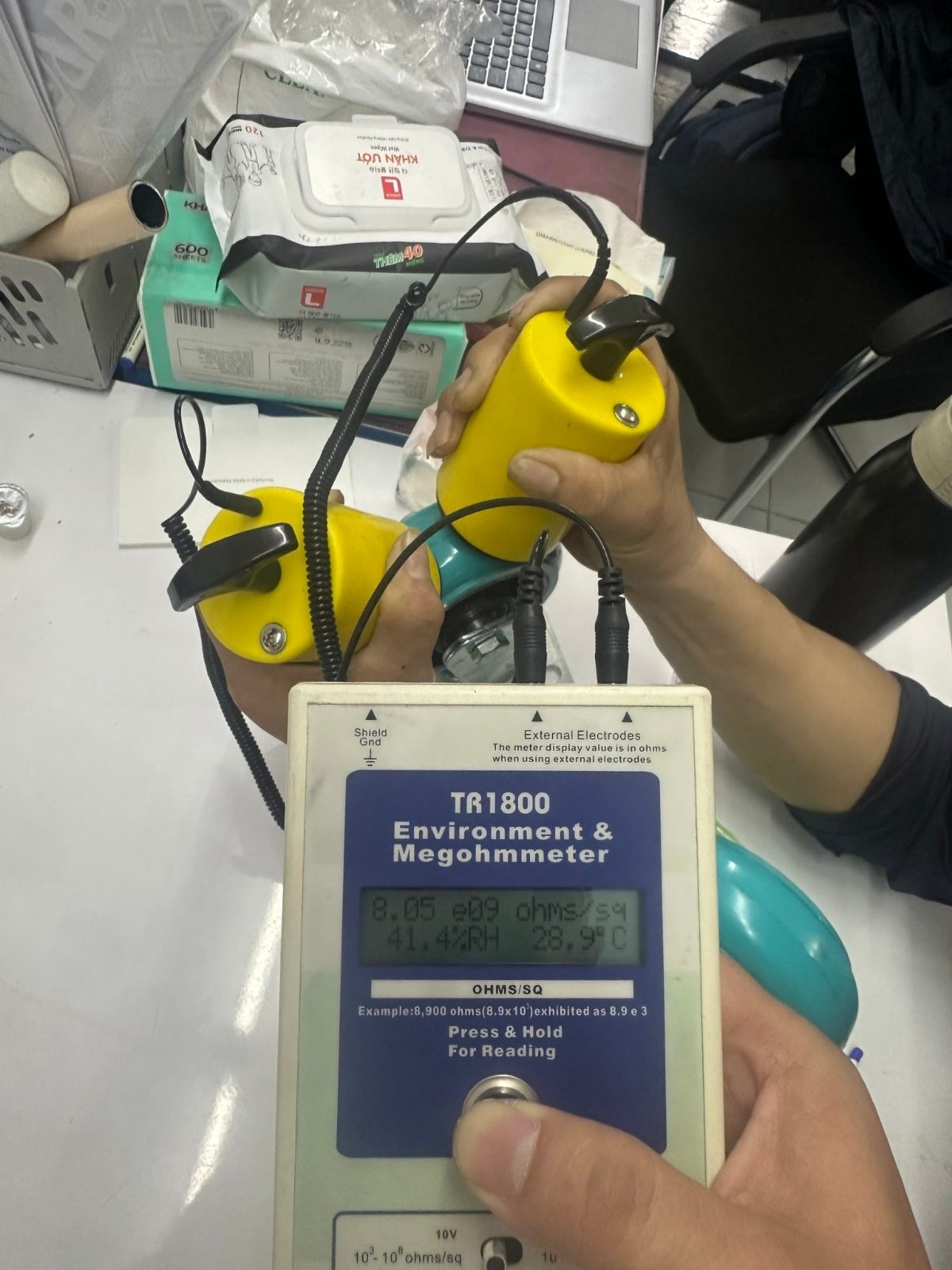
Push the cart a short distance before measuring. The TR1800 digital resistance meter has 2 × 5 lb electrodes and also displays %RH.
| Segment | Probe placement | A high reading means |
|---|---|---|
| Shelf surface – frame | Shelf surface → metal joint | Dirty surface, open connection |
| Frame – caster | Frame → metal plate under the caster | Dirty, worn or wrong-type caster |
| Floor alone | Floor where the cart is parked → ground point | Dirty or waxed floor |
| Cart – floor – ground | Shelf surface → ground point via the floor | Whole system; compare with the three rows above |
Record readings by cart number to see which carts degrade fastest. For testing casters on their own, see the article measuring the resistance of 5-inch ESD casters.
When to clean, when to replace
- Clean: wipe the surface and remove adhesive from the casters, then re-test and it passes.
- Replace casters: the frame–caster segment is still high after cleaning; treads worn down or cracked.
- Replace the shelf surface: laminate scratched through, edges delaminating, or still high even after the joints are tightened.
Casters carry a 12-month warranty, frames 3 years. Re-tighten the joint bolts after the first month and add a paint mark so you can see if they turn loose.
Replacement parts and carts
Industrial casters are available in conductive ESD versions; send a photo of the old caster so we can match the right code. If the floor does not pass, consider 600×600 ESD PVC floor tiles, conductive 10⁴–10⁶ Ω or dissipative 10⁶–10⁹ Ω.
Replacing carts: the multi-tier ESD steel pipe trolley uses Φ28 pipe, 100 kg/tier; for carrying PCB trays in clean areas, the aluminum profile cart with ESD shelves with Φ75 conductive PU casters is a good fit. See ESD carts for electronics factories.
Real project
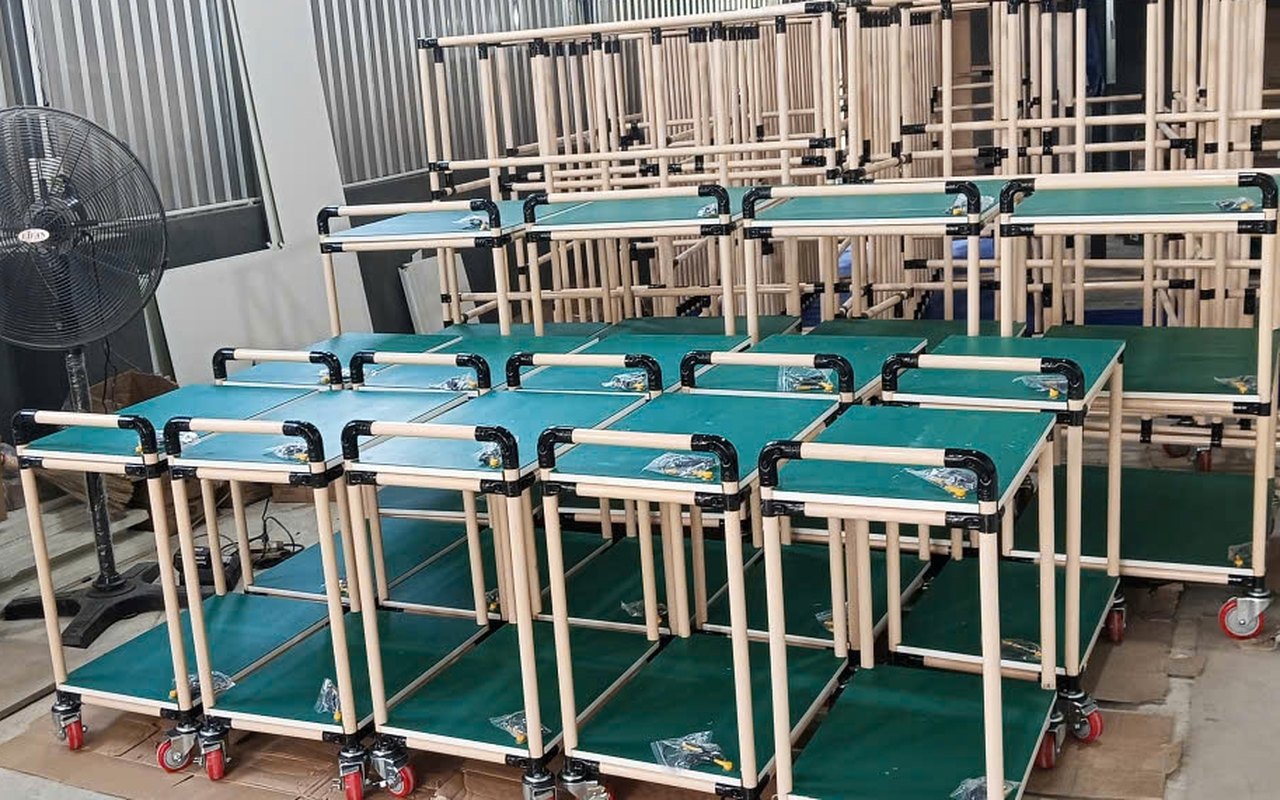
In 03/2026, PRIMEAG delivered 50 carts with ESD shelves to an electric bicycle factory.
Where to start
Start with the three carts with the highest readings. For a fleet already in use, you can ask PRIMEAG to bring a TR1800 and 5 lb electrodes for free on-site measurement of each cart at your plant (Dong Nai, Ho Chi Minh City, Binh Duong; Monday to Saturday), including carts bought elsewhere and with no purchase obligation; within 3–5 working days you receive a PDF with readings for each position and photos, for reference only, not as audit documentation.
Frequently asked questions
- What resistance should an ESD cart measure to pass? — Below 1×10⁹ Ω from the shelf surface to ground per S20.20, measured with 5 lb electrodes.
- Can I use just a drag chain and skip ESD casters? — Not recommended. The chain has very little floor contact and easily breaks or curls up. Conductive casters are the main discharge path.
- How often should an ESD cart fleet be re-tested? — S20.20 does not set a frequency. Carts are usually tested on the same schedule as workbench surfaces, about every 6 months; high-risk areas monthly or quarterly.
Email: info@primeag.vn · Phone/Zalo: +84 906 108 292
Written by the PRIMEAG engineering team
Updated: 2026-10-28