
An ESD trolley for an electronics factory in Vietnam only truly protects components when the resistance from shelf surface to ground is below 1×10⁹ Ω. PRIMEAG checks every link: ESD shelf surface, frame, conductive casters touching the ESD floor, then an acceptance measurement on each trolley before it is allowed into the EPA.
- Discharge chain: shelf surface → frame → casters → ESD floor → earth; one open point and that tier loses its ground.
- Anodised aluminium frames have an insulating oxide layer and need penetrating screws or a separate bonding wire, confirmed by measurement.
- All 4 casters conductive; a drag chain only plays a secondary role.
- Measure with a 5 lb electrode on each tier; repeat after every caster replacement or added tier.
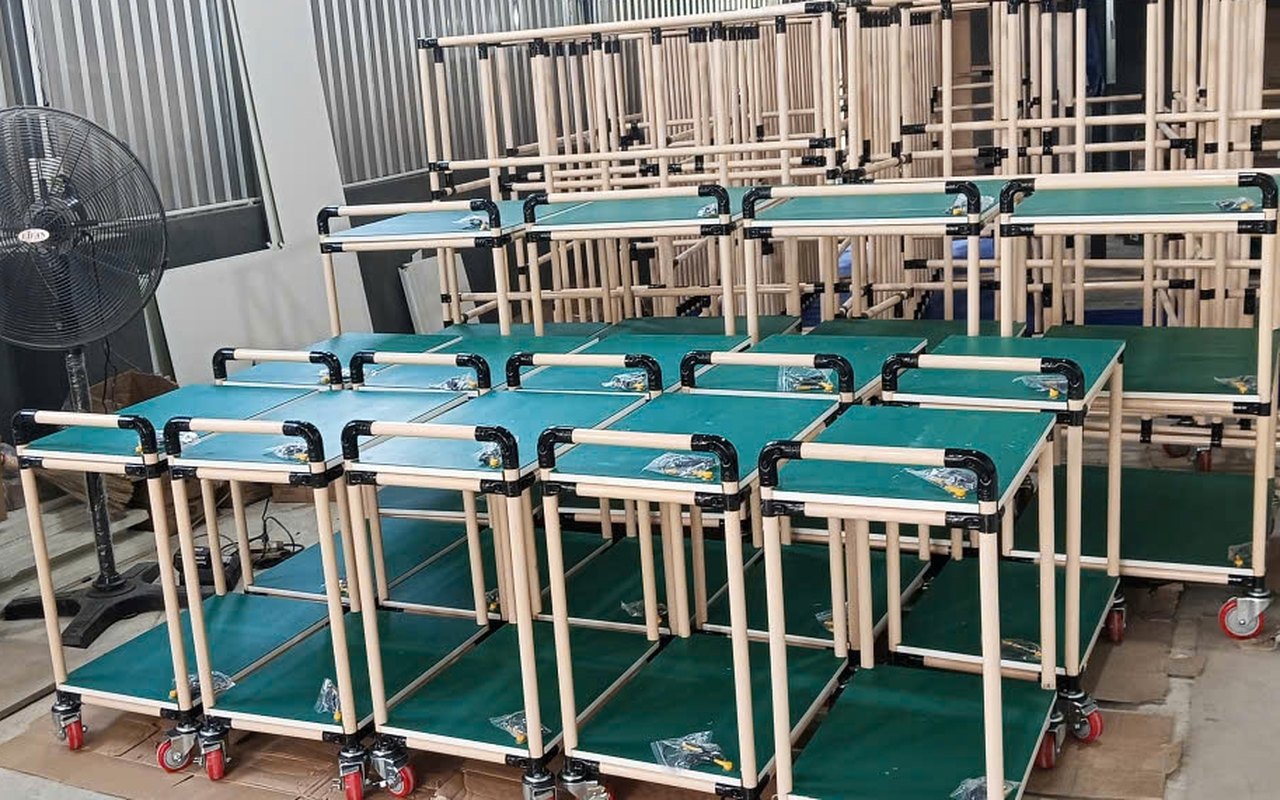

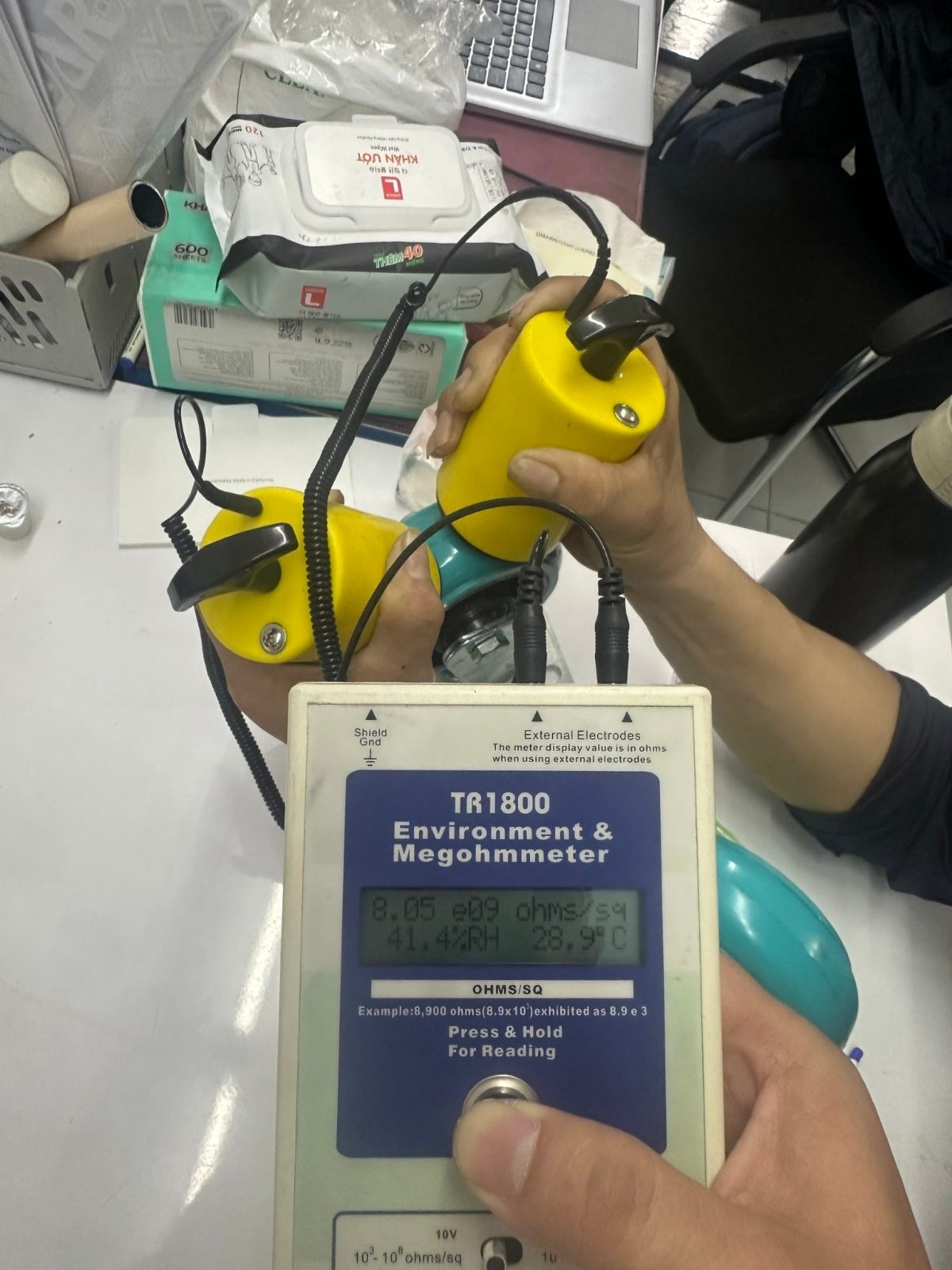
The static discharge path of an ESD trolley in an electronics factory
A moving trolley also generates charge and transfers it to the goods it carries; the charge only drains through a continuous conductive path to the ESD floor.
When buying, choose shelf surfaces of 10⁶–10⁹ Ω. The ABS coating on the pipe is normally insulating, so the shelf surface must connect to a metal joint or a conductor, then through the caster fork to the floor. A trolley running on an ordinary epoxy floor has no path to ground.
ESD plastic-coated steel pipe frame or aluminium profile
| Criterion | Lean pipe (plastic-coated steel pipe, Φ28) | Anodised aluminium profile 30×30 |
|---|---|---|
| Conductive path | ESD surface connected to metal joints; black ESD pipe gives a continuously conductive frame | Anodising is insulating; discharge via toothed screws/brackets or a separate wire per tier |
| Reference model load | 100 kg/tier, 400 kg total | 40 kg/tier, 150 kg total |
| Suited to | Component bins, heavy semi-finished goods | PCBs, ESD-sensitive trays, clean areas |
Matching models: multi-tier steel pipe trolley and aluminium profile trolley with ESD shelves. For boards stored in slots, use the magazine rack and PCB trolley.
ESD casters and grounding chains
Per ANSI/ESD S541, below 10⁴ Ω is conductive, and from 10⁴ to below 10¹¹ Ω is dissipative. Blickle classes conductive casters at ≤ 10⁴ Ω and antistatic casters at ≤ 10⁷ Ω.
A caster touches the floor over about 1 cm², while a floor test electrode covers about 31 cm²: a floor that passes does not guarantee the caster passes.
Choose the ESD version of industrial PU casters and size the load on 3 load-bearing casters. Replacing a failed caster with an ordinary PU caster of the same size cuts the discharge path.
Drag chains make intermittent contact and are only a backup; when a trolley is parked for a long time, plug in a grounding cord. For real measurements, see measuring the resistance of 5-inch ESD casters.
Acceptance and periodic measurement procedure
- Push the trolley a short distance on the ESD floor.
- Place a 5 lb (about 2.3 kg) electrode in the middle of each tier and measure to ground through the floor per ESD TR53. Pass when below 1×10⁹ Ω; also measure where trolleys are usually parked.
- If it exceeds the limit, measure tier to frame and frame to ground to find the open connection.
- Record the report by trolley ID.
Equipment: surface resistance meter with 5 lb electrode, range 10³–10¹² Ω, test voltage 10/100 V.
S20.20 does not set a frequency; typically benches and mats every 6 months, floors every 12 months, high-risk areas monthly or quarterly. Put trolleys on the same list.
Projects and ordering lead time
03/2026: an e-bike factory received 50 trolleys with ESD shelves. Each trolley batch is delivered with an ESD measurement report, CO/CQ and test certificate.
Standard-model trolleys are produced in 5–7 working days. The steps for building trolleys to drawing are in the article lean pipe racks and trolleys made to drawing.
Self-check before ordering trolleys
- Is the floor along the trolley route already an ESD floor, and has it been measured?
- Will the trolley carry bare PCBs, trays or closed bins?
- Do you already have the equipment and a measurement schedule for trolleys?
Trolley frames have a 3-year warranty; casters and ESD shelf surfaces 12 months. Export processing enterprise customers receive 0% VAT invoices; for orders from VND 20 million, PRIMEAG handles the on-the-spot import/export customs declaration free of charge.
Frequently asked questions
What resistance should an ESD trolley measure to pass? Shelf surface to ground below 1×10⁹ Ω, measured with a 5 lb electrode while the trolley stands on an ESD floor.
Does an ESD trolley with a drag chain still need conductive casters? Yes. The main discharge path is the four conductive casters; the drag chain is only a backup.
Does an aluminium frame trolley discharge static through its casters by itself? Not necessarily. Anodising is insulating, so penetrating screws or brackets or a separate bonding wire are needed, followed by a confirming measurement on each tier.
Updated: 20/10/2026 — PRIMEAG engineering team
Mon–Sat, 8:00–17:00 (GMT+7) · Phone/Zalo: +84 906 108 292 · Email: info@primeag.vn
Start where it suits you: Free technical advice · Send a drawing or layout · Get a quote within 30 minutes
Written by the PRIMEAG engineering team
Updated: 2026-10-21