
Buying ESD cleanroom garments in Ho Chi Minh City? Start from the cleanliness class of the area. For ISO 7–8 a two-piece suit is enough, ISO 5–6 needs a hooded coverall, and an EPA with short entries only needs a smock. For this product group, stocked items are delivered in 24–48 hours in Ho Chi Minh City, Binh Duong and Dong Nai.
- ISO 5–6 needs full-body garments; ISO 7–8 and EPA use two-piece suits or smocks.
- Fabric: 98 % polyester with 2 % carbon, 5 mm stripe, declared surface resistance 10⁶–10⁹ Ω (IEC 61340-4-9).
- On receipt: inspect carbon threads, measure resistance, check seams, zips, sizes and the batch test sheet.
- Ordinary PE shoe covers are insulating and cannot replace ESD shoes.
Choosing ESD cleanroom garments in Ho Chi Minh City by cleanliness class
ISO 14644-1 classifies cleanrooms by the number of particles per cubic metre of air. People are the largest particle source, so the higher the class, the more the garment must seal at the head, neck, wrists and ankles.
| Area / cleanliness class | Garment | Headwear | Feet |
|---|---|---|---|
| ISO 5 (Class 100) | Coverall in grid fabric or 2.5 mm stripe, made to order | Hood with bib | High ESD boots |
| ISO 6 (Class 1,000) | Hooded coverall, 5 mm stripe | Attached hood or hood with bib | ESD boots |
| ISO 7–8, SMT, assembly | Two-piece suit | Carbon fabric cap | ESD shoes/slippers |
| EPA, engineering, QC | Long-sleeve smock | Fabric cap | ESD shoes/slippers |
| Visitors, contractors | Smock | Non-woven cap | PE shoe covers on walkways |
Hooded coverall
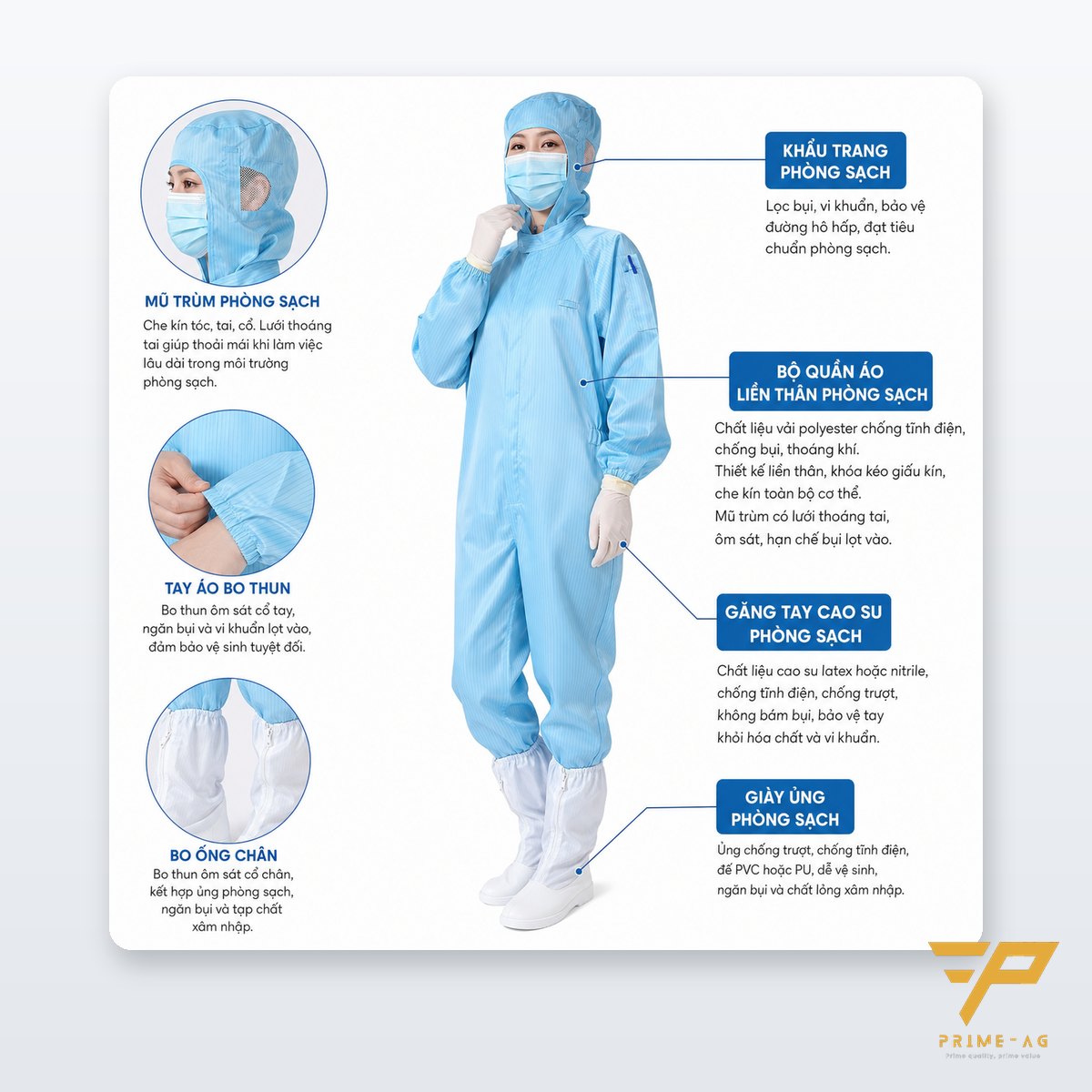
The hooded cleanroom coverall has an attached hood, covered zip, high collar, and elastic cuffs at wrists and ankles. 100–110 g/m² fabric is used for ISO 6–8; for ISO 5, garments in grid fabric or 2.5 mm stripe must be made to order.
Two-piece suit
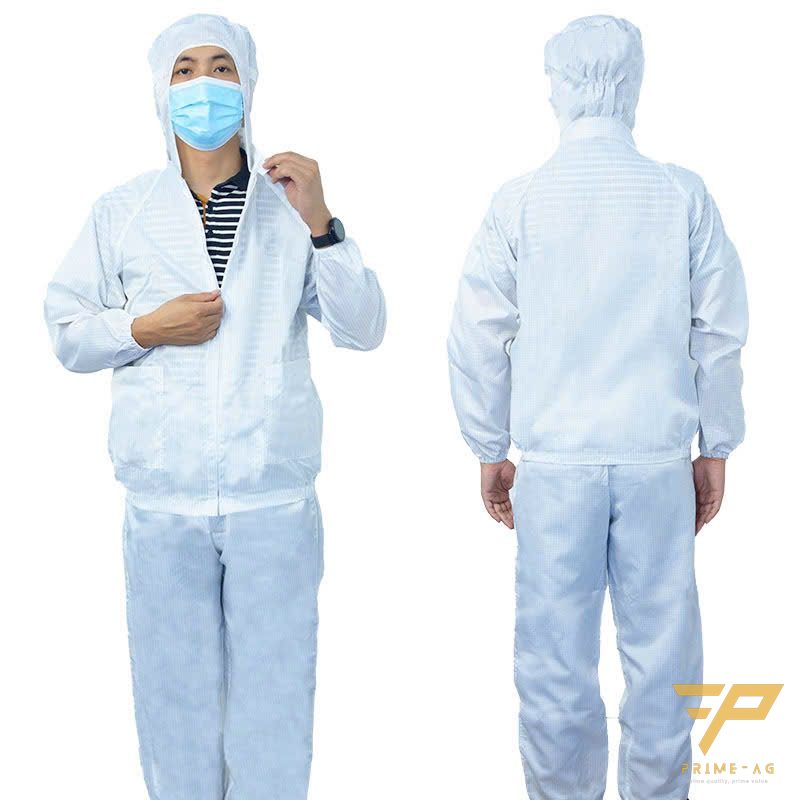
The two-piece ESD cleanroom suit uses the same fabric and the same resistance range as the coverall but leaves the back exposed when bending. It is therefore only used for ISO 7–8 and SMT lines. The jacket has a YKK zip under a placket; the trousers have an elastic waist with drawstring.
Smock (blouse)
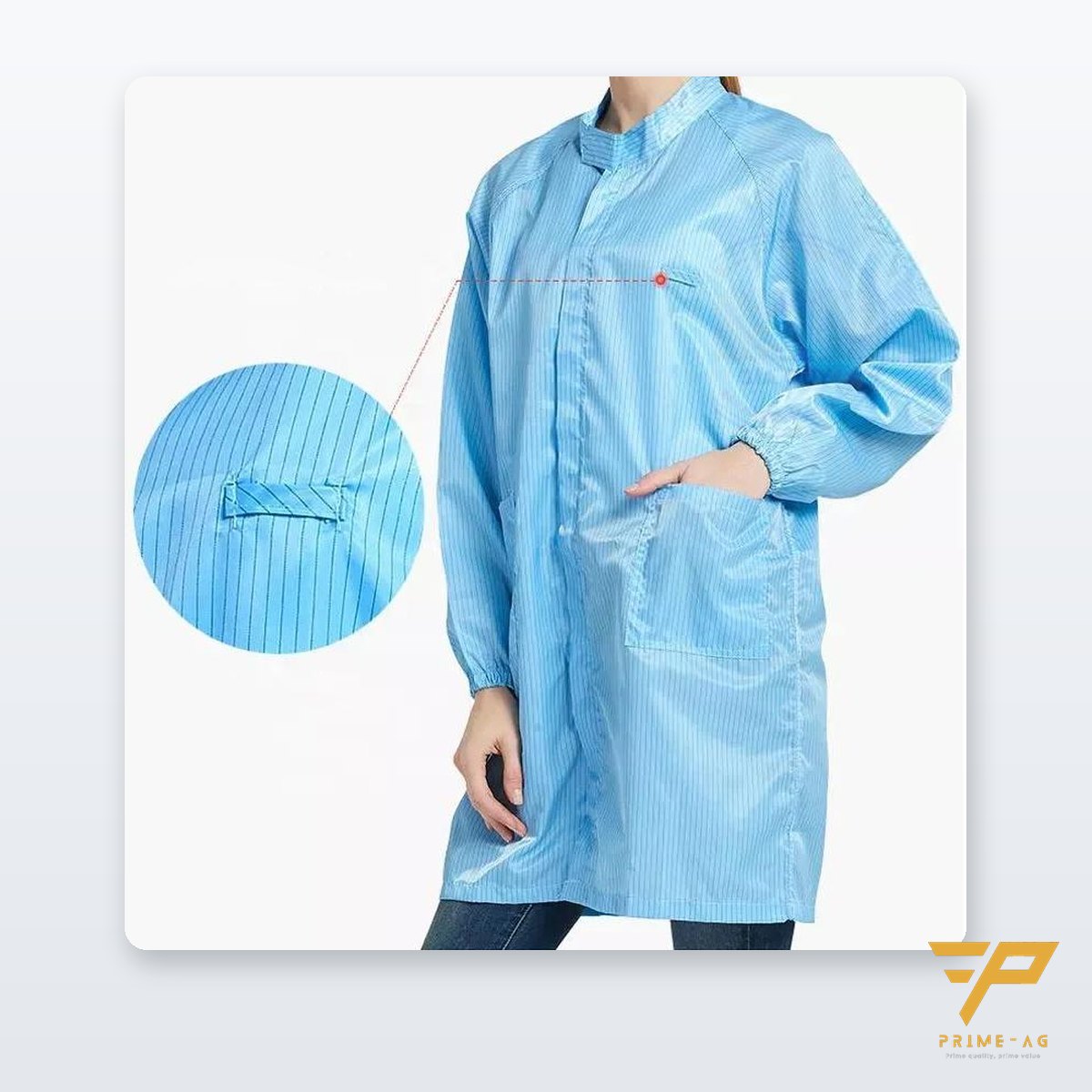
The ESD smock is knee-length and worn over the uniform by people who move between several areas. It only works when all snaps are fastened and the wearer is grounded. Do not use it in ISO 5–6. If you are setting up a new area, see how to set up an EPA for an SMT line.
Headwear, shoe covers
Cleanroom hoods and caps come in three styles: hood with bib for ISO 5–7, carbon fabric cap for EPA and ISO 7–8, mesh cap for visitors. Visitors use disposable cleanroom bouffant caps and shoe covers. The entrance also needs an air shower and sticky mats: see dust control at the clean-area entrance.
Inspection on receipt
- Carbon threads: stripes or grid run evenly, not broken at the fabric edge.
- Surface resistance: the published method for garments is IEC 61340-4-9; compare with the batch test sheet. For a quick check in the warehouse, use a handheld meter with a 10³–10¹² Ω range from the wrist strap testers and resistance meters group.
- Continuity: measure point-to-point between the two sleeves (ANSI/ESD STM2.1) to detect seams that cut the carbon network.
- Seams, zips: no loose stitching, zip covered by a placket, smooth running.
- Size: try one garment per size, sit down and raise your arms. Size S (155–160 cm) up to 5XL (over 190 cm) for coveralls and smocks; two-piece suits up to 4XL.
- Documents: fabric test sheet, CoA, RoHS.
Where to start
List the areas, ISO class, number of people per shift and sizes. Cleanroom garments, hoods and shoe covers are standard items in full sizes and colours; stocked items are delivered in 24–48 hours. Only logo embroidery/printing (from 20 sets, 3 extra days) or custom sizes need ordering time.
Frequently asked questions
Is a coverall mandatory in an ISO 7 cleanroom? No. A two-piece suit uses the same fabric, the same 10⁶–10⁹ Ω range and is more breathable. Choose a coverall when your customer requires tighter coverage.
Is an ESD smock ANSI/ESD S20.20 compliant? S20.20 does not certify individual garments; it sets resistance limits for garments, measured per STM2.1. The smock must be fully fastened and the wearer must be grounded.
Can PE shoe covers be used instead of ESD shoes? No. Ordinary PE and CPE shoe covers are insulators and block the discharge path through the floor. Operators at workstations must wear ESD shoes or slippers.
Updated: 20/10/2026 — PRIMEAG engineering team
Mon–Sat, 8:00–17:00 (GMT+7) · Phone/Zalo: +84 906 108 292 · Email: info@primeag.vn
Start where it suits you: Free technical advice · Send a drawing or layout · Get a quote within 30 minutes
Written by the PRIMEAG engineering team
Updated: 2026-10-21