
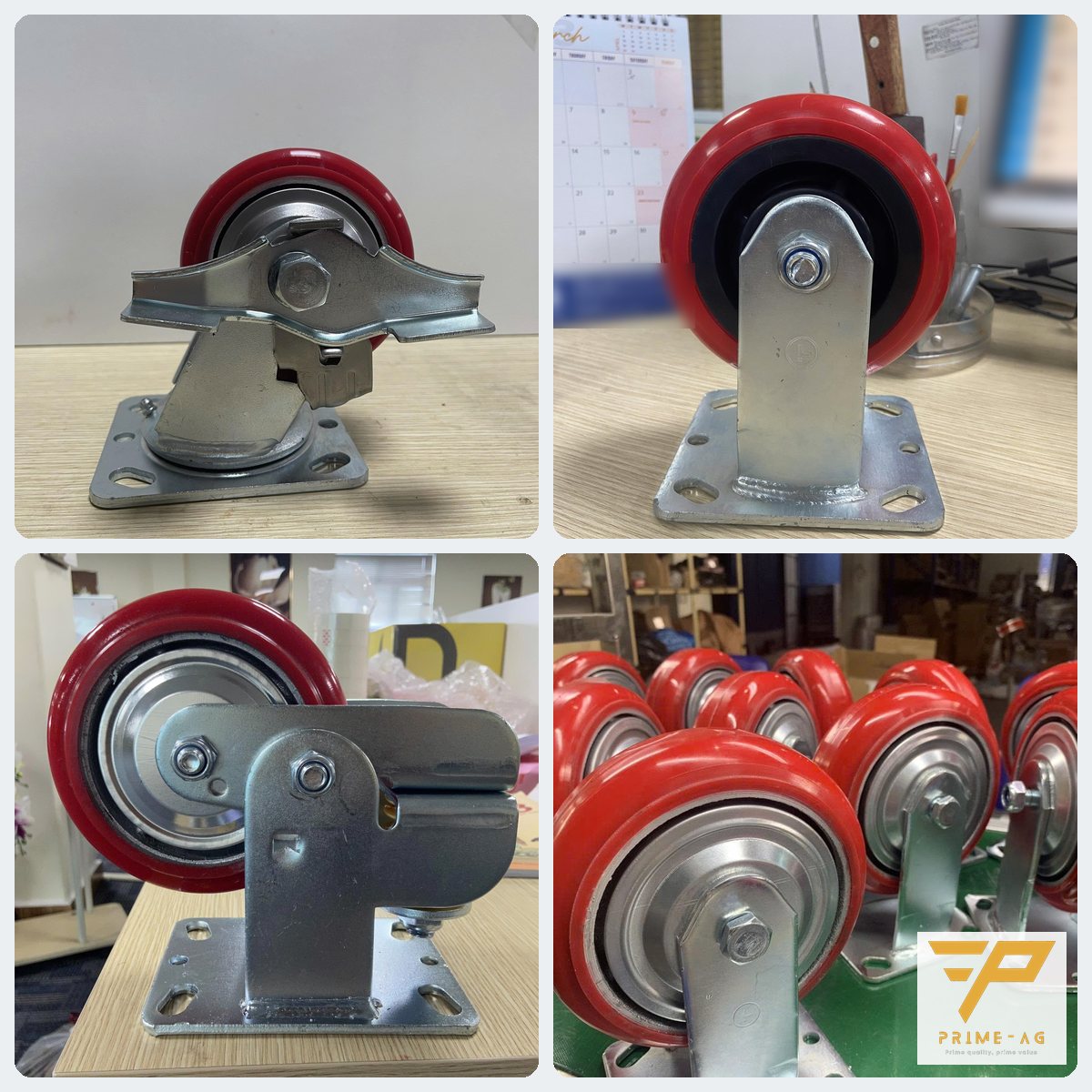
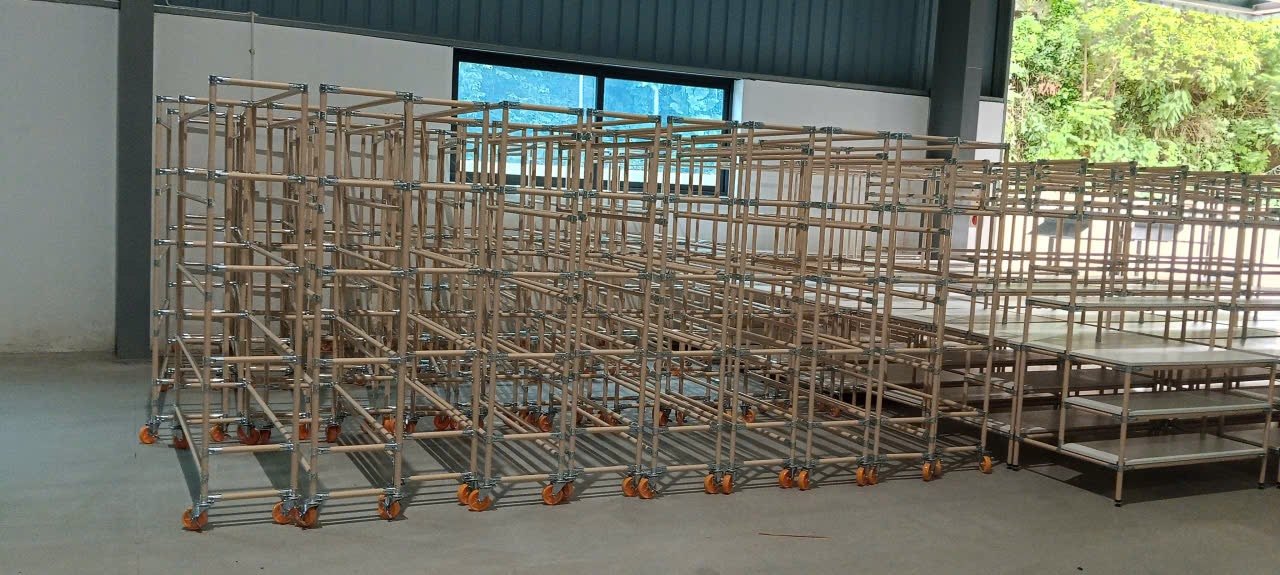
Warehouse trolleys in Vietnam break casters and tip over mostly because they are chosen by size while the load per tier is ignored. A lean pipe trolley (plastic-coated steel pipe, Φ28) carries 100 kg/tier; floors with gaps and rails need PU casters from D100, 2 swivel casters with brakes, 2 fixed casters, and heavy goods on the lower tier. PRIMEAG calculates the load from your real goods.
- Weigh the heaviest carton on each tier before choosing a trolley; do not just measure carton sizes.
- Load per caster = (trolley + goods) ÷ 3; floors with gaps and rails need at least D100.
- Long pushing distances: 2 fixed casters keep direction, 2 swivel casters with brakes hold the trolley during loading and unloading.
- Heavy goods on the lower tier, close to the uprights; clean hair and adhesive tape off caster axles on a schedule.
Five causes of broken casters and tipping trolleys
- Forgetting the tier load: the carton fits the shelf board but is heavier than the board can carry.
- Heavy goods on top: high centre of gravity, the trolley tilts when it hits a ridge.
- Small casters, hard tyres: they jam in floor gaps, door rails and ramp edges.
- All 4 casters swivel: the trolley wanders over long distances and easily hits rack legs.
- No braked casters: the trolley rolls away during loading and unloading.
Choosing a trolley by load per tier
Catalogue loads are uniformly distributed loads. The same weight concentrated at mid-span creates twice the bending moment and about 1.6 times the deflection, so place heavy cartons near the uprights.
| Trolley type | Load | Suitable for | Note |
|---|---|---|---|
| Multi-tier lean pipe trolley 1500×600×1600 mm | 100 kg/tier uniformly distributed | 600×400 cartons, order picking | Heavy loads: calculate the load per caster, usually needs D125 |
| Compact trolley for narrow aisles 720×430×1500 mm | 40 kg/tier, 120 kg total | Narrow aisles, small trays | Height/width about 3.5:1, tips sideways easily |
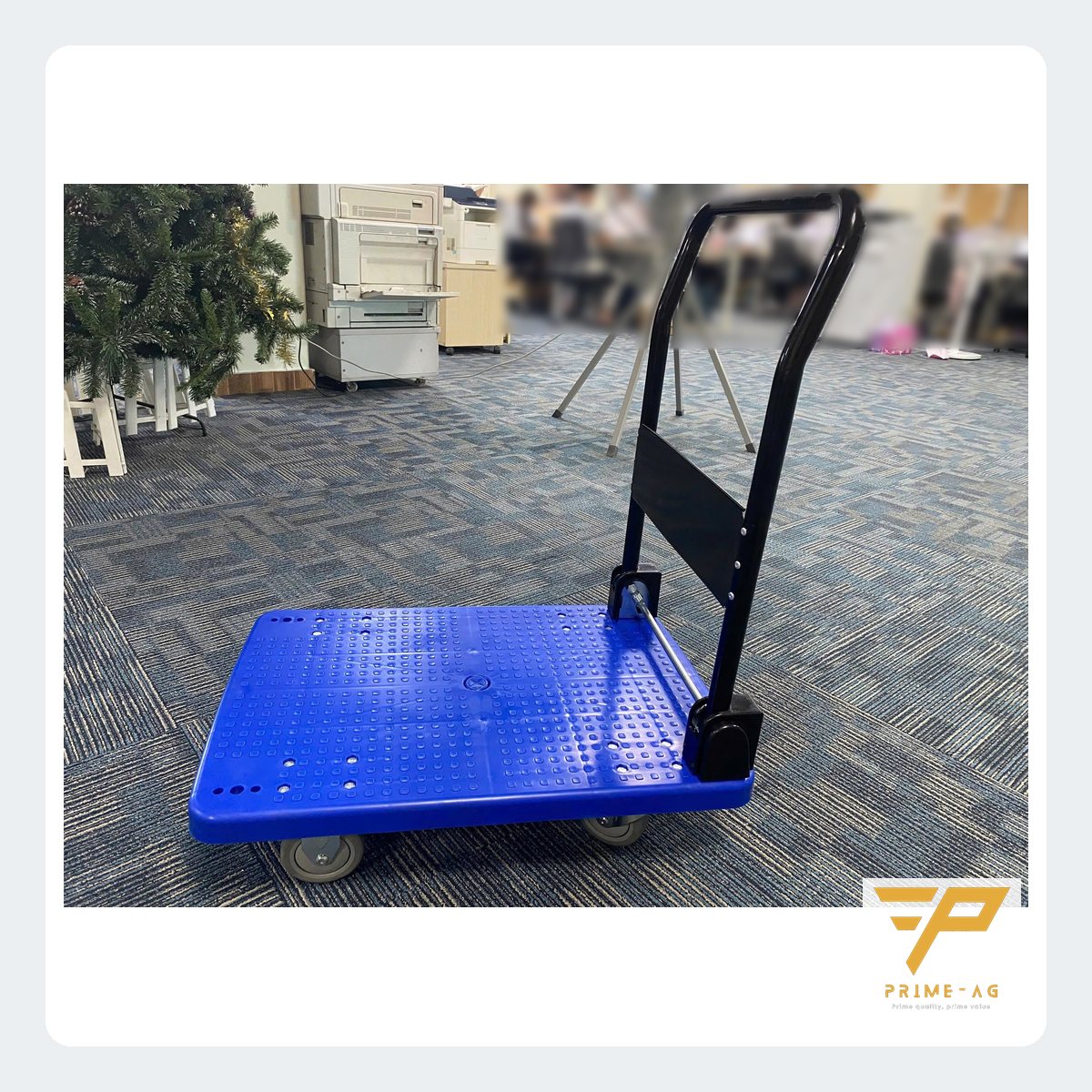
| Plastic-deck trolley 500×700 | 200 kg uniformly distributed | Moving cartons from trucks into the warehouse | Do not stand on it, do not pull it over steps |
| Panel trolley | According to actual goods | Long panels, large-format materials | Send panel dimensions for advice |
Lean pipe trolleys can be built with a different number of tiers and lengths of 900–1800 mm; standard designs are made in 5–7 working days.
Calculating caster load and choosing caster size
On an uneven floor usually only 3 of the 4 casters carry the load. So the load per caster = (trolley weight + goods) ÷ 3. A trolley carrying a full 400 kg plus a frame of about 30 kg: 430 ÷ 3 ≈ 143 kg/caster. According to the reference table for industrial PU casters, D100 carries 100–130 kg/caster and D125 carries 150–200 kg/caster, so this case needs D125.
Warehouses with gaps, rails and gentle ramps should use D125–D150, PU or elastic rubber tyres, and thick forks with double ball bearings; confirm the rated load in the catalogue for each code.
Layout: 2 swivel with brake and 2 fixed
Fixed casters keep the trolley tracking straight, and swivel casters go at the handle end for steering; a total-lock brake locks both wheel and swivel during loading and unloading. Use 4 swivel casters only in very narrow aisles.
Loading to lower the centre of gravity
The lower tier carries the heaviest goods and the upper tier light trays; cartons must not overhang the edge. Push slowly over door sills. Goods waiting to be picked should sit on a gravity flow rack rather than being stacked high on trolleys; for arranging pick locations see the article logistics warehouse solutions for wrong-location and slow picking.
Real projects
- US FDI factory in Can Giuoc, 2025–2026: 400 purpose-built lean pipe trolleys.
- Chinese-invested logistics and distribution centre in Phu Tho, 07/2026: 30 trolleys delivered together with workbenches and stainless steel tables. For the packing area, see the article e-commerce order packing tables for logistics warehouses.
Where to start
- Weigh the heaviest carton and count the cartons on each tier.
- Walk the pushing route: note floor gaps, door rails, ramps and the narrowest point.
- Calculate the caster load and add one size margin if the trolley often hits ridges.
- Inspect casters monthly: flat-spotted tyres, loose forks, loose kingpin bolts. When replacing casters, measure the old plate hole centres or thread size.
- Warranty: trolley frame 3 years; casters are accessories, 12 months.
Frequently asked questions
Can a 3-tier steel pipe trolley carry 500 kg? Not recommended. The 1500×600 three-tier model carries about 100 kg per tier uniformly distributed, i.e. about 300 kg maximum; the practical limit also comes from the casters and joints, not only the shelf boards.
Why not fit four swivel casters so the trolley turns more easily? Four swivel casters make it hard to keep a straight line over long distances, tire the operator and lead to hitting racks; warehouses with long pushing routes should use two fixed casters.
Are casters that fail after one year covered by warranty? Casters are accessories with a 12-month warranty, and the trolley frame has a 3-year warranty; casters worn by overloading or jammed debris must be replaced with the same base size as the old ones.
Updated: 21/10/2026 — PRIMEAG engineering team
Mon–Sat, 8:00–17:00 (GMT+7) · Phone/Zalo: +84 906 108 292 · Email: info@primeag.vn
Start where it suits you: Free technical advice · Send a drawing or layout · Get a quote within 30 minutes
Written by the PRIMEAG engineering team
Updated: 2026-10-21