
Choose a magazine rack from the long edge of your largest board plus about 10 mm, and the loader’s inner height from the machine documentation. A 10 mm slot pitch suits ordinary boards; if bottom-side components are taller than 8 mm, skip every other slot or use a 20 mm pitch. PRIMEAG recommends testing with real boards and measuring the rack’s resistance before ordering.
Boards jamming at the loader entrance often get blamed on the machine. Very often the culprit is the magazine: wrong size, worn grooves or side walls no longer parallel. Whether the line runs Panasonic, Fuji or Yamaha, choosing a rack still starts with the board.
- Rack size: based on the largest board run on the line, not the most common one.
- Slot pitch: 10 mm for ordinary boards; widen the spacing for tall bottom-side components.
- Resistance: rack 10⁶–10⁹ Ω, rack trolley to ground < 1×10⁹ Ω.
- Heat: plastic racks only go up to 80 °C; never put them in a baking oven.
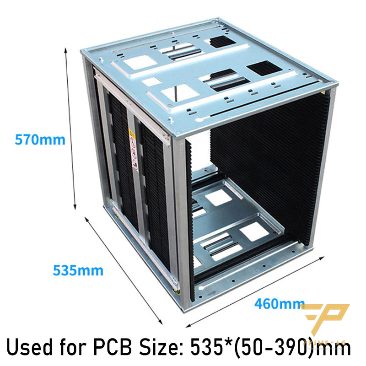

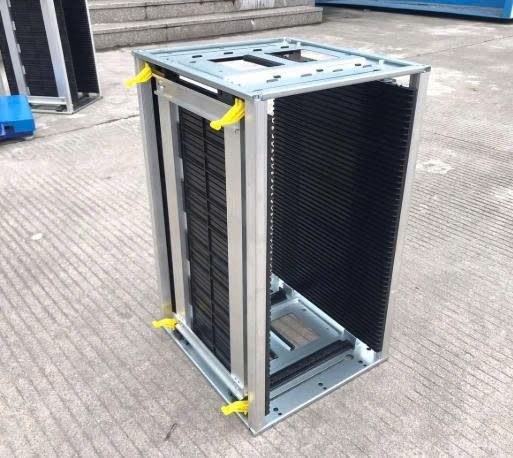
1. What to measure before choosing a rack
Take the largest board and record its length, width, thickness and the height of bottom-side components. Copy the machine model and the inner height of the loader/unloader from the documentation; do not estimate by eye.
The rack’s outer dimensions differ from the maximum board size; state clearly which figures refer to the board when you send a request.
2. Choosing the size from the board dimensions
Rule of thumb: long edge of the board plus 10 mm. A 300×200 mm board falls into size R2-M (reference 330 × 250 mm). On lines running many models, size for the largest one.
| Rack outer size (D × W × H) | Max board (L × W) |
|---|---|
| 355 × 320 × 563 mm | 330 × 50–250 mm |
| 460 × 400 × 563 mm | 445 × 50–330 mm |
| 535 × 530 × 569 mm | 530 × 50–460 mm |
Based on a European manufacturer’s catalogue; confirm again when finalising the order.
3. Slot pitch and bottom-side components
Grooves are about 3.5 mm deep and the board rests on both edges. After the first side is soldered, its components face down; if they are taller than 8 mm, load every other slot or use a 20 mm pitch rack. Check the loader’s indexing pitch against the machine documentation.
4. Materials and the grounding path
PCB magazine racks and PCB trolleys are made of PP or ABS, 10⁶–10⁹ Ω, rated to 80 °C. Boards that need baking must be moved to metal racks and returned only after cooling.
An ESD rack can only dissipate charge when it sits on a bench or trolley with a path to ground.
5. Magazine trolleys
Cleanrooms: an aluminium profile trolley with 4 tiers, 5 mm aluminium shelves covered with rubber matting, 40 kg per tier. The anodised layer on aluminium profile is not conductive, so the trolley needs its own grounding wire.
Warehouses and heavy rack loads: a multi-tier steel pipe trolley in Φ28 plastic-coated pipe with bolted joints, 100 kg per tier. For carrying boards, add 10⁶–10⁹ Ω laminate shelves and conductive casters.
Frames carry a 3-year warranty and casters 12 months; standard models take 5–7 working days. See trolleys for electronics factories.
6. Common problems
| Symptom | Cause | Fix |
|---|---|---|
| Board jams when the pusher pushes | Walls set too tight, flux in grooves, worn grooves | Loosen the walls, clean the grooves, retire worn racks |
| Board warps | Walls squeezing; thin board without a support plate | Adjust the width, add a support plate |
| Rails not parallel | Worn lead screw, heat-deformed walls | Measure the width at the front and back of the groove with calipers; replace the wall if it is off |
7. Where to start
Test real boards in a sample rack in the top, middle and bottom slots, then measure the rack on the trolley to ground. See also the range of consumables for Panasonic, Fuji and Yamaha SMT lines.
Racks and trolleys running on the line are also covered by the free on-site resistance measurement PRIMEAG provides in Ho Chi Minh City, Binh Duong and Dong Nai (Mon–Sat): TR1800 meter, 5 lb electrode, products from other suppliers included, no purchase conditions; a PDF report with photos is sent after 3–5 working days and is for reference only.
Export processing enterprise (EPE) customers can receive 0% VAT invoices, and PRIMEAG handles the on-the-spot import/export customs declaration free of charge for orders from 20 million VND.
Frequently asked questions
- Can plastic magazine racks be used right at the reflow oven exit? — Not recommended. Positions right next to the oven should use stainless steel or aluminium racks.
- Do magazine racks with flux on them need their resistance re-tested? — Yes. Clean the grooves and measure again; racks with cracked walls or worn grooves should be taken off the line.
- How many magazines fit on one tier of a PT-PCB trolley? — An 800 × 600 mm tier usually holds about 2 racks of size 355 × 320.
Email: info@primeag.vn · Phone/Zalo: +84 906 108 292
Written by the PRIMEAG engineering team
Updated: 2026-10-24