
Stocked item: delivered in 1–2 working days in Ho Chi Minh City, Binh Duong and Dong Nai; free delivery for orders from VND 20,000,000; defective items exchanged within 7 days. Shipping & return policy
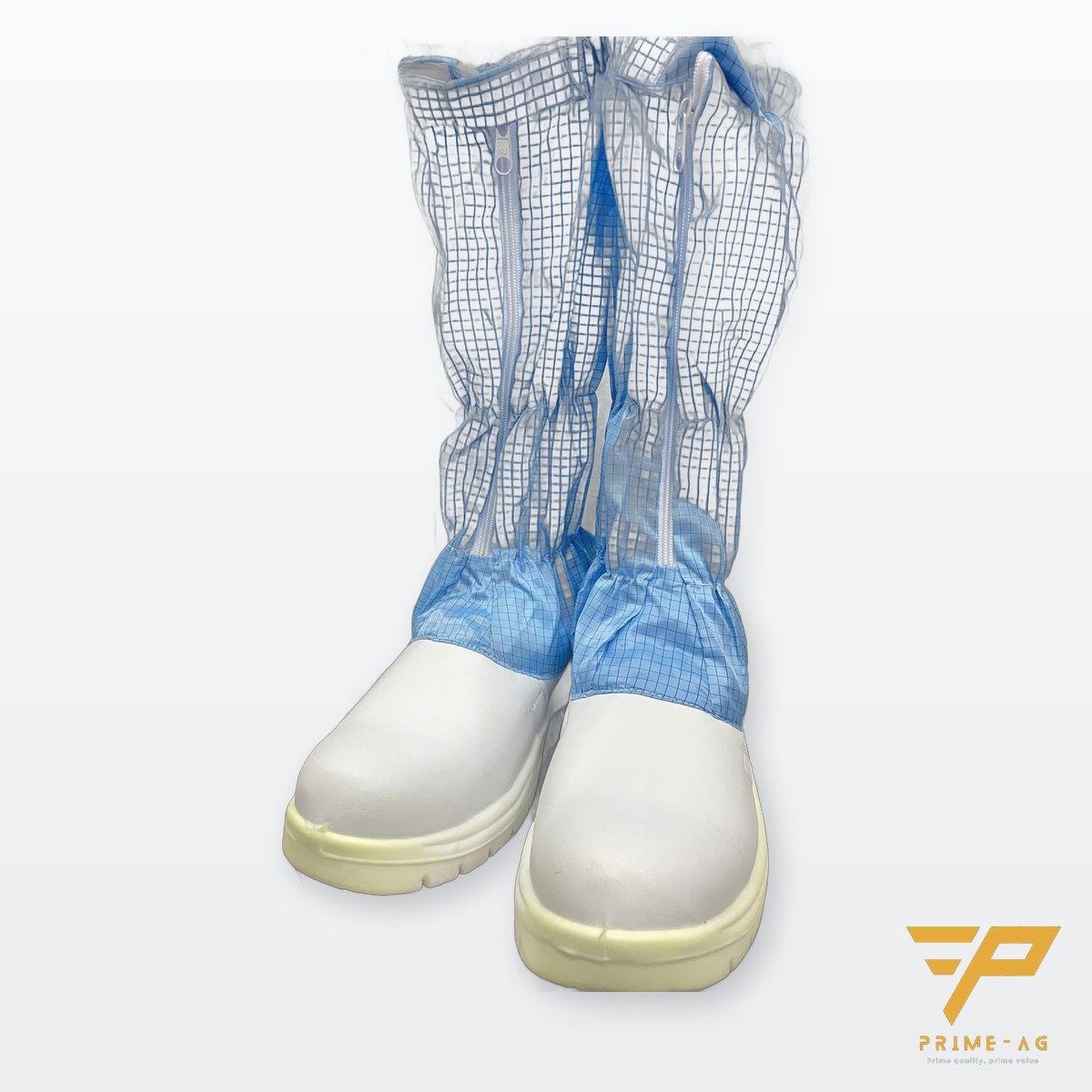
Product code: BT-PVC · Specification: ESD cleanroom boots, PVC / PU sole
ESD Cleanroom Boots (PVC / PU sole)
Equivalent to: “cleanroom boots”, “white check ESD boots”, “cleanroom boot” — what is different: 111 stock codes consolidated on 1 page, full range of colours/sizes, fabric shaft in the same fabric as the garments, PU for those who stand for long periods.
Common specifications: white check, 36–46.
Delivery: stocked items delivered in 24–48 hours (Ho Chi Minh City, Binh Duong, Dong Nai); stock is confirmed with the quotation. All sizes and colours are stocked.
High-top boots are the standard footwear for ISO 5–6: conductive PVC (economy) or PU (comfortable, durable) sole, carbon polyester fabric shaft 20–25 cm high with zip/drawstring, worn with the coverall trouser legs tucked inside for a complete seal. The shaft colour matches the garment colour: white, white check, sky blue, dark blue, pink, pink check, yellow, yellow check, grey, grey check, green, red.
| Item | Value |
|---|---|
| Sole | Conductive PVC (GU) / PU (GUPU) |
| Shaft | Carbon polyester fabric, stripe/check, 20–25 cm high, zip |
| Resistance | 10⁵ – 10⁸ Ω |
| Sizes | 36–48 (230–290 mm) |
| Colours | 12 colours/checks |
| Packing | 1 pair/bag · 10 pairs/carton |
| MOQ | 5 pairs/colour |
Selection: ISO 5–6, pharmaceuticals → boots; general EPA → shoes/slippers; areas with falling objects → steel-toe boots (BT-STEEL).
FAQ
– Should the boot shaft go inside or outside the trousers? — The coverall trouser legs go inside the boot shaft, and the zipped shaft closes snugly around them — it depends on the factory’s rules, but most tuck the trousers into the boots.
– Can the shaft be washed? — Yes; wipe the sole with IPA and hand-wash the shaft.
Why do ISO 5–6 rooms use high-top boots?
People are the largest source of contamination in a cleanroom: dead skin, hair and microorganisms are shed continuously, even when sitting still (Lighthouse). The feet and trouser legs stir up the most dust when walking. That is why rooms of ISO 5–6 or cleaner require coveralls, hoods, gloves and shoe covers/boots, whereas ISO 7–8 rooms may accept smocks (Lighthouse). High-top boots fully enclose the ankle and the lower trouser leg, blocking the path for dust escaping from inside the garment.
Construction: carbon fabric shaft and conductive sole
- Boot shaft: continuous filament polyester fabric, low lint, woven with conductive carbon yarn in stripes or a check pattern. The carbon yarn grid prevents charge from accumulating locally on the fabric.
- Zip/drawstring around the calf: keeps the shaft from slipping down when walking and leaves no gaps.
- Sole: conductive PVC or PU, forming the path that drains charge from the person to the ESD floor.
PVC sole or PU sole?
| Criterion | PVC (GU) | PU (GUPU) |
|---|---|---|
| Weight | Heavier | Noticeably lighter |
| Comfort when standing for long periods | Harder | Resilient, reduces fatigue |
| Chemicals | Good against acids and alkalis (with suitable additives) | Good against oils, greases and solvents |
| Ageing | Depends on the plasticiser | Hydrolyses if kept hot and humid for long periods |
| Best for | Low budgets, frequent replacement | Long shifts standing, a lot of walking |
Data from a safety boot maker (Dunlop) for one-piece moulded boots: the average service life of PU boots is about 9–12 months, and of PVC boots about 4–6 months. These figures only indicate the trend; the service life of cleanroom boots also depends on how many times the fabric shaft is washed.
Putting on boots in the right sequence
- Gown from top to bottom: hood, face mask, then the coverall.
- Put the boots on after the coverall, with the trouser legs inside the boot shafts; close the zip and tighten the drawstring.
- Put the outer gloves on last, pulled over the sleeve cuffs.
- If the changing room has a step-over bench: sit on the bench, put on the boots and then swing your feet over to the clean side, without letting the boot soles touch the floor on the dirty side (Cleanroom Technology).
- Check in the mirror that no skin or hair is exposed before entering the room.
ESD checks
- Person–boot–floor system: < 1×10⁹ Ω per ANSI/ESD S20.20; ESDA also requires body voltage while walking to be < 100 V.
- Test each foot on a footwear tester before entering the room. In cleanrooms wrist straps are often impractical because people move around and wear fully enclosed garments, so the boot–floor system is all the more important (ESDA).
Washing, storage and replacement
- Boot shafts should be washed using the same process as cleanroom garments; the factory should specify the maximum number of wash cycles and how to handle damaged items (Lighthouse).
- Wipe the sole with IPA; do not soak soles in hot water for long periods. Dry completely before storing.
- Store boots in a dry, well-ventilated place; keep PU soles away from prolonged heat and humidity (Kuraray).
- Replace when: the sole is worn smooth, the shaft fabric is frayed or torn, the zip is broken, or the ESD test fails.
Common mistakes
- Putting the boots on before the coverall — the boot soles drag dust inside the garment.
- Wearing cleanroom boots outside the changing area.
- Choosing a boot shaft colour different from the garment, making colour-based zoning hard to control.
- No footwear tester at the cleanroom entrance.
Technical references
- Lighthouse Worldwide Solutions – Cleanroom gowning (tech paper)
- Cleanroom Technology – How to correctly don cleanroom garments
- ESDA – Fundamentals of ESD, Part 3 (personnel grounding, footwear–flooring, gloves)
- Safety+Health Magazine – Polyurethane foot protection (PU vs PVC)
- Kuraray – Polyurethane soles: density, hydrolysis, durability
- Asiatic (Taiwan) – Anti-static PU shoes four-holes (cleanroom grade)
Price: from 115,000 VND (excl. 8% VAT).
REQUEST A QUOTE: send the quantity and specifications you need — PRIMEAG quotes within 30 minutes.
Hotline/Zalo +84 906 108 292 · info@primeag.vn
Written by the PRIMEAG engineering team.
Related guides:Cleanroom Boots Cracking, Peeling or Slipping in Wet Areas:…Analytical Balance Drifting from Static? Ionizer Fix for Weighing…
Related products:ESD Cleanroom SlippersESD Sandals with Heel StrapIndustrial Safety ShoesLinkworld ESD Shoes
Updated: 2026-10-24
Giao tận nhà máy TP.HCM, Bình Dương, Đồng Nai, Long An, Tây Ninh · Kèm biên bản đo điện trở ESD theo lô · Hotline 0906 108 292