
Stocked item: delivered in 1–2 working days in Ho Chi Minh City, Binh Duong and Dong Nai; free delivery for orders from VND 20,000,000; defective items exchanged within 7 days. Shipping & return policy
Product code: MI-INS · Specification: Low-voltage insulating mat, 10 / 22 / 24 / 35 kV
Electrical Insulating Rubber Mats
Brand: Osmonics, Vicadi (Vietnam).
Common specifications: low-voltage 4 mm in front of MSB panels; 22 kV 7 mm for 22 kV substations. Prices from 456,000 VND per 0.65 × 1 m sheet, excl. 8% VAT.
Delivery: in stock, delivered within 24–48 hours (Ho Chi Minh City, Binh Duong, Dong Nai); for large quantities, lead time is confirmed with the quote.
Insulating ≠ anti-static. An insulating mat is dielectric rubber with resistance >10¹² Ω that blocks current to protect people operating switchboards, circuit breakers and transformers — laid in front of MSB/DB panels, in electrical rooms and substations. ESD mats (MT-12) dissipate charge and are used on EPA workbenches — the two cannot replace each other. Choose the voltage class by the working voltage and the thickness by the class; supplied with a voltage test certificate per batch, re-test every 12–24 months.
Updated: 19/10/2026 — PRIMEAG technical team
Osmonics insulating mat price list (red, ribbed anti-slip surface)
The prices below are reference selling prices, excl. 8% VAT, per sheet (rolls priced per m²). The “≥ 50 m” column applies to orders of 50 linear metres or more.
| Specification | Unit | Price (VND) — under 50 m | Price (VND) — from 50 m |
|---|---|---|---|
| Low voltage (1 kV) — 4 mm thick — tested at 5 kV / 3 min | |||
| Roll 1 m × 10 m | roll | 6,720,000 | 6,600,000 |
| Sheet 1 × 1 m | sheet | 678,000 | 666,000 |
| Sheet 0.8 × 1 m | sheet | 552,000 | 540,000 |
| Sheet 0.65 × 1 m | sheet | 456,000 | 444,000 |
| 10 kV — 5 mm thick — tested at 10 kV / 3 min | |||
| Roll 1 m × 10 m | roll | 7,200,000 | 7,080,000 |
| Sheet 1 × 1 m | sheet | 726,000 | 714,000 |
| Sheet 0.8 × 1 m | sheet | 600,000 | 588,000 |
| Sheet 0.65 × 1 m | sheet | 492,000 | 480,000 |
| 22 kV — 7 mm thick — tested at 22 kV / 3 min | |||
| Roll 1 m × 10 m | roll | 9,600,000 | 9,360,000 |
| Sheet 1 × 1 m | sheet | 966,000 | 948,000 |
| Sheet 0.8 × 1 m | sheet | 786,000 | 768,000 |
| Sheet 0.65 × 1 m | sheet | 636,000 | 624,000 |
| 24 kV — 8 mm thick — tested at 24 kV / 3 min | |||
| Roll 1 m × 10 m | roll | 10,200,000 | 9,960,000 |
| Sheet 1 × 1 m | sheet | 1,032,000 | 1,008,000 |
| Sheet 0.8 × 1 m | sheet | 840,000 | 816,000 |
| Sheet 0.65 × 1 m | sheet | 684,000 | 672,000 |
| 35 kV — 9 mm thick — tested at 35 kV / 3 min | |||
| Roll 1 m × 10 m | roll | 12,120,000 | 11,880,000 |
| Sheet 1 × 1 m | sheet | 1,224,000 | 1,200,000 |
| Sheet 0.8 × 1 m | sheet | 984,000 | 960,000 |
| Sheet 0.65 × 1 m | sheet | 804,000 | 792,000 |
- Rolls are only available in 1 m × 10 m; there are no 0.8 m or 0.65 m × 10 m rolls. The 0.8 and 0.65 m widths are pre-cut sheets 1 m long.
- Full rolls ordered with cutting to a custom size: a cutting fee is added per order.
- Vicadi (Vietnam) mats of the same voltage class: quoted per batch.
Reference selling prices, excl. 8% VAT, delivered in Ho Chi Minh City; exact prices depend on quantity and stock at the time of quotation. Export processing enterprise (EPE) customers: 0% VAT invoices, and PRIMEAG handles the on-the-spot import/export declaration for orders from 20 million VND.
*The figures “5 kV, 10 kV, 22 kV…” are the test voltages printed on the label, not the permitted working voltage. Under the OSHA 1910.137 / ASTM D178 class system: Class 0 is tested at 5 kV for use up to 1,000 V; Class 1 tested at 10 kV for use up to 7.5 kV; Class 2 tested at 20 kV for use up to 17 kV; Class 3 tested at 30 kV for use up to 26.5 kV; Class 4 tested at 40 kV for use up to 36 kV. Choose by the highest working voltage of the panel or substation in front of the mat, and check each batch’s test certificate when ordering.
Matching equipment: insulating gloves, insulating boots, insulating hot sticks, portable grounding sets, insulating stools. How to choose a complete set by voltage class: electrical safety equipment for electrical rooms and MSB panels.
FAQ
– Can I use an insulating rubber mat in an ESD area (EPA)? — No; insulation prevents people from discharging static.
– Where can insulating mats be tested and certified in Vietnam? — At a testing and inspection body for electrical equipment that is qualified under current electrical safety regulations; PRIMEAG provides the factory test certificate.
Osmonics and Vicadi insulating mats
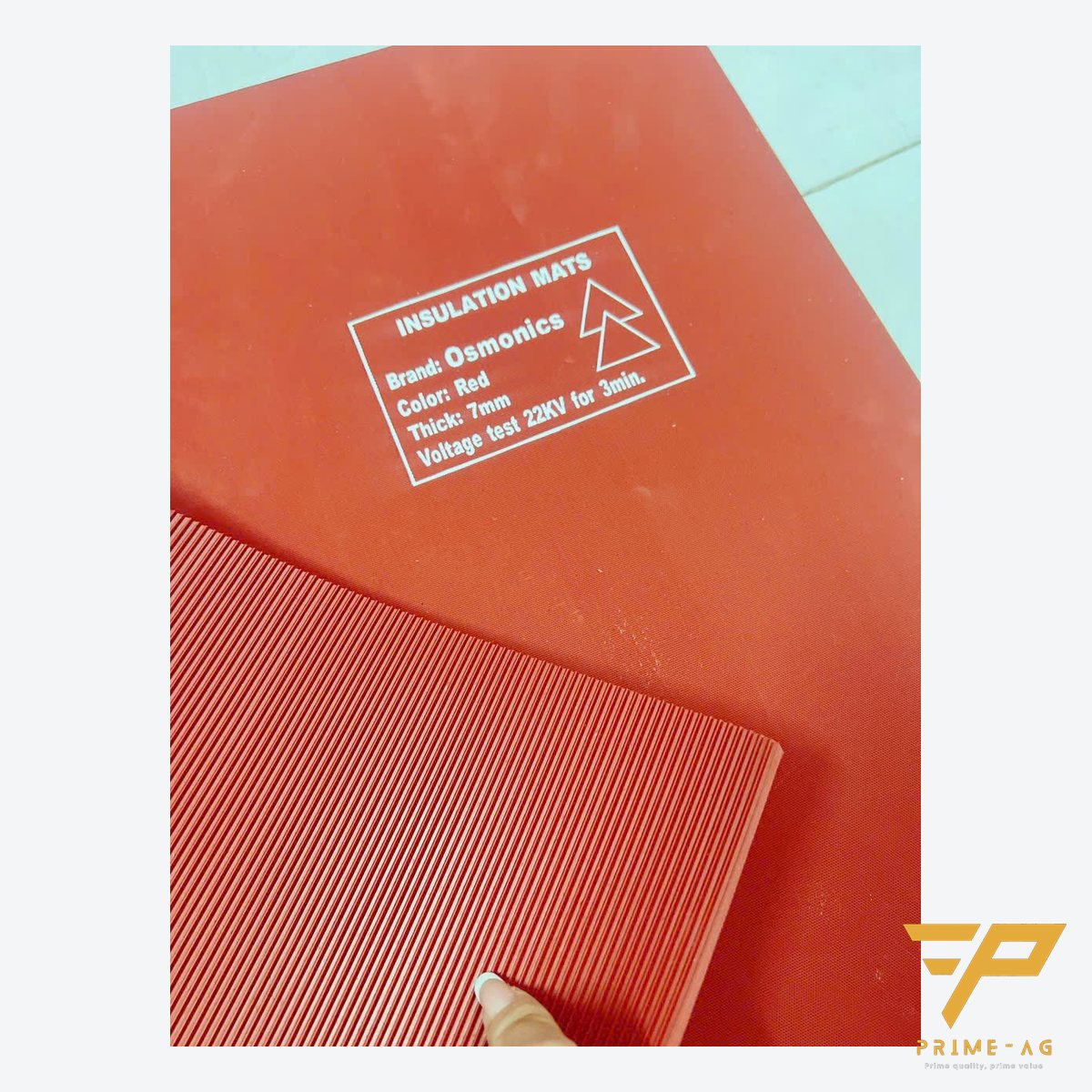
PRIMEAG supplies Osmonics and Vicadi (Vietnam) insulating mats. Osmonics mats are red, with one smooth side and one ribbed anti-slip side; the label printed on the mat shows the thickness and the test voltage of the batch:
| Osmonics mat | Thickness | Test voltage on label |
|---|---|---|
| 4 mm type | 4 mm | 5 kV for 1 minute or 3 minutes (depending on batch) |
| 7 mm type | 7 mm | 22 kV for 3 minutes |
Reading the label correctly: the figure on the label is the test voltage, not the permitted working voltage. Compare with the OSHA 1910.137 classes in the table below: a mat tested at 22 kV meets the Class 2 test level (20 kV), i.e. a maximum use voltage of 17 kV; a mat tested at 5 kV meets the Class 0 test level (5 kV), i.e. a maximum of 1,000 V. Choose the mat by the actual working voltage of the panel and the batch test certificate.
How does an insulating mat work?
An insulating mat is a sheet of dielectric rubber laid on the floor in front of switchboards, circuit breakers and transformers. If the operator touches a live part during a fault, the mat breaks the current path from the body to the floor, reducing the risk of electric shock. The mat is an additional layer of protection, used together with insulating gloves, insulating boots and hot sticks — it does not replace isolation, lockout and tagout procedures.
Under ASTM D178 (rubber insulating matting), the material can be any elastomer or elastomer compound. ASTM D178 defines two types:
- Type I: properly vulcanised rubber, for general use.
- Type II: with special properties — ozone-resistant, flame-retardant or oil-resistant. Choose Type II for substations, generator rooms and areas with oil.
ASTM D178 tests both electrical properties (proof test voltage, AC/DC breakdown voltage) and physical properties (moisture absorption, oil resistance, tensile strength, elongation, heat ageing, flame resistance). The mat must stay flexible over the normal service temperature range.
International voltage classes (Class 00–4)
Rubber insulating equipment (gloves, blankets, mats) shares one class system based on maximum use voltage. The table below follows OSHA 29 CFR 1910.137 (USA); ASTM D178 uses classes 0–4 for matting:
| Class | Maximum use voltage (AC, rms) | Test voltage (AC, rms) |
|---|---|---|
| 00 | 500 V | 2,500 V |
| 0 | 1,000 V | 5,000 V |
| 1 | 7,500 V | 10,000 V |
| 2 | 17,000 V | 20,000 V |
| 3 | 26,500 V | 30,000 V |
| 4 | 36,000 V | 40,000 V |
Selection rule: the maximum use voltage of the mat’s class must be greater than or equal to the working voltage of the equipment in front of it. In Vietnam, mats are usually named after grid voltage levels (10, 22, 35 kV). When buying, check the class marked on the mat, the test voltage on the test certificate and the applicable standard (IEC 61111 or ASTM D178) — do not rely on the name alone.
Pre-use inspection and periodic testing
- Visually inspect before every shift and immediately after any incident that may have damaged the mat (per OSHA 1910.137).
- Remove the mat from service if it has holes, tears, punctures or cuts; ozone cracking (a network of fine criss-cross cracks that appears when rubber under bending or stretching is attacked by ozone); embedded foreign objects (metal chips, nails, glass fragments); or if it is swollen, soft, hardened or tacky.
- Re-test the voltage whenever insulation degradation is suspected, after repair, and at the inspection interval set by your electrical safety management. For reference, OSHA requires insulating blankets to be re-tested every 12 months and insulating gloves every 6 months.
- Keep test certificates by roll/batch and post the latest test date where the mat is laid, for checking during safety audits.
Storage and cleaning
- Per OSHA, insulating equipment must be stored away from light (including sunlight), extreme temperatures, excessive humidity, ozone and other harmful substances.
- Do not place mats near motors, spark-producing machines or high-voltage equipment with corona discharge — all sources of ozone.
- Roll loosely for storage and never fold: a fold held under bending for a long time is where ozone cracking appears first.
- Clean with water and mild soap, then let dry. Do not use petrol, oil or solvents unless the mat is an oil-resistant type (Type II).
Common mistakes
- Confusing insulating mats with anti-static mats. ESD mats have a resistance of 10⁶–10⁹ Ω to dissipate static and offer no protection at all against electric shock. Conversely, an insulating mat laid in an EPA prevents people from discharging static.
- Laying a mat shorter than the switchboard, leaving a stretch of floor the operator can step onto.
- Putting boxes or tools on the mat, or dragging trolleys with sharp edges over it, causing cuts that cannot be seen.
- Using a mat that is oily or wet — the surface becomes conductive and the mat loses its effect.
Technical references
- OSHA 29 CFR 1910.137 – Electrical protective equipment (voltage classes, inspection, storage)
- ASTM D178-19 – Standard Specification for Rubber Insulating Matting
- ESDA – Fundamentals of ESD, Part 3 (packaging, ANSI/ESD S541, garments, carts)
Price: from 456,000 VND (excl. 8% VAT).
REQUEST A QUOTE: send the quantity and specifications you need — PRIMEAG quotes within 30 minutes.
Hotline/Zalo +84 906 108 292 · info@primeag.vn
Written by the PRIMEAG engineering team.
Related guides:Safety Gear for MSB Rooms and 22 kV Substations:…ESD Resistance Testing for Incoming Acceptance: 3 Measurements, ANSI/ESD…ESD rubber bench mat curling or bulging: 6 causes…
Related products:Portable Earthing and Short-circuiting SetElectrical Insulating Rubber GlovesInsulating Stool for SubstationsTelescopic Insulating Hot Stick
Updated: 2026-10-24
Giao tận nhà máy TP.HCM, Bình Dương, Đồng Nai, Long An, Tây Ninh · Kèm biên bản đo điện trở ESD theo lô · Hotline 0906 108 292