
Stocked item: delivered in 1–2 working days in Ho Chi Minh City, Binh Duong and Dong Nai; free delivery for orders from VND 20,000,000; defective items exchanged within 7 days. Shipping & return policy
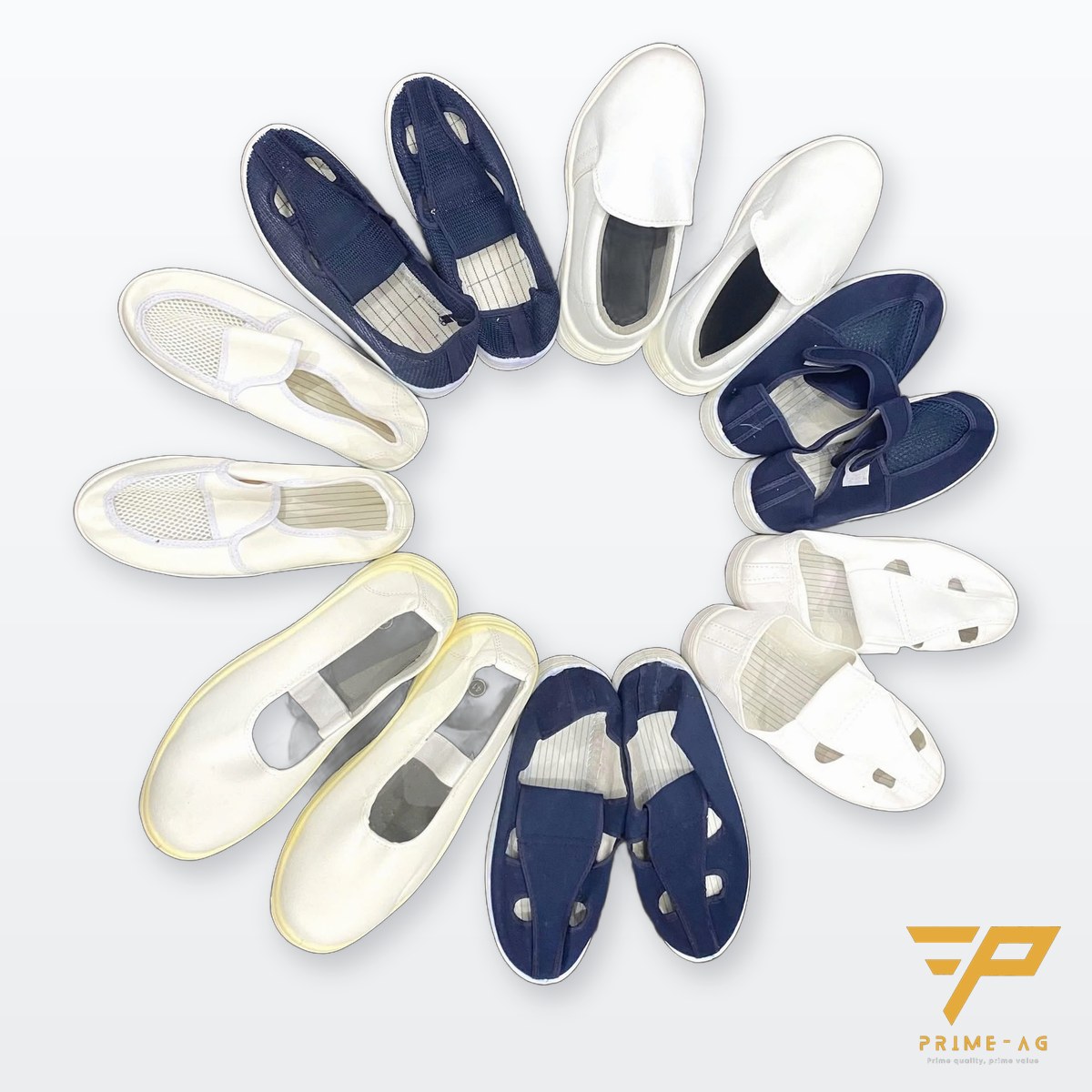
Product code: SH-PVC · Specification: ESD cleanroom shoes with PVC sole (4-hole, mesh upper)
ESD Canvas Shoes, PVC sole, 4-hole / mesh
Also called: “4-hole cleanroom shoes”, “ESD mesh shoes”, “white antistatic canvas shoes” — what is different: sizes 35–48 (47–48 available for tall men), 3 colors, 2 upper styles, lot resistance report.
Common specifications: white 4-hole, sizes 36–42.
Delivery: in stock, delivered within 24–48 hours (Ho Chi Minh City, Binh Duong, Dong Nai); lead time for large quantities confirmed at quotation.
Closed-toe, budget-friendly shoes for operators in ISO 6–8 cleanrooms and EPAs: one-piece molded conductive PVC sole and canvas upper; the 4-hole upper (4 vent holes on the instep) for general areas, the mesh upper for hot areas. Lightweight, washable, replaced every 6–12 months.
| Item | Value |
|---|---|
| Sole | Conductive PVC, anti-slip |
| Upper | Polyester canvas, white / sky blue / navy |
| Resistance | 10⁵ – 10⁸ Ω (IEC 61340-4-3 / ANSI/ESD STM9.1) |
| Style | 4-hole (G4L) / mesh upper (GML) |
| Size | 35–48 (225–290 mm) |
| Test method | ANSI/ESD STM9.1 |
| Packing | 1 pair/bag · 20 pairs/carton |
| MOQ | 10 pairs |
How to choose: long standing hours, need more cushioning → Linkworld (SH-LW) or PU (SH-PU); need toe protection → steel toe (SH-STEEL).
FAQ
– White or navy – which color should we order? — White for cleanrooms (dirt shows up), navy for factory-floor EPAs.
– Can ESD cleanroom shoes be machine washed? — Yes, at 40 °C, then air dry.
– What is the size chart? — 35 = 225 mm … 48 = 290 mm; measure foot length + 5 mm.
Materials: conductive PVC sole and canvas upper
- PVC sole: PVC softened with plasticizers, blended with conductive additives and molded in one piece with the upper. PVC is inexpensive, reasonably abrasion-resistant and resists oil and grease, many acids, alkalis and alcohols. According to Tingley (USA), PVC is not recommended for contact with ketones (acetone, MEK) and certain solvents — do not clean soles with acetone.
- How PVC ages: plasticizer gradually migrates out of the polymer, so the sole hardens and cracks. High temperatures (sun exposure, hot drying) speed this up.
- Polyester canvas upper: breathable, washable, low cost. The woven fibers hold more dust than a PU leather upper — which is why canvas shoes suit ISO 6–8 cleanrooms and EPAs, while higher-grade cleanrooms use PU shoes or cleanroom boots.
- Insole: must be conductive/dissipative like the sole; do not add ordinary insoles.
Two upper styles: 4-hole and mesh
The 4-hole (G4L) style has a closed upper with only 4 vent holes on the instep — less dust gets in, suitable for clean areas and air-conditioned EPAs. The mesh upper (GML) is more breathable and suits hot areas (wave soldering, reflow ovens, warehouses), but mesh holds dust and is more open — use it preferably in factory-floor EPAs, not in cleanrooms.
Measuring shoe resistance: three methods, three purposes
| Method | What it measures | Test procedure (summary) | Used for |
|---|---|---|---|
| ANSI/ESD STM9.1 | The shoes alone, no floor | Resistance from inside the shoe to the sole | Product qualification under ANSI/ESD |
| IEC 61340-4-3 | The shoes alone | Shoes conditioned for temperature and humidity (low humidity, simulating the dry season), placed on a stainless steel plate, electrode inside, load 12.5 kg ±2.5 kg; ESD must be < 1×10⁸ Ω | Lot resistance reports, European ESD certification |
| ANSI/ESD STM97.1 / footwear tester | Person + shoes (+ floor) | Person wearing the shoes stands on an electrode plate and touches a hand electrode | Daily check at the EPA entrance; floor–footwear system evaluation |
A 10⁵–10⁸ Ω lot resistance report shows the shoes passed when they left the factory; in the plant, however, ESD TR53 recommends testing every day while worn, each foot separately, with results logged. Note the different limits: “antistatic” safety footwear under EN ISO 20345 only needs 10⁵–10⁹ Ω (tested with 4 kg of steel balls inside the shoe, 100 V for 1 minute) — a wider range than the ESD limit.
Washing shoes and the effect on ESD performance
- Wash in warm water (max 40 °C per PRIMEAG instructions) with a mild silicone-free detergent. Silicone and fabric softeners leave an insulating film on the insole and sole.
- Air dry in a ventilated place; no hot drying and no strong sunlight (the PVC sole loses plasticizer and hardens quickly).
- Shoes must be completely dry before wearing again; re-test on the footwear tester after washing.
- Wash on a fixed schedule (e.g. at the weekend) and rotate 2 pairs, so nobody wears damp shoes for a whole shift.
When should shoes be replaced?
- Sole tread worn smooth, slippery on epoxy/vinyl floors.
- Sole hardened, with cracks at the toe flex area.
- Sole separating from the upper, torn toe, flattened or torn insole.
- Daily test fails even after the sole has been cleaned.
The 6–12 month interval recommended by PRIMEAG is for planning issue cycles; the deciding criteria remain the actual condition and the daily test results.
Common mistakes
- Stepping on the heel and wearing shoes like slippers — the heel counter breaks and the foot no longer contacts the insole.
- Cleaning soles with acetone to remove glue or paint marks.
- Wearing ESD shoes outside the production area, picking up oil, mud and dirt.
- Relying only on the lot resistance report, with no footwear tester or daily test log.
- Using ESD shoes on a non-ESD floor and believing the operator is grounded.
Certificates and test reports
- Antistatic footwear EN ISO 20347:2012 — SGS Guangzhou (footwear lab), report no. SL92219280304501FW (20/07/2022): PASS “Antistatic footwear”: dry 51.0–53.7 MΩ, wet 1.8–3.9 MΩ (requirement 0.1–1,000 MΩ). Download PDF
Applicant/manufacturer details on the report are masked to protect the supply chain; the full version is provided to customers on request. See all: PRIMEAG product certificates and test reports.
Technical references
- uvex – Antistatic vs ESD: EN ISO 20345 and IEC 61340-4-3 test methods
- Desco – STM97.1 vs S9.1/STM9.1 for ESD footwear (Q&A)
- Tingley – Footwear material guide (PVC: plasticizers, ketones)
- Desco – Foot grounder datasheet (daily testing per TR53)
- Desco – Foot grounders: silicone-free cleaning
- ESDA – ANSI/ESD STM9.1-2022 Footwear resistive characterization
Price: from 70,000 VND (excl. 8% VAT).
REQUEST A QUOTE: send the quantity and specification you need (style, color, size breakdown) — PRIMEAG quotes within 30 minutes.
Hotline/Zalo +84 906 108 292 · info@primeag.vn
Written by the PRIMEAG engineering team.
Related guides:ESD Shoes Failing After Washing: 5 Causes, Correct Washing,…
Related products:ESD Cleanroom SlippersESD Sandals with Heel StrapIndustrial Safety ShoesLinkworld ESD Shoes
Updated: 2026-10-24
Giao tận nhà máy TP.HCM, Bình Dương, Đồng Nai, Long An, Tây Ninh · Kèm biên bản đo điện trở ESD theo lô · Hotline 0906 108 292