
Are ordinary tweezers and brushes safe in an EPA? Bare stainless steel tweezers, plain plastic tweezers and nylon brushes all carry risk: plastic charges up through friction, and bare metal touching a component causes a fast discharge. PRIMEAG recommends ESD-coated or carbon-filled plastic ESD tweezers, brushes with 10⁶–10⁹ Ω handles, and a tested wrist strap.
- Picking small chips: Vetus ESD-11, ESD-15; for glass and displays use carbon plastic tweezers.
- Board cleaning: brushes with carbon-filled PP handles; copper bristles only for stencils and tooling.
- Mandatory: whoever holds the tool wears a wrist strap tested at the start of the shift.
- Periodically: inspect tweezer tips, measure brush handles, discard worn tools.

Why ordinary tools cause damage and when you need ESD tweezers
Brushing a board is continuous rubbing and separating, which means triboelectric charging. Nylon bristles and ordinary plastic handles are insulative, so the charge stays on the tool. Ordinary plastic tweezers are the same.
Bare stainless steel tweezers, on the other hand, are fully conductive. According to Desco, metal touching a charged component discharges it very fast (CDM model); a dissipative surface slows the discharge down.
Choosing tweezers by process
Vetus ESD-coated tweezers are 120–140 mm long, with a non-magnetic stainless steel body and coating resistance as published by the manufacturer; carbon-filled plastic tweezers are used where glass and displays must not be scratched.
- Picking 0402, 0201: ESD-11 or ESD-15.
- Picking ICs, straightening leads: ESD-12, ESD-13.
- Pulling wires, removing labels: ESD-14, ESD-17.
- Glass, displays: carbon-filled plastic 93302, 93303; hard to pick 0402 with them.
- Holding parts while soldering: ceramic tips, insulative, not for normal handling.
Vetus ST is bare stainless steel, better suited to mechanical work and labs than to sensitive components.
Choosing ESD brushes
BR-ESD anti-static brushes have carbon-filled PP handles at 10⁶–10⁹ Ω (dissipative range) and IPA-resistant nylon bristles. A2 and A3 are soft for boards after soldering; the F group is for connector gaps; C1–C2 and D1–D3 for benches and trays. The copper-bristle type is only for stencils and soldering tips, never on boards.
Same direct-contact group: gloves and finger cots
Carbon gloves with PU-coated fingertips at 10⁵–10⁸ Ω per batch test sheet, and Trufit ESD finger cots with a CoA for each batch. Insulative gloves cut off the brush’s discharge path. Glove allocation by station is covered in the article choosing gloves for each process in an electronics factory.
Tools only dissipate when the person is grounded
According to ESDA’s ESD TR20.20, hand tools are grounded through the ESD work surface and the grounded operator. If the hand is not grounded, the charge has no path back.
Each station needs a coiled-cord ESD wrist strap; the cord is 1.8 m long with a 1 MΩ current-limiting resistor, tested at the start of the shift with a wrist strap tester (pass 0.75–35 MΩ). For the order of setting up stations, see the article setting up an EPA for an SMT line.
| Tool | Ordinary type | ESD type | Used in process |
|---|---|---|---|
| Metal tweezers | Bare stainless steel, fully conductive | Stainless steel with dissipative ESD coating | Picking chips, ICs, board rework |
| Plastic tweezers | Insulative plastic, charges through friction | Carbon-filled plastic, replaceable tips | Glass, displays, large components |
| Brushes | Plastic handle, ordinary nylon bristles | Carbon-filled PP handle 10⁶–10⁹ Ω | Brushing boards after soldering, connector gaps, trays |
Periodic checks and tool retirement
- Inspect tweezer tips with a magnifier: both tips meet at the same time with no gap. Discard bent or splayed tips.
- If the ESD coating is peeling or badly cracked, take the tweezers out of the EPA; they are usually replaced after 6–12 months.
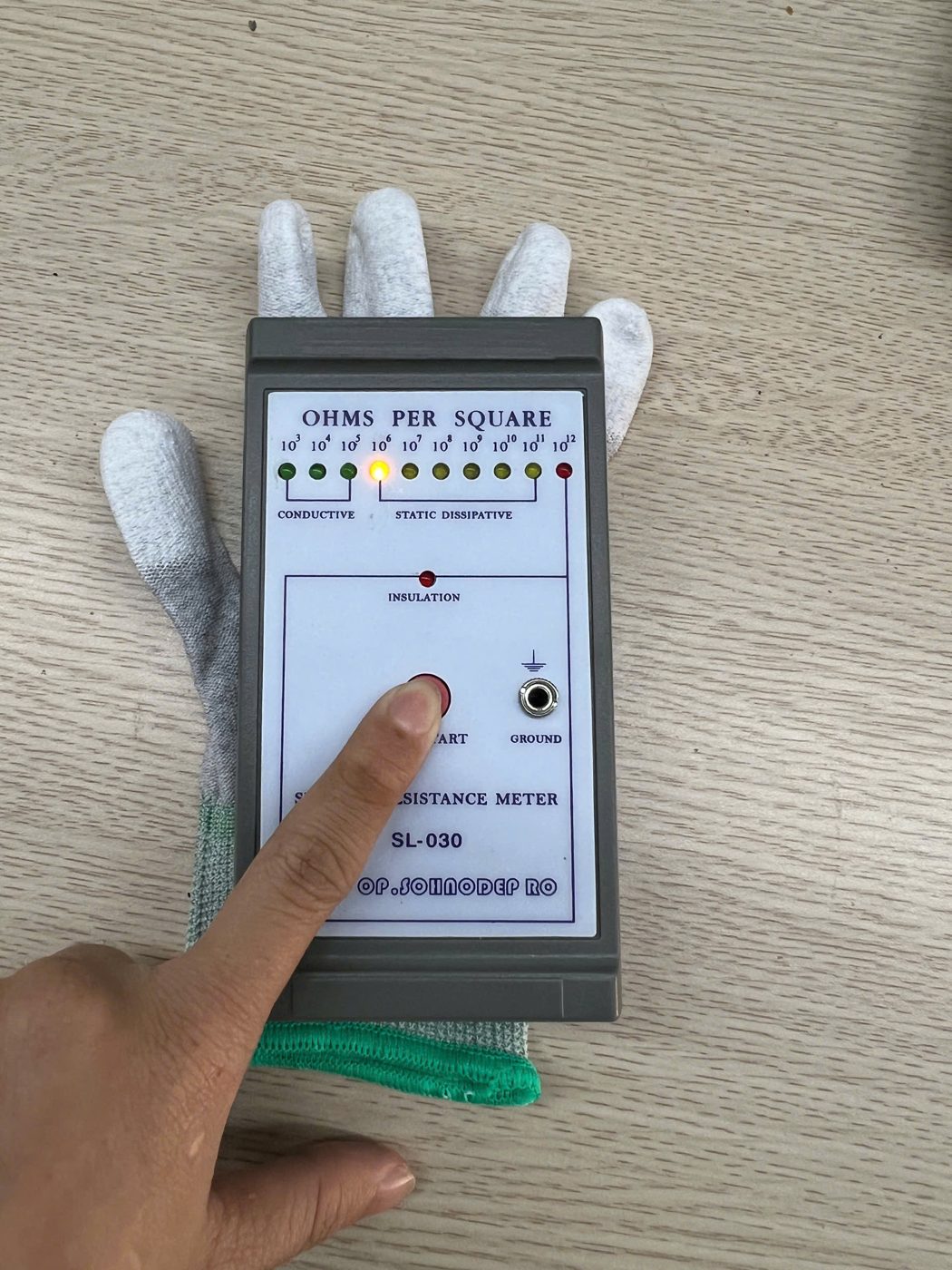
- Quickly measure brush handles and gloves with an SL-030 handheld meter (10³–10¹² Ω); work surfaces must be below 1×10⁹ Ω.
- Remove ordinary tools from the EPA and label them to tell them apart.
- When PRIMEAG visits your factory in Ho Chi Minh City, Binh Duong or Dong Nai for free ESD material resistance testing, collect a few tweezers and brushes from the line beforehand so they can be measured together with the work surfaces using a TR1800; the PDF report is sent within 3–5 working days and is for reference only.
Frequently asked questions
Can bare stainless steel tweezers be used in an EPA? They can be used for mechanical work or less sensitive components, but should not be used for ESD-sensitive components, because bare metal touching a charged component causes a fast discharge; choose ESD-coated tweezers.
Is a black plastic brush automatically an ESD brush? Not necessarily. Black colour proves nothing; it must be carbon-filled plastic with measurable resistance. BR-ESD brushes have 10⁶–10⁹ Ω handles and come with a resistance sheet.
If we use ESD tweezers, do operators still need wrist straps? Yes. ESD tweezers and brushes only discharge through the hand of a grounded person; without a wrist strap the tool has no path to ground.
Updated: 21/10/2026 — PRIMEAG engineering team
Mon–Sat, 8:00–17:00 (GMT+7) · Phone/Zalo: +84 906 108 292 · Email: info@primeag.vn
Start where it suits you: Free technical advice · Send a drawing or layout · Get a quote within 30 minutes
Written by the PRIMEAG engineering team
Updated: 2026-10-21