
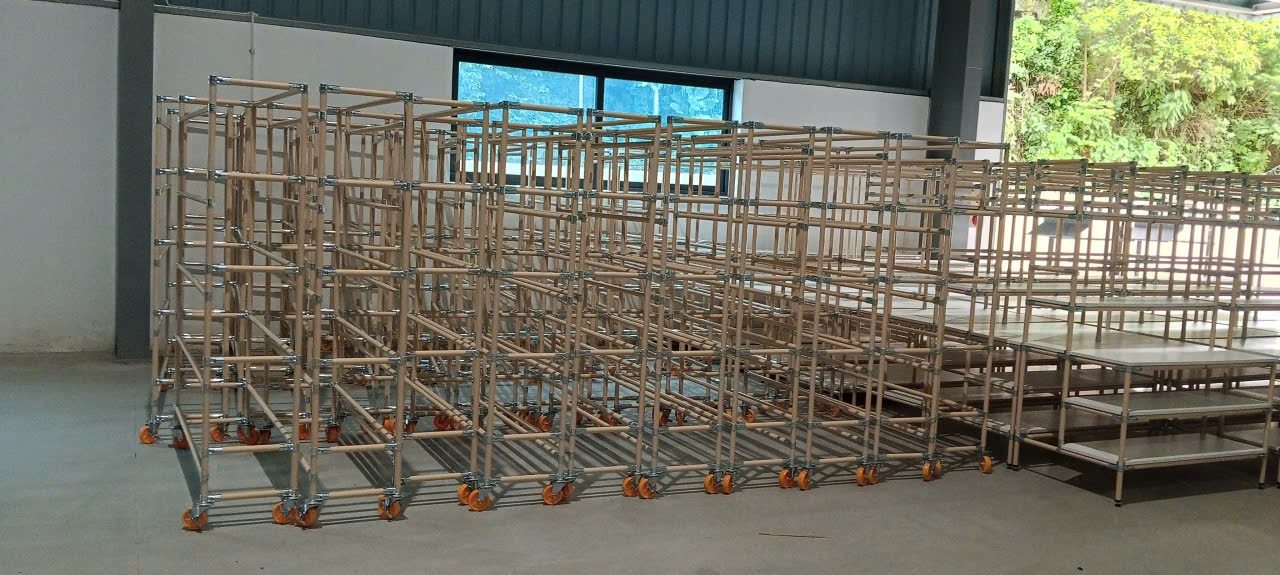
For the output end of an automatic fabric cutter (Gerber, Lectra) in a garment factory in Vietnam, use 3–4 tier flat-deck bundle carts, one cart per cut order or cutting table. PRIMEAG builds carts from lean pipe (plastic-coated steel pipe, Φ28) rated 100 kg per tier, sized to your cutting room, plus size-labeled staging racks and plastic bins for size separation.
The faster the cutter, the higher the pile of bundles at the end of the table. Once a factory moves to Gerber or Lectra, the bottleneck shifts from cutting to collecting, numbering and bundling into sets. Without bundle carts after the automatic cutter and addressed staging spots, bundles get mixed sizes, mixed tables and creases before they reach the sewing line.
- Bottleneck: bundles pile up at the end of the cutting table waiting for numbering.
- Carts: one cart per cut order, flat board decks, 100 kg per tier.
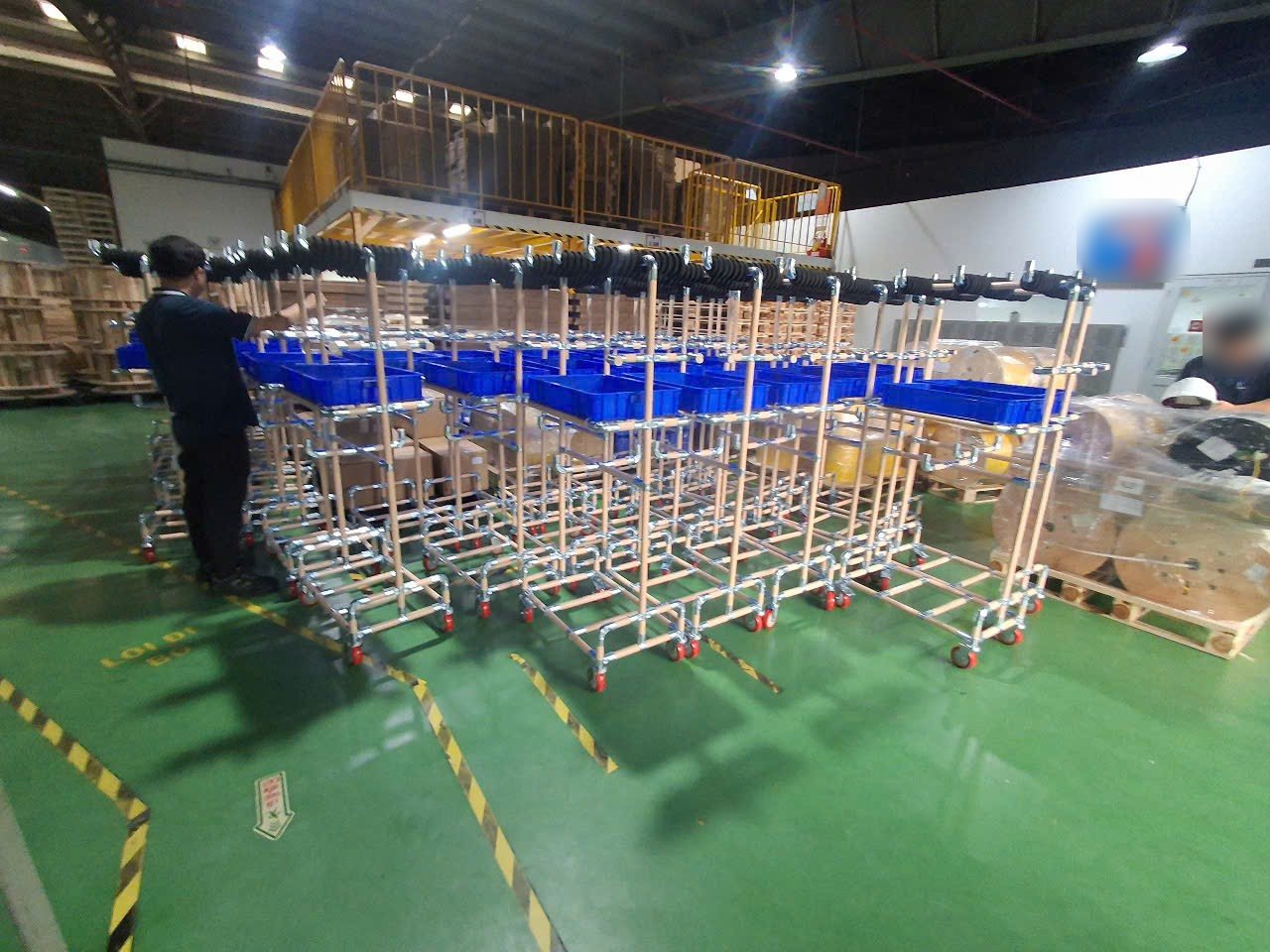
- Staging racks: plastic-coated Φ28 steel pipe, one labeled slot per size.
- Flow: cutting → numbering → set matching → sewing line, bundles never touch the floor.
Why you need bundle carts after an automatic fabric cutter
The cutter delivers parts continuously and one person cannot keep up collecting them, so bundles get stacked on the table or put on the floor. The result: size M mixed with L, the morning table mixed with the afternoon table, thin fabric crushed and creased, and the numbering operator digging through every bundle.
The bottleneck sits in the few meters behind the cutter. The fix is to give every bundle an addressed location the moment it leaves the cutting table, and keep it there until the sewing line.
Layout of the area behind the cutter
Carts per cut order or cutting table
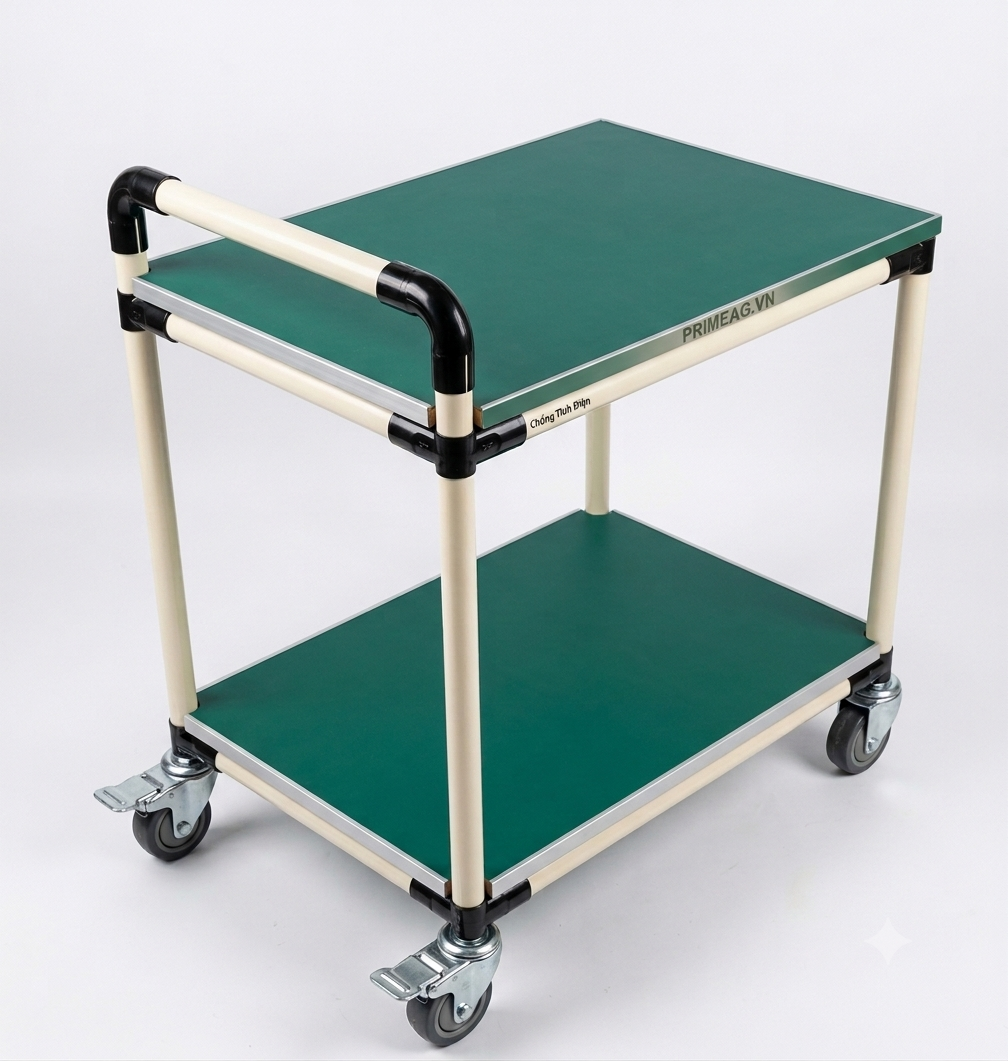
The standard multi-tier plastic-coated steel pipe cart is 1500×600×1600 mm with 3 tiers; it can be changed to 2–5 tiers and 900–1800 mm long. Load is 100 kg per tier, more than enough for fabric bundles.
15–17 mm MDF boards with plastic edging keep bundles flat. Φ75 PU casters, 2 of them locking; for aisles narrower than 1.2 m choose the 1400×600 or 900×600 mm version.
Rule: the order ticket is clipped to the push handle, full carts go out, empty carts come in, and nobody re-sorts.
Size-labeled staging racks for set matching
Body, sleeve and collar bundles wait until all parts are complete before set matching. Staging racks are assembled from plastic-coated Φ28 pipe and metal joints, one slot per size, with labels on the front cross bar.
If your factory assembles in-house, PRIMEAG sends the BOM and pipe cutting list free of charge.
Plastic bins for small parts
Pockets, plackets and collar facings easily fall out of bundles; use industrial plastic bins with label card holders in 610×420×100 or 610×420×250 mm, with dividers to separate sizes, placed on a cart tier.
Numbering and set-matching table
The Φ28 plastic-coated steel pipe workbench has a 750 mm top height, 150 kg load, 600–1800 mm length and ±20 mm adjustable feet; the powered version carries 2 LED lights for the numbering step.
Flow from the cutting table to the sewing line
| Step | Equipment | Rule |
|---|---|---|
| Cutter output | 3–4 tier cart | One cart per order, ticket on the handle |
| Numbering | Workbench with light | Return each bundle to its tier after numbering |
| Waiting for set matching | Φ28 pipe rack with slots | Slots by size, order label on the front |
| Sets to sewing line | Cart, bins with cards | One cart per line, record the set count |
Once bundles are on the line, for the next bottleneck see WIP pile-ups between garment processes: WIP racks and carts. Lint makes casters harder to push over time: garment factory carts getting heavy because thread and lint wrap around caster axles.
Carts built to fit your cutting room
PRIMEAG built 400 custom carts for a US FDI factory in Can Giuoc during 2025–2026, made to the customer’s dimensions.
Standard models take 5–7 working days, new designs 10–15 working days. Frames carry a 3-year warranty, casters 12 months.
Where to start
- Count the average number of bundles per order and the largest bundle size.
- Measure the cutter output area and the aisle to the numbering table.
- Choose the number of tiers based on bundle height.
- List the sizes running in parallel to divide the rack slots.
- Send the cutting room layout to PRIMEAG to design carts and racks.
Send the layout via the cart and rack drawing request page, and PRIMEAG will quote within 30 minutes.
Frequently asked questions
- How many tiers should a fabric bundle cart have? — Usually 3–4 tiers, with tier spacing slightly higher than the bundle so it can be pulled out without creasing. To change the number of tiers, just add pipe and joints.
- Should cart decks for fabric bundles be boards or wire mesh? — MDF boards with plastic edging, because soft fabric bundles lie flat and do not get mesh marks. Wire mesh is better for bins or rigid goods.
- Can the set-matching staging rack be reconfigured when the style changes? — Yes. The Φ28 pipe frame uses bolted joints; loosen the bolts with a 5 mm hex key to move support bars and add or remove slots.
Updated: 30 Oct 2026 — PRIMEAG engineering team
Email: info@primeag.vn · Phone/Zalo: +84 906 108 292
Written by the PRIMEAG engineering team
Updated: 2026-10-30