
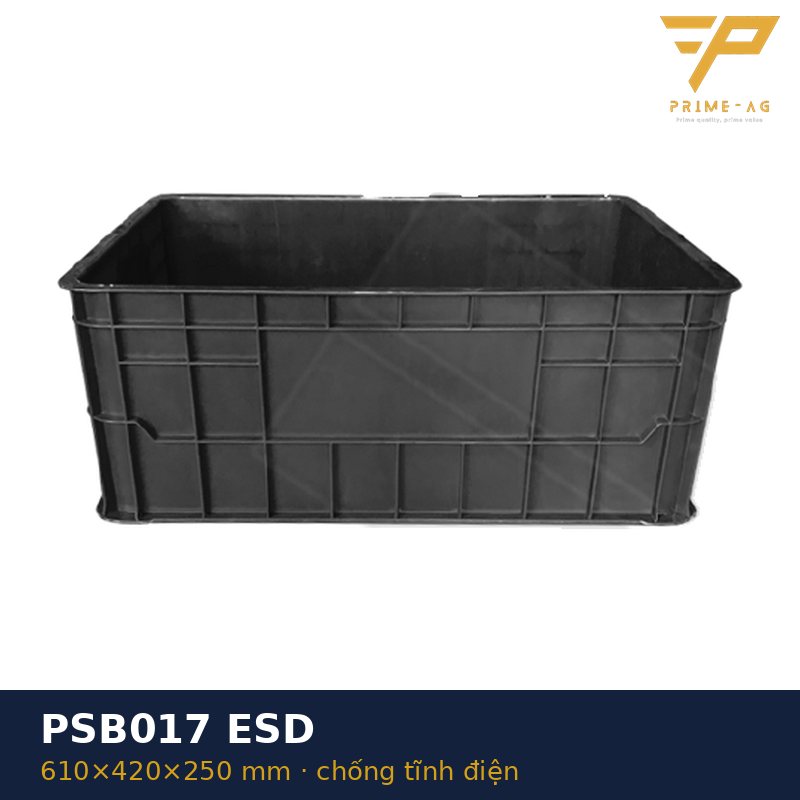
An ESD plastic bin that measures above 10¹¹ Ω is already in the insulative range under ANSI/ESD S541. PRIMEAG recommends checking in this order: electrode placement and humidity, surface contamination, and only then whether the lot contains coated antistatic bins or ordinary plastic bins. A compliant carbon-filled PP bin or tray must measure within 10³–10⁹ Ω.
QC at a factory in Vietnam receives a new lot of bins, puts the meter on a few of them and the display shows more than 10¹¹ Ω. Reject or accept? Before writing up a rejection report, separate three possibilities: a measurement error, dirty bins, or the wrong type of bin.
- Re-measure on the flat bottom or wall, away from labels, ribs and curved corners; record %RH.
- Clean off oil, adhesive and silicone-based cleaners before drawing conclusions.
- Blue and pink bins are usually only low-charging (antistatic), not dissipative.
- Still ≥ 10¹¹ Ω: quarantine the bin and remove it from the EPA.
Why ESD plastic bins measure above 10¹¹ Ω
Under ANSI/ESD S541, below 10⁴ Ω is conductive, 10⁴ to below 10¹¹ Ω is dissipative, and 10¹¹ Ω and above is insulative. But a high reading is not necessarily caused by the material. Go through four causes in order, cheapest step first.
1. Incorrect measurement method
- The electrode sits on a label, rib or curved surface instead of making flat contact.
- A multimeter is used instead of 5 lb electrodes.
- Wrong test voltage: measure at 10 V first, and switch to 100 V from 10⁶ Ω upward.
- A dry room makes chemically coated bins read higher; always record %RH.
Use the TR1800 digital surface resistance meter with two 5 lb electrodes placed on the flat bottom or wall, wait for the reading to stabilize, and write it down together with the humidity shown on the meter.
2. An insulating film on the surface
Skin oil, label adhesive, pallet stretch film and silicone-based cleaners all leave a thin film. Wipe the measuring area with IPA, let it dry and measure again. If the reading drops below 10⁹ Ω, the problem lies in cleaning.
3. Wrong type: antistatic-coated or carbon-filled
“Antistatic” bins are coated or sprayed with a chemical on the surface, and the effect fades after repeated washing and in dry weather. Most blue and pink bins belong to this low-charging group. A black carbon-filled PP ESD bin, by contrast, is conductive through its whole body. Lightly scrape one edge and measure on the scraped spot to tell them apart.
4. Ordinary black plastic bins mixed into the lot
Black color does not prove carbon content. If only a few bins exceed the limit, suspect ordinary bins mixed in: measure each bin, label the ones that pass, and keep failed bins outside the EPA.
How to read the measurement and what to do
| Reading (5 lb electrodes) | Conclusion | Action |
|---|---|---|
| Below 10³ Ω | Highly conductive, outside the 10³–10⁹ Ω range | Check with the supplier; line very sensitive components with a dissipative tray |
| 10³–10⁹ Ω | Within the range for ESD trays and bins | Use as normal, log the reading with %RH |
| Above 10⁹ to below 10¹¹ Ω | Still dissipative under S541 but outside the required range | Clean and re-measure; if no improvement, remove from the line |
| 10¹¹ Ω and above | Insulative | Review the method, wipe, scrape the edge and re-measure; if still high, return or scrap |
Only compare readings taken at the same voltage, with the same electrodes, and with humidity recorded.
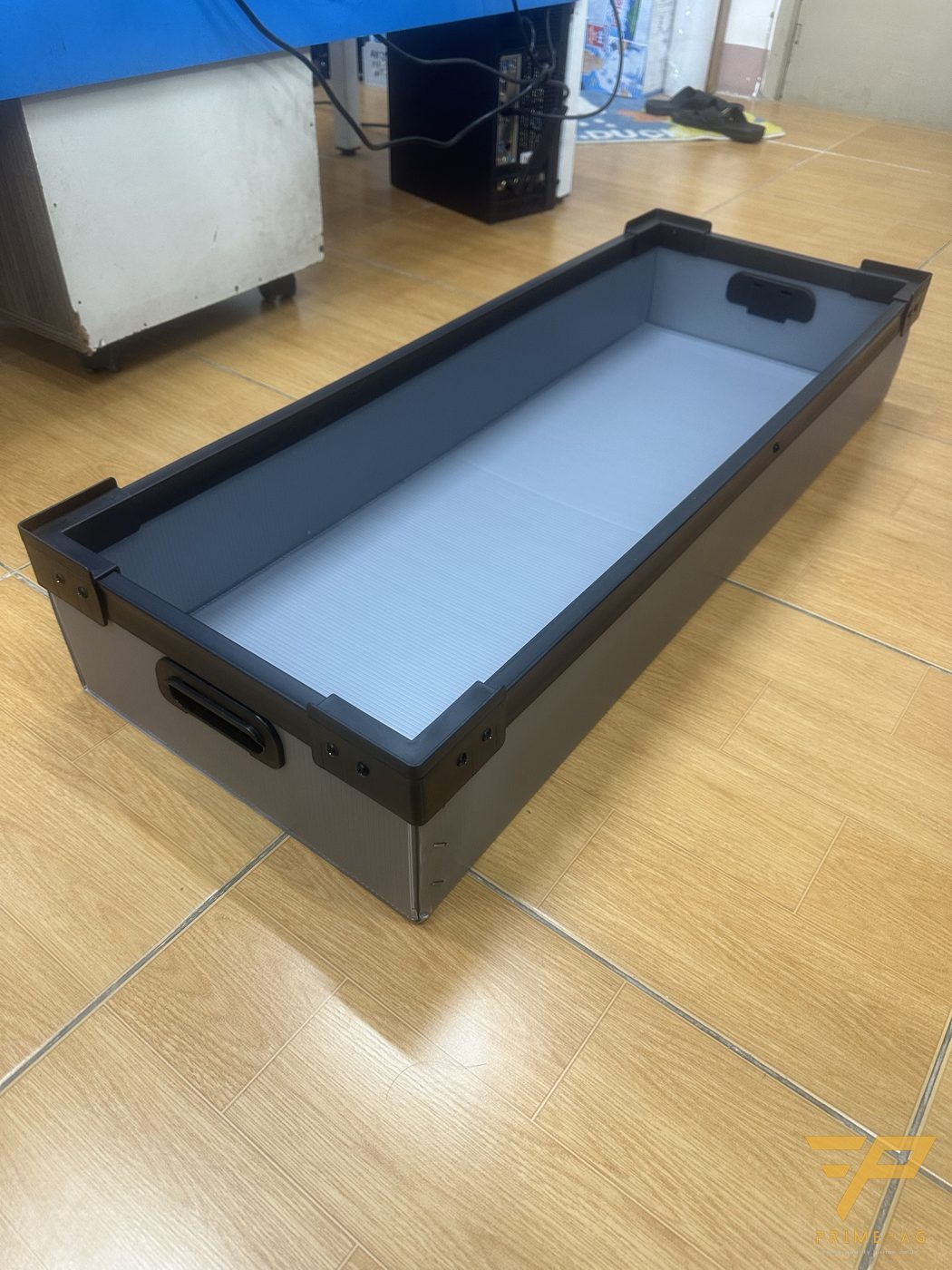
Loose components should go in an ESD plastic tray, which can be ordered in the 10⁶–10⁹ Ω range; light items on racks can use an ESD corrugated plastic (danpla) box made to drawing. The role of each type is covered in the guide where to use ESD trays, bins or danpla boxes; for dented dividers see ESD danpla boxes warping and collapsing dividers.
Where to start
Randomly pick a few bins of each part number and measure two points on the bottom and one on the wall. If your line uses bins and trays from several sources, including ones bought elsewhere, collect samples of each type so PRIMEAG can carry out free on-site ESD resistance testing at your factory with the TR1800 and 5 lb electrodes, grouping them as conductive, dissipative or insulative; the results are for reference only and are not audit documents. Goods bought under a supply contract come with a per-lot ESD measurement report and CO/CQ. If a worktop gives different readings at different spots, see the guide ESD worktop failing in some areas.
Frequently asked questions
- A new bin reads 10¹² Ω – is the meter faulty? — Rarely. Place the electrodes flat on a clean area and measure at 100 V; if it still reads 10¹² Ω, the bin is most likely not carbon-filled.
- Can blue bins marked “antistatic” be used in the EPA? — Do not store circuit boards in them if the reading is outside 10³–10⁹ Ω.
- Does washing carbon-filled PP bins with water remove their ESD properties? — No, the carbon is distributed through the whole body. Avoid silicone-based cleaners, let the bin dry, then measure.
Mon–Sat, 8:00–17:00 (GMT+7) · Phone/Zalo: +84 906 108 292 · Email: info@primeag.vn
Start where it suits you: Free technical advice · Send a drawing or layout · Get a quote within 30 minutes
Written by the PRIMEAG engineering team
Updated: 2026-10-25