
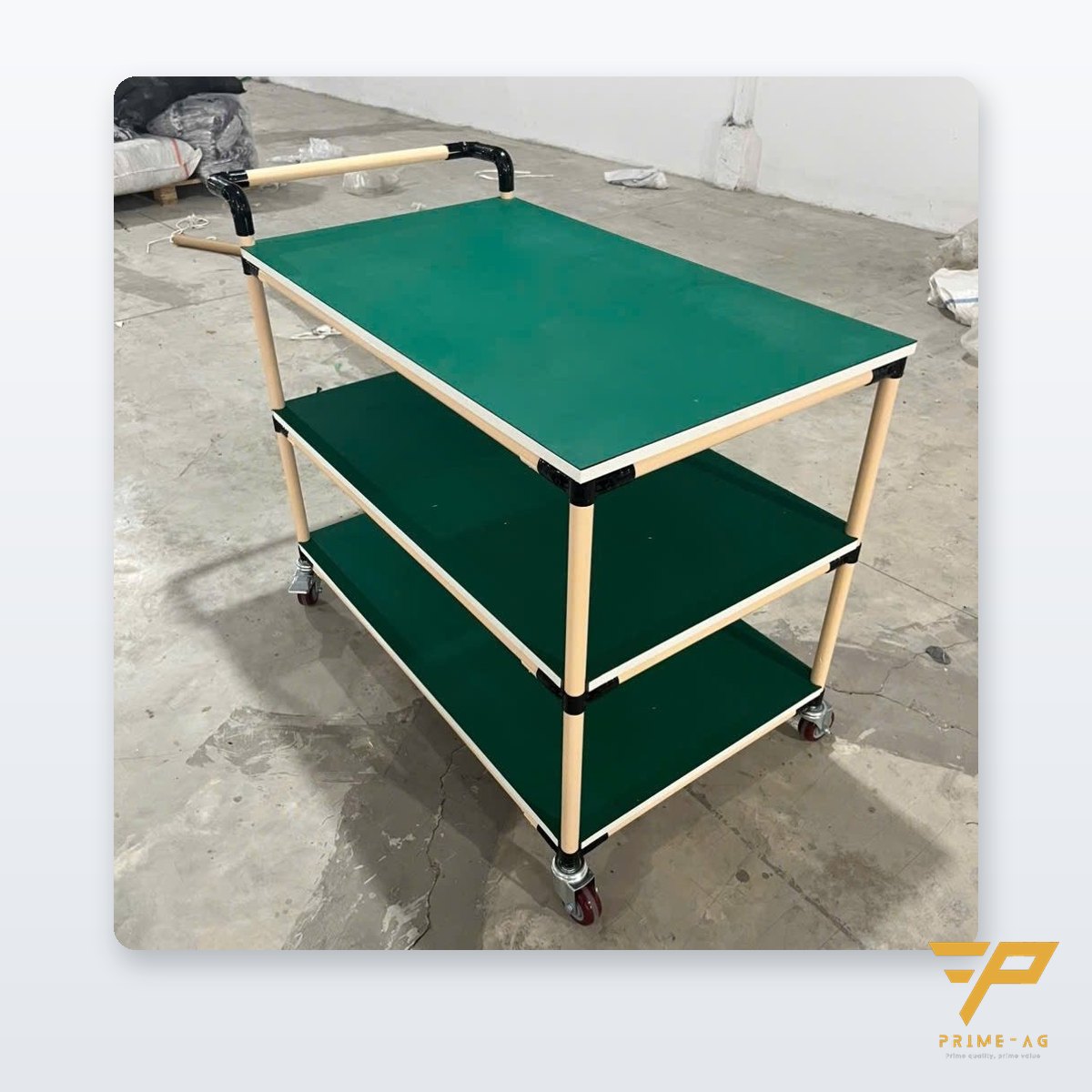
A kitting trolley carries a complete set of components for a fixed quantity of product, prepared in advance in the warehouse and delivered to the line per shift or per hour. Operators do not have to leave their station to fetch parts. PRIMEAG builds kitting trolleys on a lean pipe (plastic-coated steel pipe, Φ28) frame; standard designs are produced in 5–7 working days.
- Kit by quantity: each trolley = components for a set output (for example 2 hours of line running), not “fill it to the top”.
- One compartment per part number: divided danpla box or ESD plastic tray 450×300×60.
- Two trolleys in rotation: one at the line, one in the warehouse being picked.
- Trolley sized to the aisle: for narrow aisles use the small trolley 720×430×1500.


The problem: the line stops for missing parts
When parts are supplied on a “go and get more when it runs out” basis, an operator or team leader leaves the line, searches the warehouse and carries parts back. The line waits. Small parts delivered in whole large bags pile up on the bench and get mixed up. Kitting separates picking from the line: the warehouse picks, the line only assembles.
1. Fix the size of one kit
Size the kit by product quantity, for example enough for 2 hours or half a shift. A kit that is too small means the trolley is constantly on the move. A kit that is too large makes the trolley heavy, takes up space beside the line and brings back excess WIP. Start from the BOM: list each part number and its quantity per product, multiply by the number of products in the kit, then choose a compartment big enough for each part number.
2. One compartment per part number, arranged in assembly order
For loose parts use an ESD plastic tray with dividers; for parts supplied as sets use an ESD danpla box with compartments made to drawing and a 105×70 mm label pocket at the end of the box for the kit card. Arrange compartments in process order, with the first process on the top shelf, so an empty compartment immediately shows that the kit is incomplete.
3. Choose the trolley frame by aisle and load
Aisles of 600–800 mm between stations: small trolley with Φ28 pipe frame, about 18 kg, can be pushed with one hand. Large kits with many bins: multi-tier steel pipe trolley 1500×600×1600. EPA and cleanroom areas: aluminium-frame trolley with ESD shelves and conductive casters. Set the shelf pitch to the tray height plus clearance to slide trays out.
4. Trolley swap procedure
Use at least two trolleys per station: trolley A at the line, trolley B being picked in the warehouse. When trolley A is nearly empty, the material handler brings out trolley B and takes trolley A back. Floor tape marks the parking spots for full and empty trolleys. The kit card shows the model, quantity, shift and picker.
Choosing a kitting trolley
| Situation | Suggested trolley | Notes |
|---|---|---|
| Narrow aisle, small kit | Small trolley 720×430×1500, 4–5 tiers | Shelves can be added on site with a hex key |
| Kit with many bins, large sub-assemblies | Steel pipe trolley 1500×600×1600 | MDF shelves, ESD laminate optional |
| EPA, cleanroom | 30×30 aluminium-frame trolley with ESD shelves | Conductive Φ75 PU casters drain charge to the floor |
| PCBs between SMT processes | PCB magazine racks and PCB trolleys | Boards stand upright without touching |
Reference projects
PRIMEAG has delivered 400 special-purpose trolleys to a US-invested factory in Can Giuoc (2025–2026) and 50 ESD-surface trolleys to an e-bike factory (03/2026).
Checklist before ordering trolleys
- Do you have the BOM and the product quantity per kit?
- Measure the narrowest aisle and the height at the line where the trolley parks.
- List the trays and bins that will go on the trolley (outer dimensions).
- Does the area have ESD requirements?
Standard trolley designs are produced in 5–7 working days; new designs take 10–15 working days including drawing approval. Trolley frames carry a 3-year warranty, casters 12 months. For compartment layout and labeling to prevent mix-ups: divided trays and labels on the assembly line.
Frequently asked questions
How long should one kitting trolley supply the line? Usually sized by the number of products for 1–2 hours or half a shift. Too short and the trolley runs back and forth constantly; too long and it gets heavy and stock piles up beside the line.
How many kitting trolleys does one station need? At least two in rotation: one at the line, one in the warehouse being picked. Lines running several models may need extra trolleys per model.
How does a kitting trolley for an ESD area differ from a standard one? ESD-surfaced shelves, ESD trays and boxes, and conductive casters that drain charge to the ESD floor.
Updated: 21 October 2026 — PRIMEAG engineering team
Mon–Sat, 8:00–17:00 (GMT+7) · Phone/Zalo: +84 906 108 292 · Email: info@primeag.vn
Start where it suits you: Free technical advice · Send a drawing or layout · Get a quote within 30 minutes
Written by the PRIMEAG engineering team
Updated: 2026-10-19