
A sagging medium-duty shelving rack in a Vietnam factory warehouse is usually caused by actual load exceeding the 200–500 kg per level rating, or heavy goods concentrated at mid-span. PRIMEAG recommends unloading, weighing each level again, adding support bars under the boards, switching to moisture-resistant MDF and moving heavy goods to lower levels. If the beam is still bent after fully unloading, replace it.
Is the shelf bending down like this because the rack is weak, or because we overloaded it? Usually it is the way goods are stacked. Sagging medium-duty shelving has a fairly clear inspection order, and most cases can be fixed without scrapping the rack.
- Check first: weigh the actual load on each level.
- Common faults: goods concentrated at mid-span, missing support bars, thin or moisture-damaged boards.
- Quick fix: unload, post load signs, move heavy goods down.
- Replace the beam: when it stays bent after fully unloading.
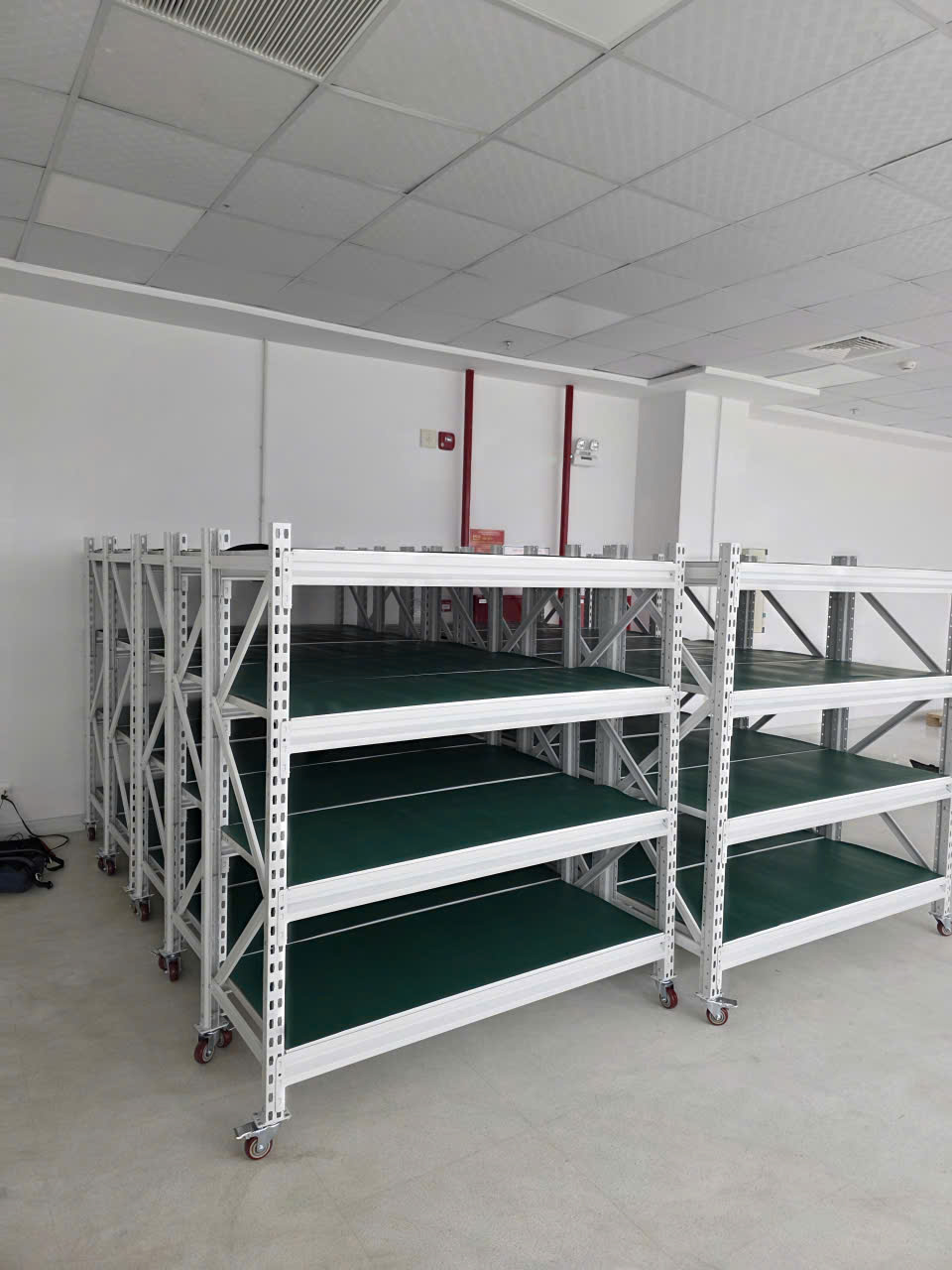
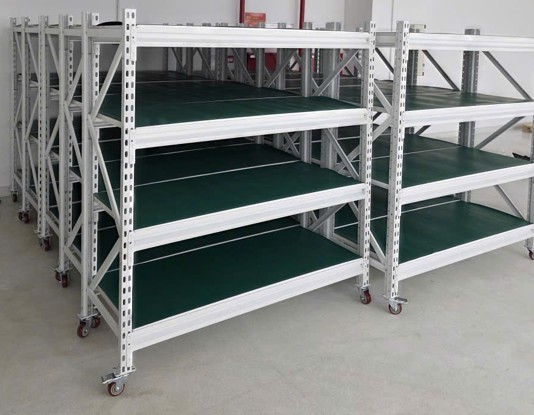
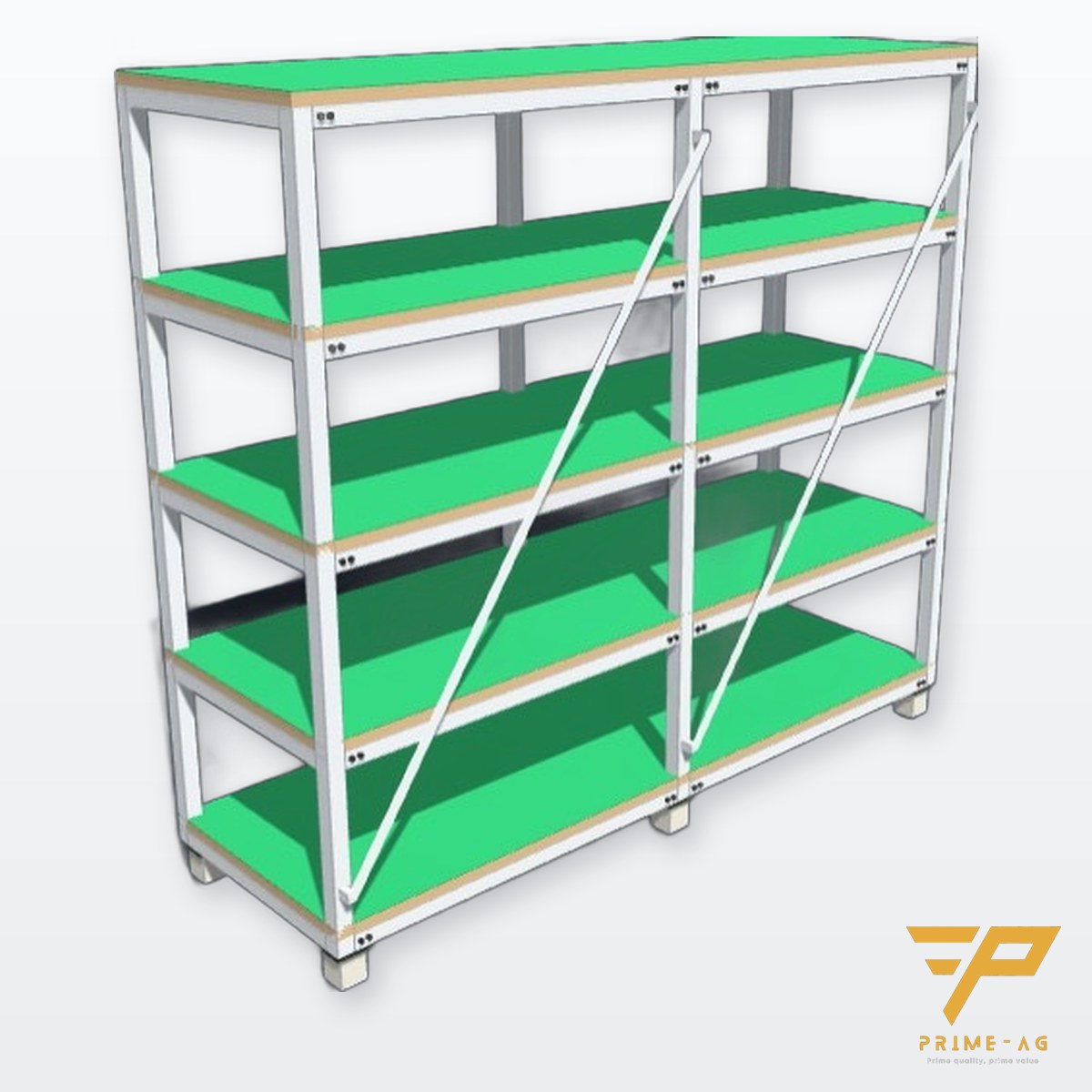
Sagging medium-duty rack: check in this order
1. Actual load vs. rated load
The design rating is 200–500 kg per level depending on beam and board. Figures on the receiving slip usually leave out cartons and trays. Put each carton from one level on an electronic bench scale (30–150 kg) and add them up.
2. Goods concentrated at mid-span
The rated load is a uniformly distributed load. The same weight concentrated at mid-span creates twice the bending moment and about 1.6 times more deflection. Heavy cartons should sit close to the uprights.
3. No support bars under the board
A board resting only on two beams sags first and twists the beams with it. Support bars under the board share the load between both beams.
4. Thin boards or standard boards that absorbed moisture
Brown-core MDF with open edges absorbs moisture, swells and gradually softens. Even a moisture-resistant core is not waterproof; edges must be fully sealed with edge banding.
5. Beam safety locks not fully engaged
A beam missing its locks can rotate or drop at one end; it looks like sagging but is actually a misaligned hook.
6. Sinking feet or floor
One sinking foot tilts the whole bay. Put a spirit level on the bottom level and adjust or re-shim the feet before concluding the beam is damaged.
7. Cart impacts
Dented end-of-aisle uprights or chipped paint at caster height are signs of impact. A dented upright weakens the entire frame.
What to do once a level has sagged
Unload the sagging level and all levels above it, and cordon off the bay. Post load signs showing the maximum for each level and for the whole bay.
Add support bars and replace the deck with pre-cut moisture-resistant MDF boards, 17 or 25 mm thick, CNC cut to ±1 mm with 1 mm PVC edge banding. PRIMEAG calculates the thickness from the support bar spacing on the drawing.
Move the heaviest goods to the lower levels to lower the center of gravity.
Goods beyond medium-duty, such as molds and pallets, should go to heavy-duty racks with 90×60 uprights at about 1,000 kg per level. Prices include delivery and installation; made to order in 2–3 weeks.
Choosing a configuration for a parts store: 250 kg medium-duty racks for spare parts and component stores. For steel pipe racks: plastic-coated steel pipe racks with loose joints, wobbling and sagging shelves.
When to replace the beam
Unload everything and lay a straightedge along the beam. If the beam springs back straight, just reduce the load and redistribute the goods.
If the beam stays bent or the hook welds are cracked, replace it with a beam of the same part number; do not straighten it. PRIMEAG rack frames carry a 3-year warranty.
| Symptom | Common cause | Action |
|---|---|---|
| Sag at mid-span | Concentrated load, no support bars | Spread the goods, add support bars |
| Swollen board edges | Standard board absorbed moisture | Replace with moisture-resistant MDF |
| One beam end lower | Missing locks, misaligned hook | Reseat the beam, fit all locks |
| Whole bay tilting | Sinking feet, uneven floor | Adjust feet, re-shim |
| Beam bent after unloading | Prolonged overload | Replace beam or move to heavy-duty racks |
Inspect your racks within one shift
- Mark the sagging bay and stop adding goods.
- Weigh one level and compare with the load sign.
- Check beam locks, feet and impact marks.
- Unload and recheck beam straightness.
- Send photos, weights and bay dimensions to PRIMEAG.
Send them via the warehouse rack consultation form, and PRIMEAG will quote within 30 minutes. Export processing enterprises (EPEs) ordering from VND 20 million receive a 0% VAT invoice, and PRIMEAG handles the on-the-spot import/export customs declaration free of charge.
Frequently asked questions
- How much weight can a medium-duty shelving rack hold per level? — 200 to 500 kg per level, assuming the load is spread evenly across the deck. Heavier goods should go on heavy-duty racks at about 1,000 kg per level.
- Can a bent rack beam be straightened and reused? — Not recommended. A permanently deformed beam is weaker than originally; replace it with a new beam of the same part number and check the hooks and locks at both ends.
- Will thicker shelf boards stop the sagging? — Only if the board is the weak point. If the beam is already overloaded, a thicker board just adds weight; weigh the load and add support bars first.
Updated: 30 Oct 2026 — PRIMEAG engineering team
Email: info@primeag.vn · Phone/Zalo: +84 906 108 292
Written by the PRIMEAG engineering team
Updated: 2026-10-30