
A stainless steel table in a food processing area meets requirements when three things hold: no spots where water and dirt collect, water drains to the right place, and the material does not corrode from salt and cleaning chemicals. PRIMEAG builds tables with stainless steel 304 frames in 40×40 square tube to the dimensions of the processing area; new designs take 10–15 working days.
- Material: stainless steel 304 for wet and washing areas; consider 316 where there is frequent contact with salt, fish sauce or acids.
- Structure: fully sealed welds ground flush, capped tube ends, no crevices, high clearance underneath for floor cleaning.
- Drainage: raised edge on the top, sloped to one side, drain hole piped down to the floor drain.
- Operation: wipe dry at the end of each shift, no ordinary steel brushes, mix chemicals at the correct concentration.
1. Why stainless tables still get dirty and rust
Most faults are not in the tabletop but in the details. Square tubes cut with open ends let water and grease run inside the tube. Tack welds instead of continuous welds leave a gap between top and frame. Stiffening ribs glued under the top hold moisture and cause odors. Tables placed tight against the wall and floor cannot be cleaned behind or underneath. These are the places where microorganisms survive cleaning, and also where pitting rust starts.
2. Choose the stainless grade for the environment
Stainless steel 304 (about 18 % chromium, 8 % nickel) is the default choice for food prep, washing and packing areas. Stainless 201 is cheaper but stains easily in humid environments or with salt or chlorine-containing chemicals; use it only in dry areas. For areas in constant contact with salt, fish sauce, vinegar or seawater, ask about stainless 316 (contains molybdenum, better chloride resistance). A detailed comparison and how to check the steel grade on receipt are in the article stainless 201 or 304 for food and pharma tables, racks and trolleys.
3. A structure that is easy to clean
- Continuous TIG welds along all joints, ground flush; no rivets or exposed screws on the working surface.
- Tube ends sealed with welded stainless caps or stainless leveling feet; no plastic plugs in wet areas.
- Open underside, with the lower shelf as mesh or bars so water does not pool; leave a gap from the wall for cleaning.
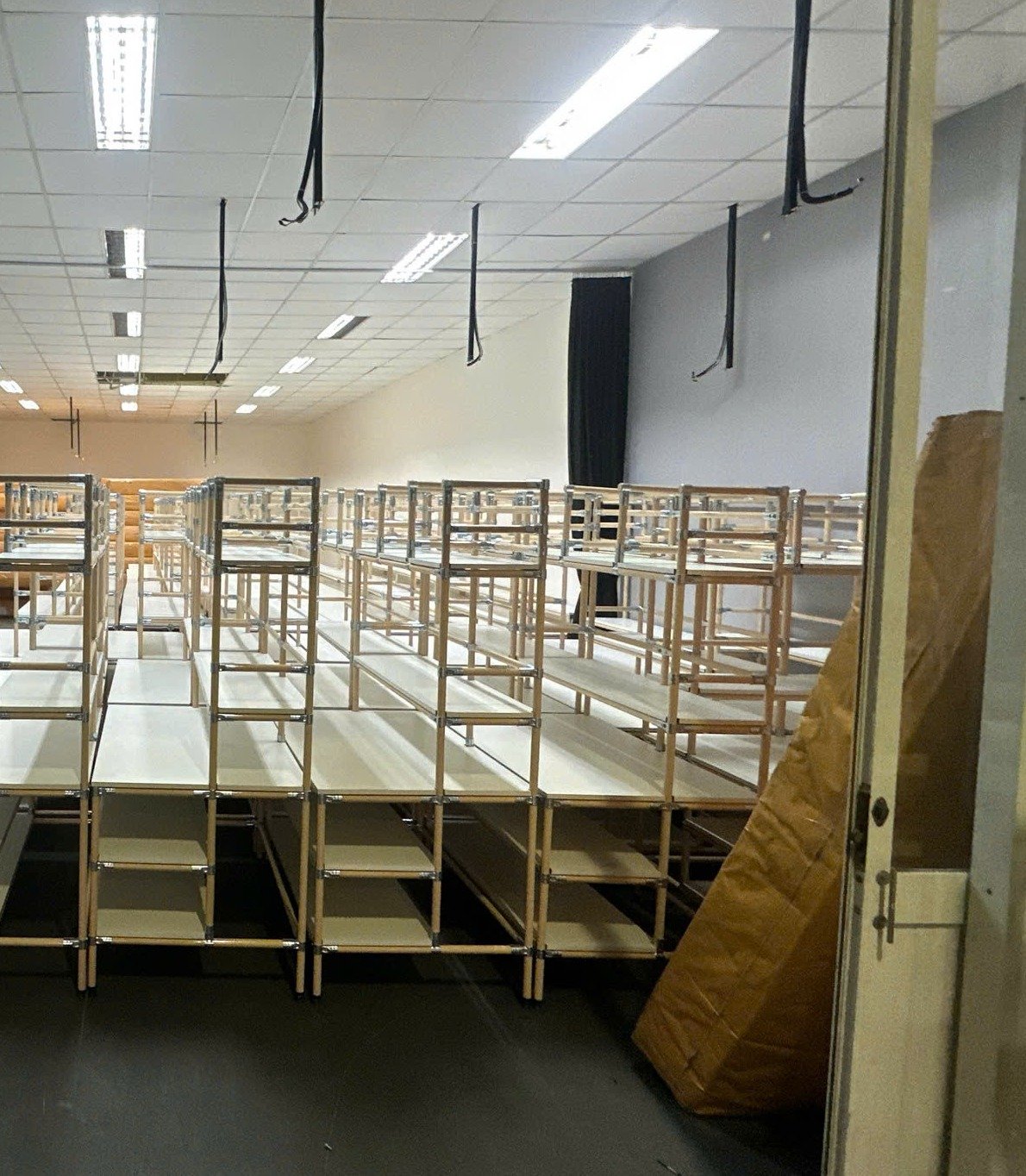
- No wood or MDF tops in wet areas. Laminate-faced MDF tops are only for dry areas such as the QC room or labeling area.
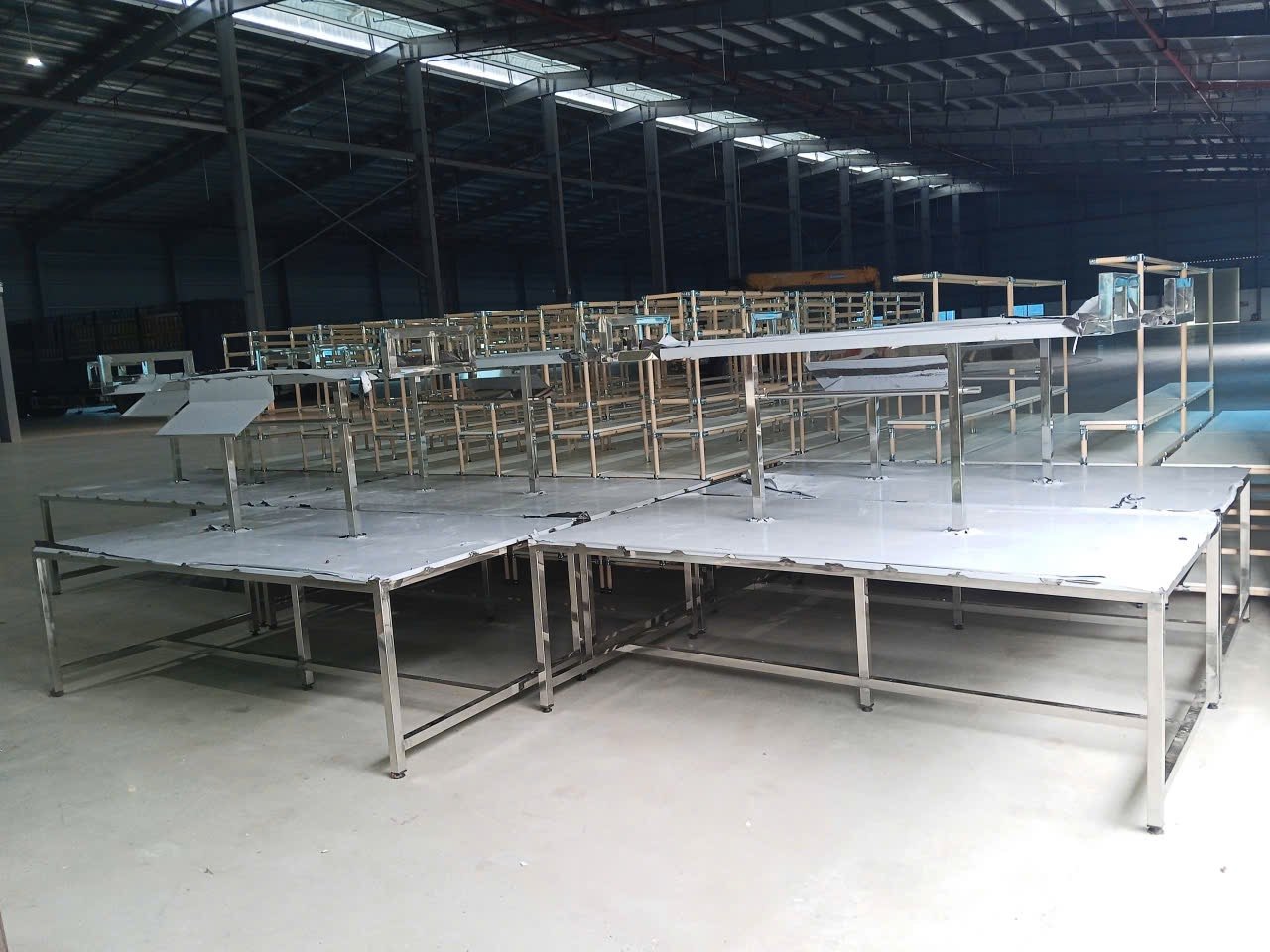
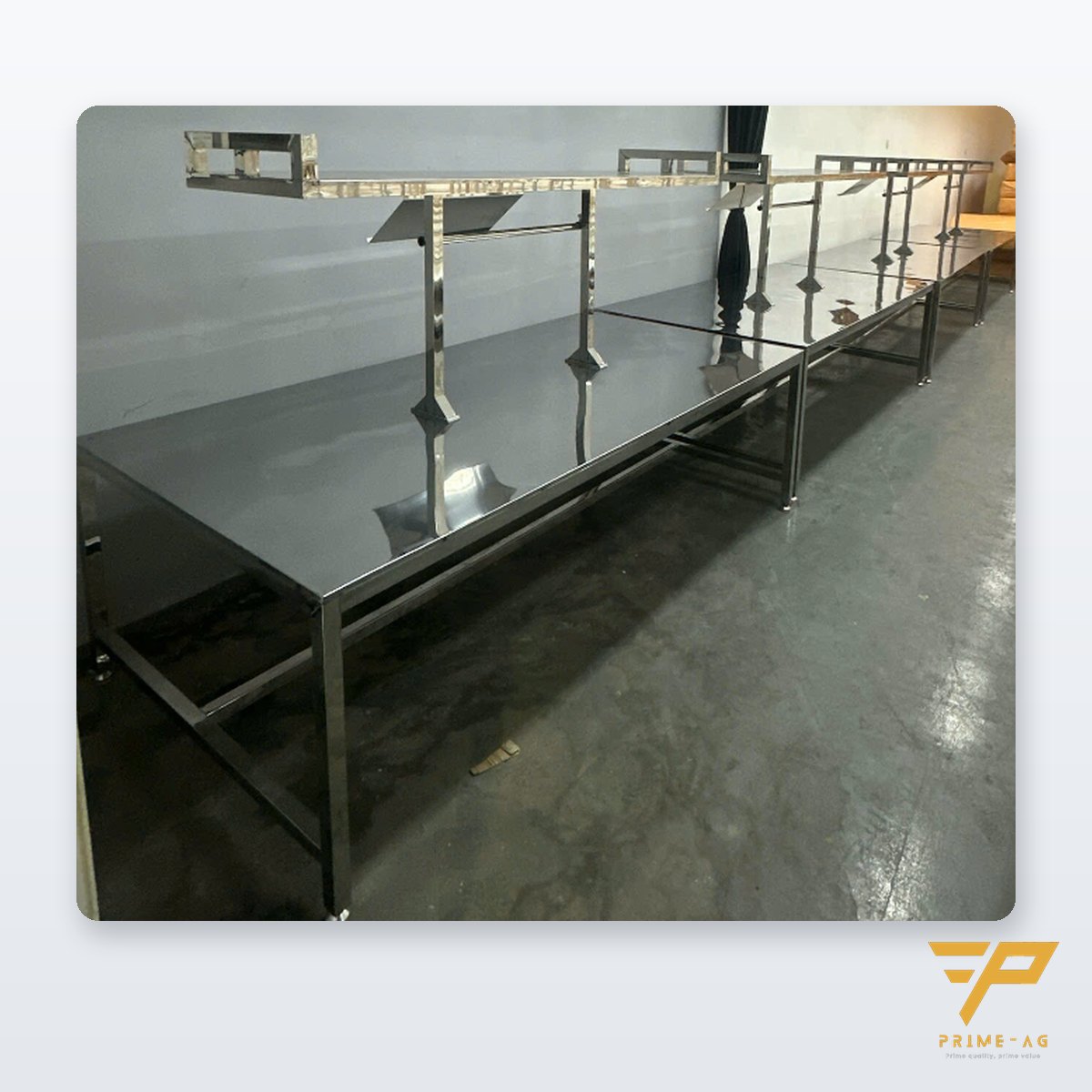
PRIMEAG’s stainless steel 304 frame table uses 40×40 square tube, unpainted, with stainless leveling feet; the top can be stainless sheet for wet areas or moisture-resistant MDF or phenolic for dry areas.
4. Drainage on the tabletop and at floor level
Prep tables that use a lot of water should have a raised edge around the perimeter (folded or welded), with the top sloping slightly to one corner with a drain hole piped to the floor drain. For tables with a sink, place the sink on the side nearest the drain, with a splashback at the rear. Tables used only for dry work (weighing, packing) keep a flat top without a drain hole. For baskets and containers holding raw materials, use industrial plastic bins with perforated drainage bottoms so they drain before being placed on the table.
Choosing the table configuration by area
| Area | Tabletop | Frame, accessories |
|---|---|---|
| Prep, washing raw materials | Stainless 304 sheet, raised edge, drain hole or sink | Sealed-weld 304 frame, mesh lower shelf |
| Contact with salt, fish sauce, acids | Stainless 316 (on request) | 304 or 316 frame, wipe dry at end of shift |
| Packing, weighing, labeling (dry) | Flat stainless 304 or laminate-faced moisture-resistant MDF | 304 frame, optional upper shelf and lamp |
| QC room, sampling | Phenolic or laminate | wall-mounted stainless steel 304 frame table |
| Moving raw materials | — | stainless steel 304 racks/trolleys, casters with stainless steel 304 forks |
Reference projects
PRIMEAG has produced large 1200×2400 stainless tables for two logistics operations: 4 stainless steel 304 tables at a Singapore-invested e-commerce transit warehouse in Ho Chi Minh City (09/2026) and 5 stainless tables at a Chinese-invested logistics center in Phu Tho (07/2026).
Check the stainless tables you are using
- Look at the tube ends and underside: are there open tubes, crevices, glued ribs?
- Pour a jug of water on the top: does it run to the drain hole or pool in the middle?
- Look for brown stains around welds and legs: test the stainless grade or ask for the material CO/CQ.
- Check the cleaning tools: are ordinary steel brushes or steel wool used (they cause iron contamination and pitting rust)?
- Check that staff washing the tables wear a waterproof PVC apron and mix chemicals at the correct concentration.
Stainless table frames carry a 3-year warranty; accessories (casters, lamps, power sockets) carry a 12-month warranty. Standard designs are produced in 5–7 working days; orders of more than 20 tables take 2–3 weeks.
Frequently asked questions
Can stainless 201 tables be used in food processing areas? Only in dry areas. Wet areas, or areas with salt or chlorine-containing cleaning chemicals, should use stainless 304 to limit staining and pitting rust.
Does a stainless tabletop need a slope and a drain hole? Yes for prep and washing tables that use a lot of water: a raised edge around the perimeter, sloping slightly to a drain hole piped to the floor drain. Dry packing and weighing tables keep a flat top.
How long does a custom-size stainless 304 table take? New designs take 10–15 working days, including drawing approval; standard designs 5–7 working days; orders of more than 20 tables 2–3 weeks. Frames carry a 3-year warranty.
Updated: 25/10/2026 — PRIMEAG engineering team
Mon–Sat, 8:00–17:00 (GMT+7) · Phone/Zalo: +84 906 108 292 · Email: info@primeag.vn
Start where it suits you: Free technical advice · Send a drawing or layout · Get a quote within 30 minutes
Written by the PRIMEAG engineering team
Updated: 2026-10-19