
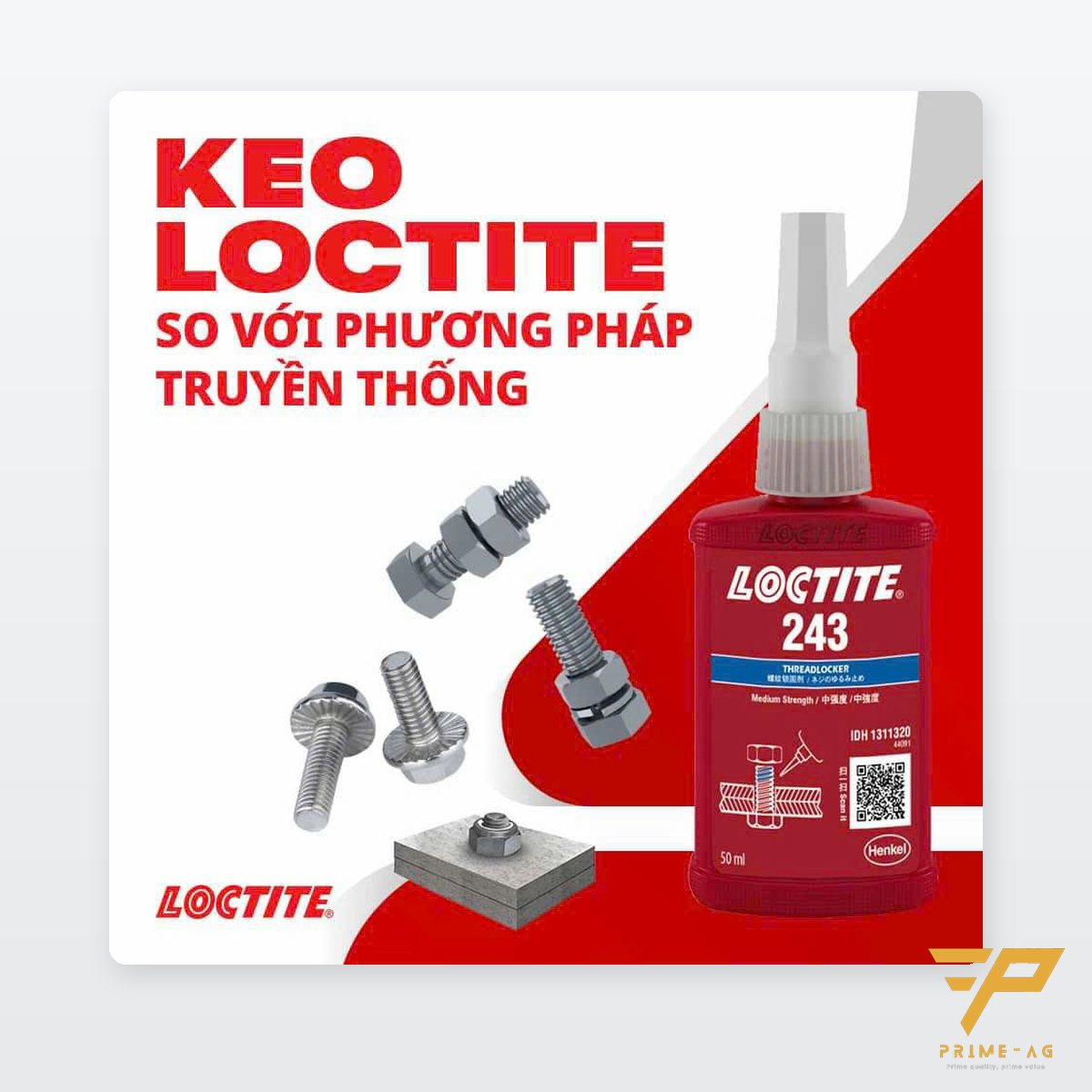
Bolts and screws loosen on vibrating machines because the threads still have clearance that lets the bolt slip sideways; split washers only slow this down. For maintenance teams at factories in Vietnam, PRIMEAG recommends filling the thread gap with Loctite threadlocker, choosing the grade by locking strength, thread size and temperature, e.g. 243 for M6–M20 threads operating up to 180 °C.
- Not sure what to pick: 243, medium strength, M6–M20, tolerates light oil.
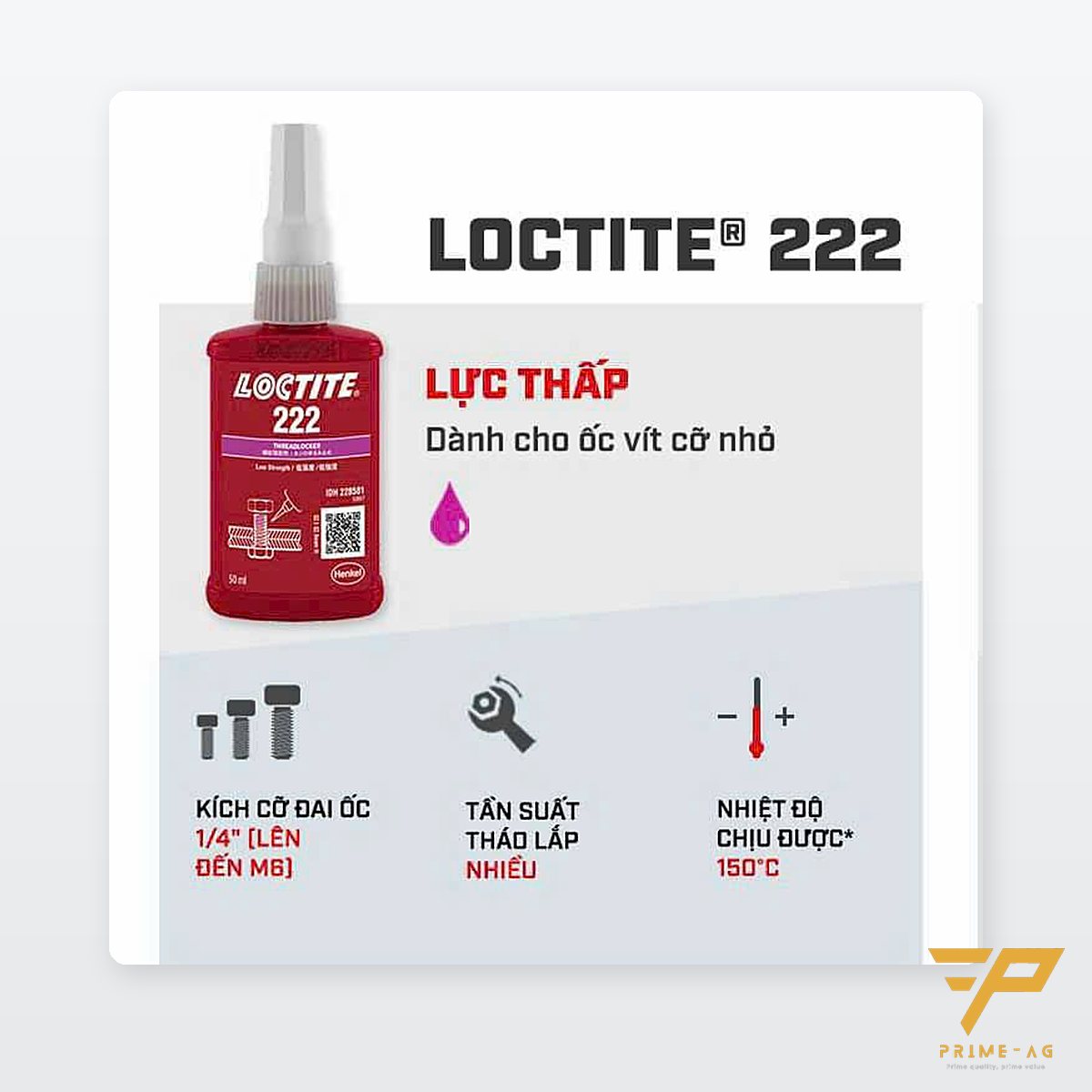
- Small screws, set screws: 222 low strength; permanent assemblies use 263, large M20–M36 threads use 277.
- Screws already installed and loose: 290 applied after assembly; the thin liquid wicks into the threads by itself.
- Application: clean the threads, use primer 7649 on stainless steel and plated surfaces; allow 24 hours for full strength.

Why split washers and lock nuts are not enough
According to Henkel, when a bolt is tightened only about 15 % of the thread surface has metal-to-metal contact; the rest is clearance. Under transverse vibration the bolt slides within that clearance and gradually loses clamp load. Junker transverse vibration tests show that split washers and nylon-insert nuts only slow down loosening. Threadlocker fills the thread gap and so stops the sliding.
Anaerobic mechanism: where the adhesive cures
Loctite threadlockers are one-component acrylic adhesives that cure anaerobically. In the bottle, with air present, the adhesive stays liquid. When trapped in the thread gap, without oxygen and in contact with metal ions, it cures into a thermoset plastic.
On steel and copper it cures quickly; on stainless steel, plated steel and anodised aluminium it cures more slowly. At 5 °C, 263 reaches only about 80 % of its strength after 72 hours.
Selection table by strength, thread size and temperature
| Grade | Colour | Strength | Thread size | Max. temperature | Use when |
|---|---|---|---|---|---|
| 222 | Purple | Low | ≤ M6 | 150 °C | Adjustment screws, small screws, soft metals |
| 243 | Blue | Medium | M6–M20 | 180 °C | General purpose, lightly oiled threads |
| 263 | Red | High | ≤ M25 | 180 °C | Permanent assemblies, oil-resistant |
| 277 | Red | High | M20–M36 | 150 °C | Large bolts, high viscosity |
| 290 | Green | Medium–high | M2–M12 | 150 °C | Applied after assembly to screws that have loosened |
Breakaway torque per the LOCTITE 2025 catalogue (M10 steel bolt, ISO 10964): 222 about 6 N·m, 243 about 26 N·m, 263 about 33 N·m. Above 180 °C, choose 272. The full range is on the Loctite threadlocker page; for retaining bearings on shafts, use Loctite retaining compounds for shafts and bearings.
Correct application procedure
- Clean the threads with a cleaner and let them dry.
- Stainless steel, plated surfaces: spray primer SF 7649 before applying 222, 277, 290. 243 and 263 do not require primer, unless the workshop is cold or the gap is wide.
- Shake the bottle; keep the nozzle tip from touching metal so the adhesive does not cure in the nozzle.
- Through holes: apply a few drops to the bolt where it engages the nut. Blind holes: apply into the bottom 1/3 of the internal thread so trapped air does not push the adhesive out.
- Tighten to the correct torque and wait for the adhesive to fixture before running the machine.
222, 243, 263, 290 fluoresce under UV light so QC can check which bolts have been treated. Checking tightening torque: see checking incorrect screw torque with a torque tester.
Disassembling threadlocked joints
222 and 243 can be removed with ordinary spanners and sockets. 263 and 290 require local heating to about 250 °C and removal while still hot. Do not use 263 on bolts that must be opened at every maintenance interval.
For hot threaded joints that must be disassembled later, such as exhaust pipes and furnace flanges, use Loctite anti-seize.
What to note before choosing a grade
Note the thread size, bolt material, operating temperature and whether the joint must be disassembled during maintenance.
Henkel, CO per batch, 2-year shelf life. Loctite is supplied to order; the lead time is stated with the quotation. Store at 8–21 °C, together with the primer, in a 5S tool cabinet for the maintenance team.
Frequently asked questions
Which Loctite threadlocker should I use if I’m not sure? Start with 243: medium strength, M6–M20 threads, up to 180 °C and tolerant of light oil. It can still be removed with hand tools during maintenance.
How long does Loctite threadlocker take to cure? Handling strength after about 10–25 minutes at room temperature and full strength after 24 hours. On stainless steel and plated surfaces, grades 222, 277, 290 should be used with primer 7649; 243 and 263 still cure without primer.
How do I remove a bolt locked with Loctite 263? Heat the threaded joint to about 250 °C and remove it immediately, or use a high-torque tool.
Need codes for thread sealing, gasketing, retaining or anti-seize: Download LOCTITE catalogue 2025 (PDF, Japanese, 4.7 MB).
Updated: 21/10/2026 — PRIMEAG engineering teamMon–Sat, 8:00–17:00 (GMT+7) · Phone/Zalo: +84 906 108 292 · Email: info@primeag.vn
Start where it suits you: Free technical advice · Send a drawing or layout · Get a quote within 30 minutes
Written by the PRIMEAG engineering team
Updated: 2026-10-21