
Lithium battery and UAV assembly lines carry two risks at the same bench: static discharge damaging BMS boards and flight controllers, and shorted terminals causing fire. PRIMEAG designs assembly benches on 2 principles: a grounded dissipative surface of 10⁶–10⁹ Ω, and no bare conductive objects touching battery terminals.
- Metal frame, no welding: lean pipe (plastic-coated steel pipe, Φ28) or aluminum profile, easy to re-layout when the pack model changes.
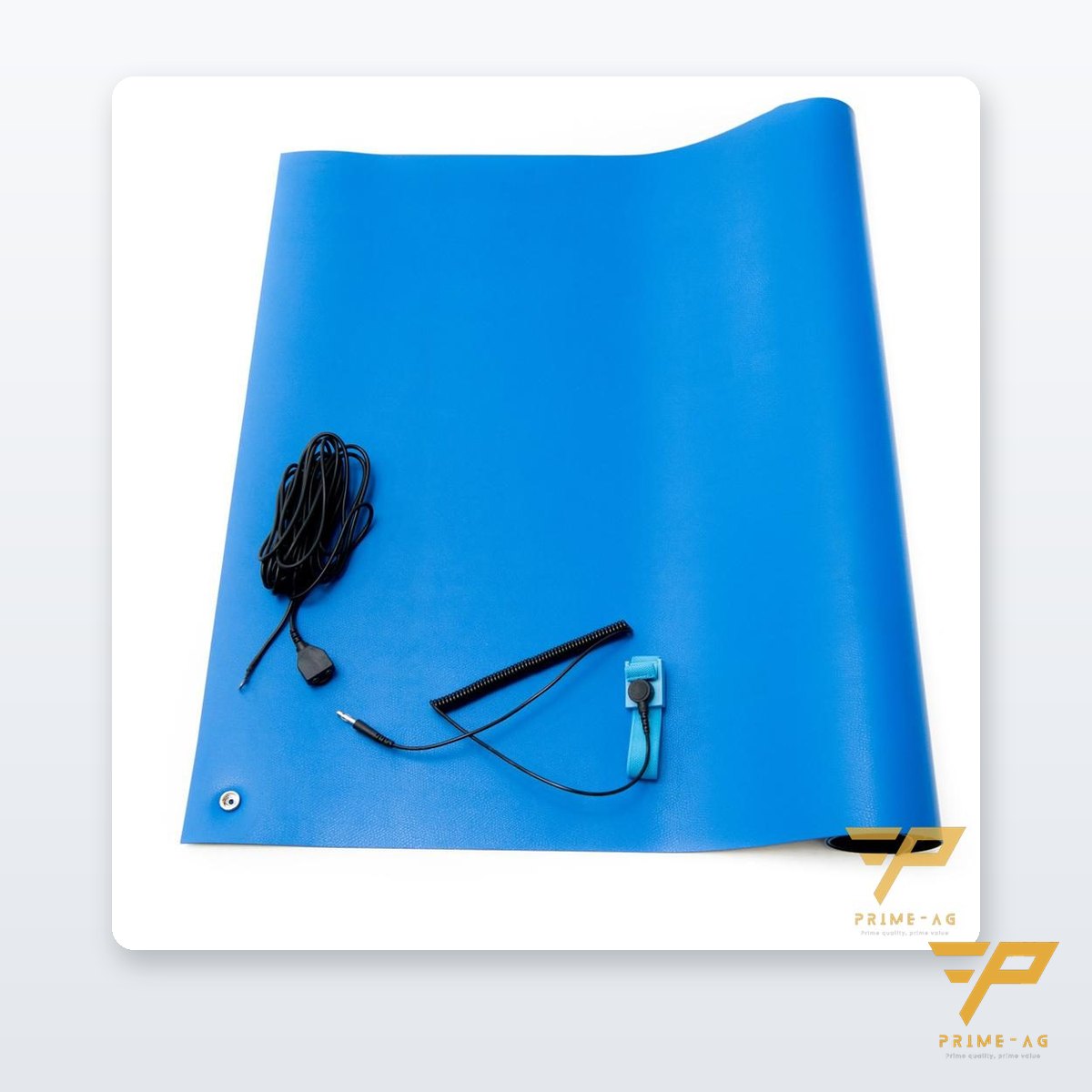
- Dissipative, not highly conductive, work surface: 2-layer ESD rubber mat at 10⁶–10⁹ Ω, enough to drain static but without shorting terminals.
- Terminal insulation: Kapton tape, terminal caps, insulated tools; remove metal jewelry.
- Quarantine area: swollen, dropped or abnormally hot batteries go into a metal tray at a separate location, away from combustibles.
1. ESD control: why a dissipative surface is the right choice
BMS boards, flight controllers, ESCs and GPS modules are all static-sensitive and must be handled in an EPA per ANSI/ESD S20.20 or IEC 61340-5-1. But lithium batteries have high voltage and short-circuit current, so the work surface must not be as conductive as bare metal. A 2-layer anti-static rubber mat (dissipative top layer 10⁶–10⁹ Ω, conductive bottom layer) meets both needs: it drains static slowly and does not create a short path between terminals. Every operator wears an anti-static wrist strap with a 1 MΩ safety resistor in the cord.
2. Frame and work surface
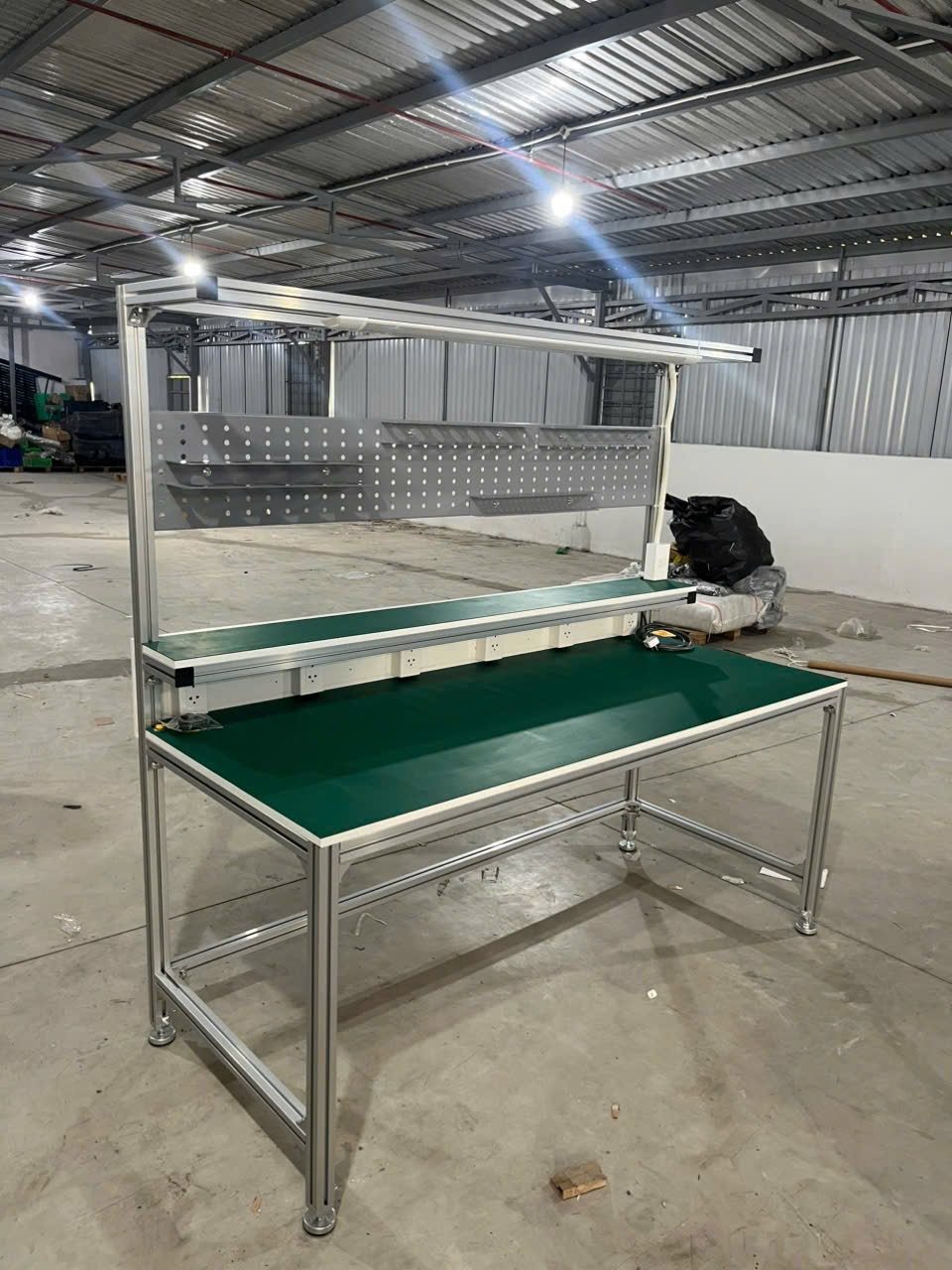
- Frame: the 40×40 aluminum profile workbench is rigid and suits cell welding and pack testing stations; the lean pipe Φ28 bench is flexible for UAV assembly lines or frequent model changes.
- Work surface: moisture-resistant MDF covered with an ESD mat is the most common. Charging, discharging and aging-test stations should use metal tops and shelves covered with mats, or be moved to separate, spaced racks, to reduce combustible material around energized batteries.
- Power: outlets on the shelf, cables tidy, never running across the work surface.
3. Reducing short-circuit and fire risk at the station
- Cover terminals and loose leads with Kapton heat-resistant tape during assembly; remove it only when making connections.
- Use insulated tools (pliers, screwdrivers with insulated handles); never place metal tools on a pack.
- Remove rings and metal watches when handling packs.
- Do not pile batteries or loose cells on the bench; store them in anti-static plastic trays with dividers, one cell per compartment.
- Set up a quarantine area for faulty batteries: metal tray, dry sand or materials recommended by the fire safety authority, away from combustibles, with signage.
Firefighting plans, extinguisher types and battery storage rules must follow the advice of the fire safety authority and current regulations; PRIMEAG supplies the benches, racks, ESD supplies and station layout.
Quick comparison of station configurations
| Station | Frame / work surface | Key points |
|---|---|---|
| BMS board and UAV controller assembly | Aluminum profile or steel pipe, 2-layer ESD mat | Wrist straps, bench grounding, ESD trays |
| Cell welding and pack assembly | Rigid aluminum profile, ESD mat, upper shelf for tools | Terminal insulation, solder fume extraction, few batteries on hand |
| Charging, aging test | Separate metal rack, spacing between packs | Separated from assembly area, temperature monitoring |
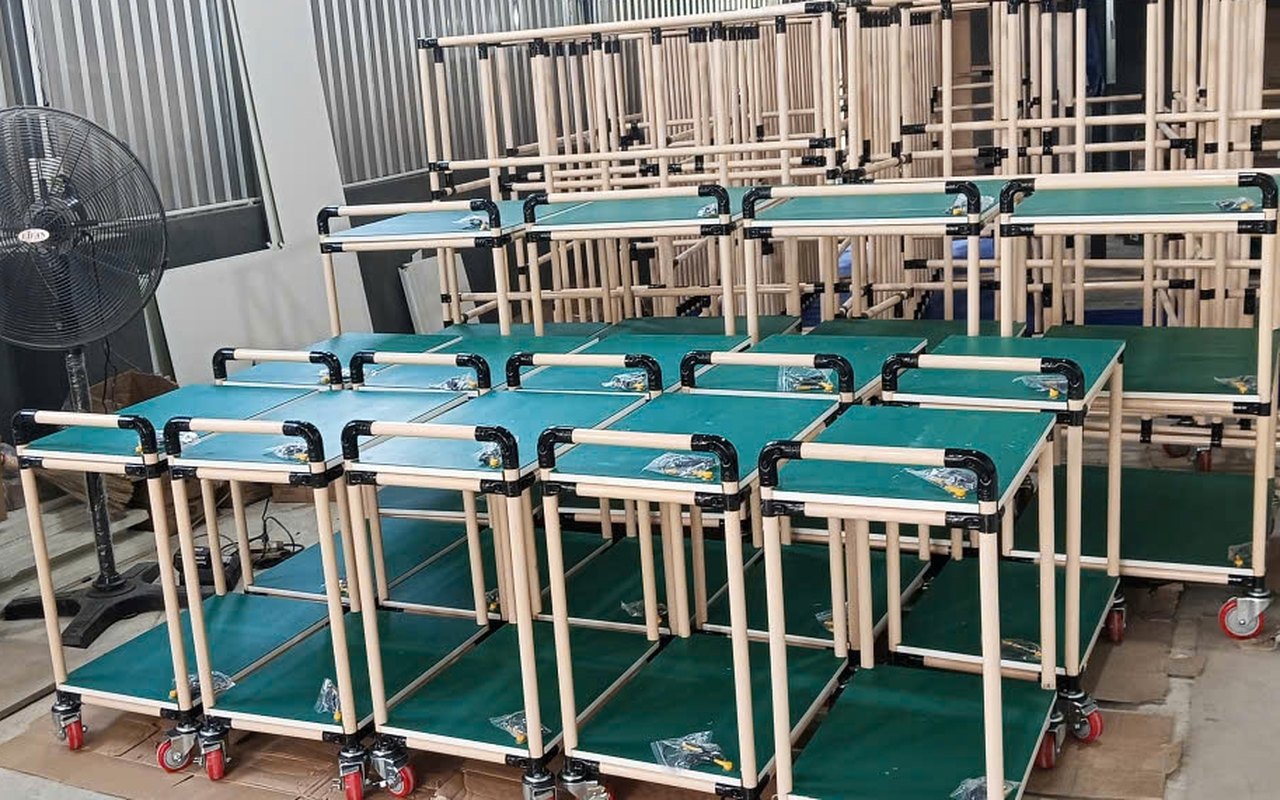
| Moving packs between stations | Multi-tier steel pipe trolley with ESD surface | Do not stack packs in contact with each other |
Related project
In 03/2026, PRIMEAG supplied 50 ESD-surface trolleys to an e-bike factory. For setting up an EPA for an assembly line, see setting up an EPA for SMT lines.
Self-check your current stations
- Is the work surface grounded and does it measure within 10⁶–10⁹ Ω?
- Are there bare metal tools, rings or watches at the pack assembly station?
- Is the quantity of batteries at the station more than a few hours’ requirement?
- Is there a quarantine area for faulty batteries and a person in charge?
New-design benches to your line layout: 10–15 working days (including drawing approval). Warranty 3 years on the frame, 12 months on the ESD work surface and power outlets.
Frequently asked questions
Should a bare metal top be used for lithium battery assembly? Not for the assembly area. Bare metal can short the terminals; use a grounded 2-layer ESD mat, dissipative at 10⁶–10⁹ Ω. Metal is more suitable for charging racks and the faulty-battery quarantine area.
Does UAV assembly need an EPA like an electronics factory? Yes, for operations that touch control boards, BMS, ESCs and sensor modules. At minimum you need grounded ESD-surface benches, wrist straps, ESD containers and a wrist strap check at the start of each shift.
How long does it take to build battery assembly benches to a custom layout? New-design benches take 10–15 working days including drawing approval; standard designs 5–7 working days; orders of more than 20 benches about 2–3 weeks.
Updated: 18/10/2026 — PRIMEAG engineering team
Mon–Sat, 8:00–17:00 (GMT+7) · Phone/Zalo: +84 906 108 292 · Email: info@primeag.vn
Start where it suits you: Free technical advice · Send a drawing or layout · Get a quote within 30 minutes
Written by the PRIMEAG engineering team
Updated: 2026-10-19