
Warped or marked injection-molded parts are usually caused by stacking them while the core is still hot. Lay them out in a single layer on open multi-tier racks, support them on shaped trays, record the time each batch leaves the mold and pack only after the full waiting time. For plastics plants in Vietnam, PRIMEAG builds Φ28 flow racks and carts rated 100 kg per level.
Parts leave the mold in tolerance, yet by the packing station faces have warped, ribs have printed into the part below and thin rims have deformed against the carton edge. Adjusting the molding machine does not cure it, because the defect arises between the discharge chute and the finished-goods carton, a zone that often has no owner.
- The skin hardens first; the core is still soft and keeps shrinking.
- Check in order: stacking load, support surface, airflow, heat sources, packing time.
- The cooling zone needs open racks, carts with time tags, first in, first out.
- Set the waiting time separately for each part number.

Why parts deform after leaving the mold
At ejection only the outer skin is rigid enough. The core in thick ribs and screw bosses is still hot and keeps shrinking. If the part is loaded, supported unevenly or cooled unevenly on its two faces at this point, it sets in the wrong shape and does not recover.
Check the causes in order
1. Stacking or piling right after the machine
Marks and dents are concentrated in the bottom layer; the top layer looks fine.
2. Support surface does not match the part shape
Placed on wire grids, carton edges or directly on rack pipes, the part sags between support points.
3. No air circulation
Parts in the middle of a pile or in a solid-walled bin cool more slowly than those at the edge; a face lying on a flat sheet cools differently from an exposed face.
4. Placed close to a heat source
The waiting area is next to the molding machine, the resin dryer or in a stream of hot air.
5. Packing before the waiting time is up
The time out of the mold is not recorded and parts are packed in a rush at the end of the shift; defects rise around shift change.
If all five points are ruled out and parts are still warped the moment they leave the mold, pass it to the molding engineers to check the mold and cooling parameters.
| Symptom | Likely cause | Fix in the cooling zone |
|---|---|---|
| Marks on the bottom layer | Loaded while still hot | Single layer, no stacking until cool |
| Warp repeating at the spacing of support bars | Wrong support surface | Shaped tray or support plate |
| Bowing to one side | Uneven cooling on the two faces | Open rack, clearance between levels |
| Defects rise at end of shift | Packed too early | Mold-out time tag, waiting rule |
Laying out the cooling zone
Open multi-tier racks. A Φ28 pipe frame with bolted joints, with trays on each level so parts do not touch the pipes. For a continuous flow, a plastic-coated steel pipe gravity flow rack (3–5 feed levels, 1 empty-return level, 100 kg per level) is loaded from the machine side and unloaded from the packing side, so trays go first in, first out.
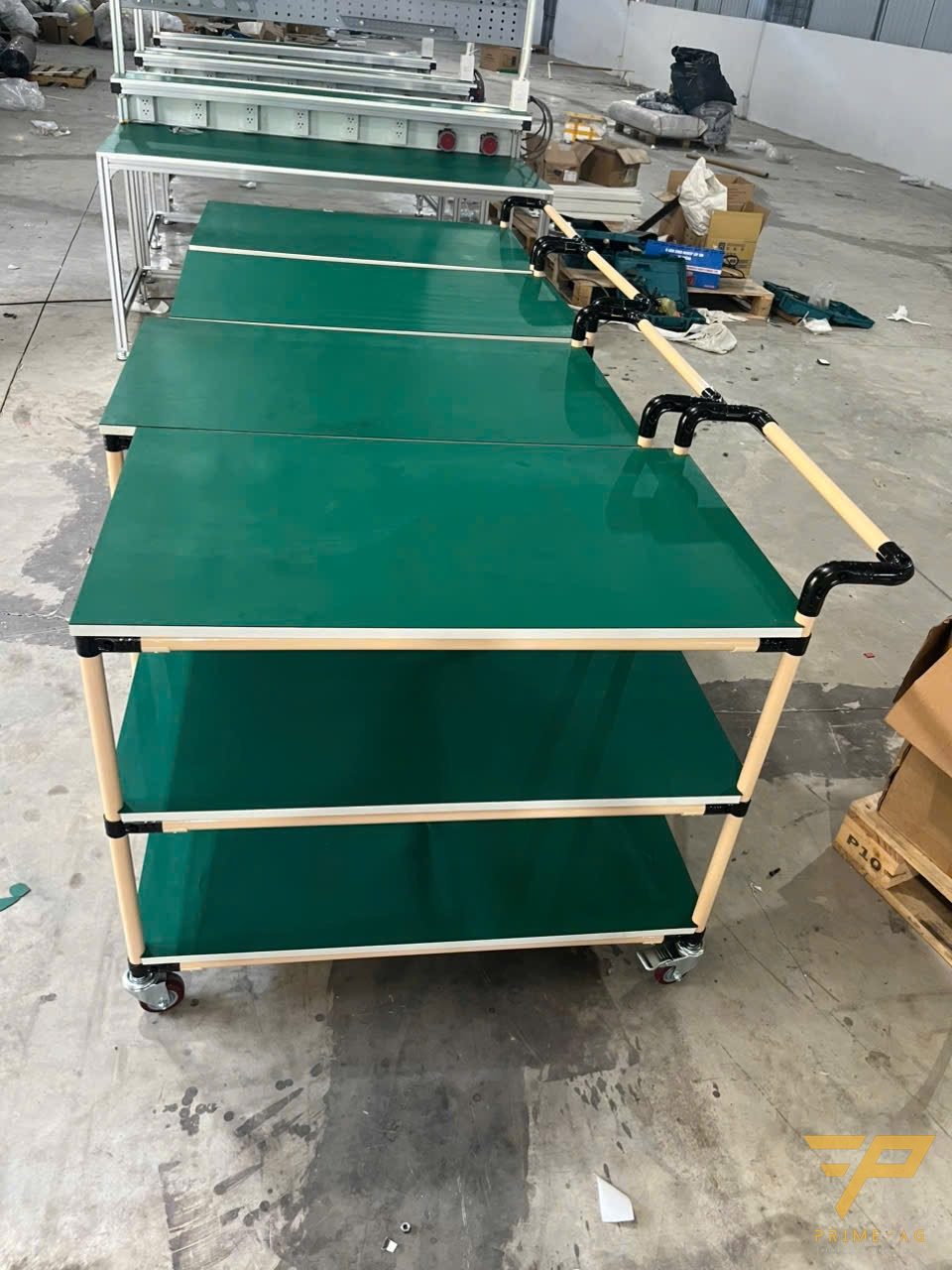
Cooling carts with time tags. A multi-tier plastic-coated steel pipe cart (2–5 levels, 100 kg per level) parks in a ventilated waiting area near the machine, away from hot air and resin dryers, with a tag on each level showing part number, shift and mold-out time; packers only take carts that have completed the waiting time.
Shaped support trays. Thin, long or large flat parts need a support plate following their profile; send a sample through the drawing submission page for advice.
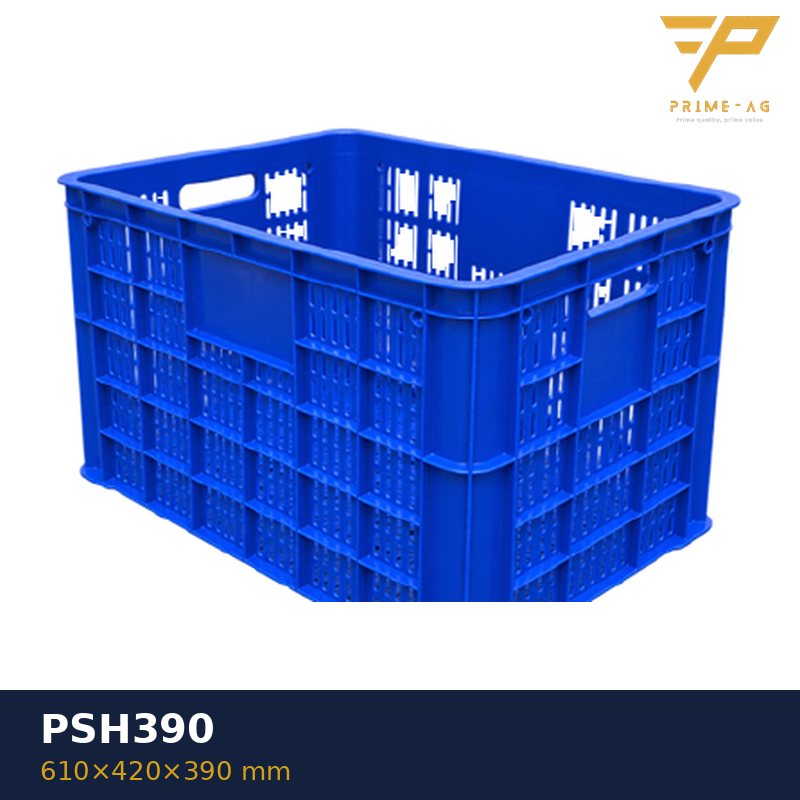
Ventilated bins. If parts must be grouped, choose an open-mesh bin from the virgin PP industrial plastic bin range, e.g. size 610×420×390 mm, in a single layer or with dividers.
Waiting-time rule before packing
Each resin and each wall thickness needs its own waiting time. For each part number: take samples at several points in time after molding, measure the surface temperature with an infrared thermometer, trial-pack, and check dimensions once they have stabilized. The earliest time point that still passes is the waiting time; write it into the work instruction. Put an inspection bench at the end of the cooling zone, for example the Φ28 plastic-coated steel pipe workbench 800×600 mm, 750 mm top height, 150 kg capacity.
When to replace trays and racks
- Warped or cracked support trays: the parts will warp with them.
- Sagging shelves, or slipped joints that tilt a level.
Where to start
- Count deformation defects by hour over 3 shifts to find the peak.
- Trial the waiting time for the part number with the most defects.
- Set up one rack or cooling cart for that machine, run it for a week, then roll it out.
Standard-model racks, carts and benches are produced in 5–7 working days; new designs in 10–15 working days; frames carry a 3-year warranty. Scratches during packing are a different issue, see glossy plastic housings scratched or marked during packing; for the step after the machine there is also laying out a deflashing and visual inspection station.
Frequently asked questions
Can a molded part that has already warped after cooling be straightened? Usually not reliably. Prevent it in the cooling zone and reject parts that are out of tolerance.
Is it OK to put freshly molded parts directly on the rack pipes? No. Round pipes only support along a line, and the still-soft part sags between two pipes; place it on a tray.
How long should injection-molded parts cool before packing? It depends on the resin, wall thickness and workshop temperature; set it by testing for each part number.
Updated: 31 Oct 2026 — PRIMEAG engineering team
Email: info@primeag.vn · Phone/Zalo: +84 906 108 292
Written by the PRIMEAG engineering team
Updated: 2026-10-31