
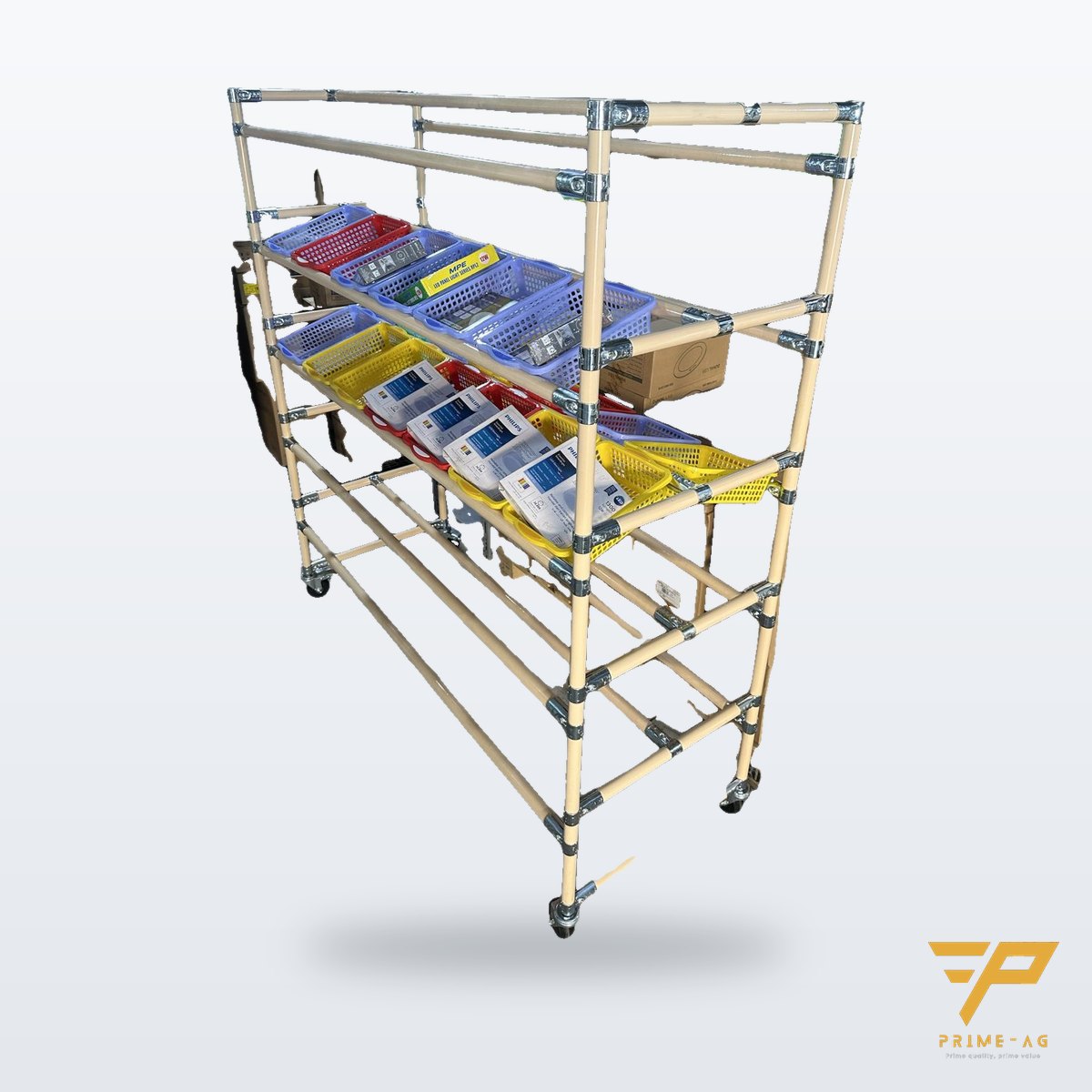
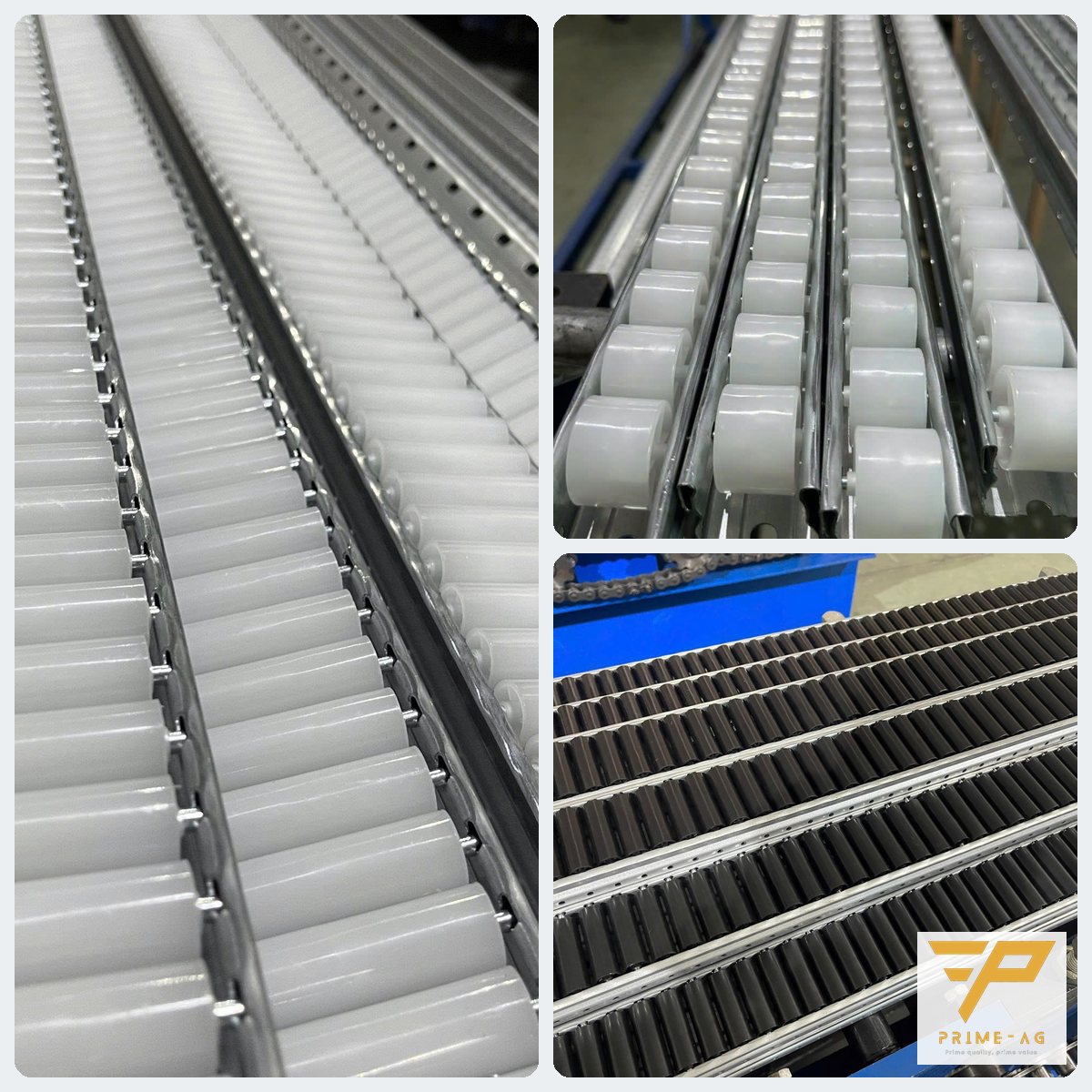
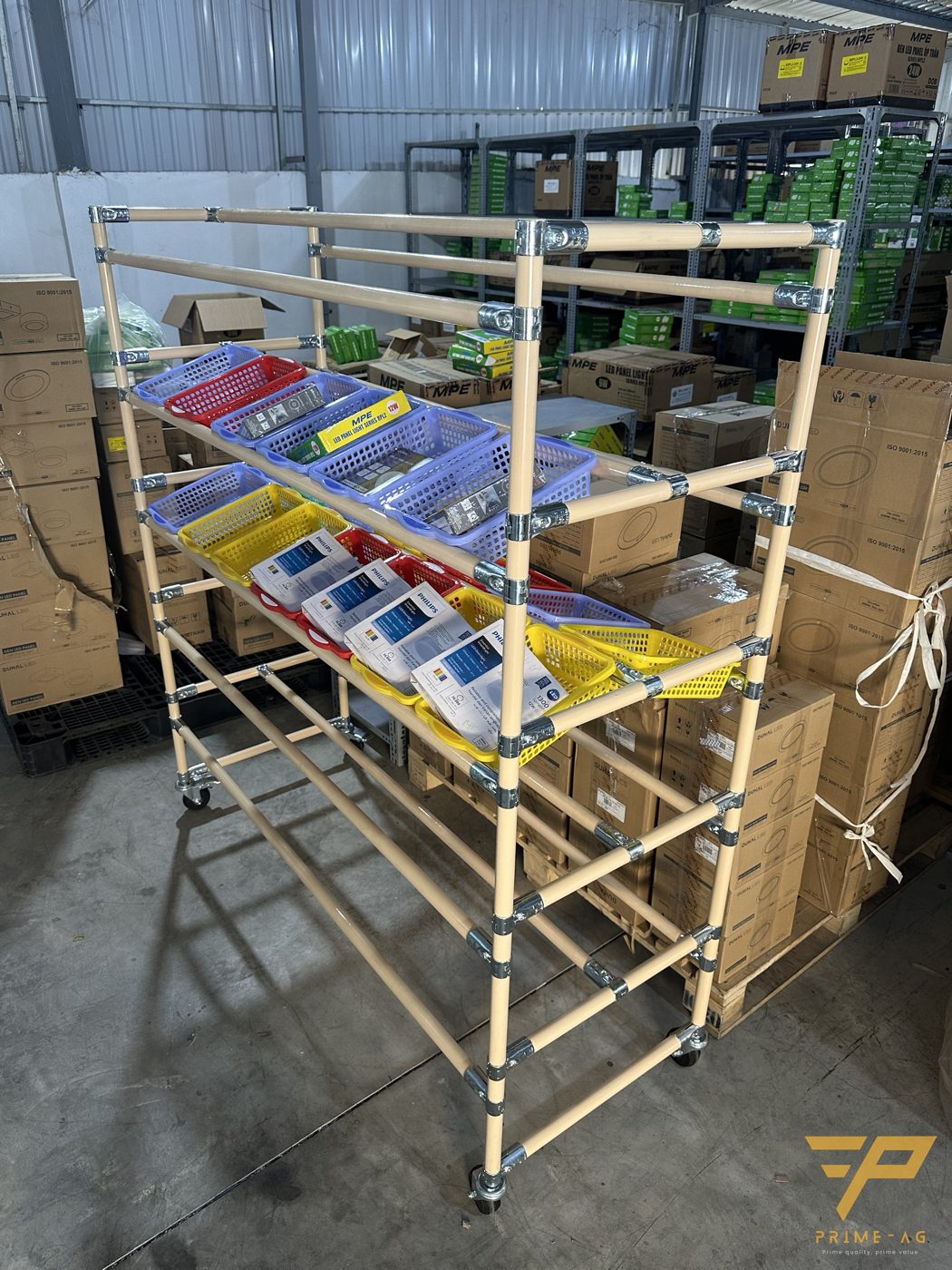
A FIFO flow rack ensures parts that arrive first are used first; operators do not leave the station to fetch parts, and material handlers load from the back without stepping into the line. PRIMEAG flow racks use a lean pipe frame (plastic-coated steel pipe, Φ28) with roller tracks inclined at 5–8°, and the number of tiers and the slope can be readjusted on site when bins change.
- Principle: load from the back, bins slide toward the operator by themselves, empty bins return on the bottom tier.
- Number of lanes: one lane per part number; high-usage part numbers can have 2 lanes.
- Bins per lane: enough for one replenishment cycle + 1 safety bin.
- Slope: 5–8°, adjusted to bin weight; light bins need a steeper slope.
What problem a flow rack solves
On assembly lines, component bins are often kept under the bench or on flat shelves. The result: new bins are placed on top of old ones (old parts stay behind and expire), operators bend down to pick parts, and material handlers have to squeeze into the work area. A gravity flow rack separates the two flows: material handlers load from the rear aisle, operators pick from the front, and FIFO happens automatically by gravity.
1. Calculate the number of lanes and bins per lane
List the parts used at the station, one lane per part number. Calculate the bins per lane as:
Bins = (usage per hour × replenishment cycle in hours ÷ quantity per bin), rounded up, + 1 safety bin.
Example: a station uses 120 screws per hour, is replenished every 2 hours, and each bin holds 200 screws: 120 × 2 ÷ 200 = 1.2 → round up to 2, plus 1 safety bin = 3 bins. With 400 mm long bins, the lane needs about 3 × 400 = 1,200 mm plus the end stop, so choose a suitable rack depth. For high-usage part numbers in small bins, use a larger bin or split into 2 lanes.
2. Slope and roller tracks
- The slope is typically 5–8°. For a 1,200 mm deep lane, the height difference between the two ends is about 105–170 mm.
- Light bins (small parts) need a steeper slope to slide; heavy bins need less slope so they do not hit the end stop hard.
- Choose roller tracks to suit the bin base: flat bases run well; ribbed bases or bins with feet need a closer roller pitch. Test 1 sample lane with real bins before building the whole row.
- The bottom tier slopes the other way to return empty bins to the material handler.
3. Choosing suitable bins
| Type of part | Suggested bin | Notes |
|---|---|---|
| Electronic components, PCBs, static-sensitive assemblies | ESD plastic tray 450×300×60 or ESD bin | Rack uses black ESD pipe, grounded |
| Screws, nuts, plastic parts | Standard plastic bin 400×300 or 600×400 | Flat base slides steadily |
| Bulky, heavy parts | plastic bin 610×420 | Reduce the slope, add a soft end stop |
| Kitting by set | Corrugated plastic (danpla) box with compartments made to drawing | One box per set, FIFO by order |
4. Layout on the line
- Place the rack right beside or behind the workbench, with pick positions within arm’s reach, roughly between waist and shoulder height.
- High-usage part numbers on the middle tiers; low-usage and heavy part numbers on the lower tiers.
- Label the part number at both the operator end and the loading end of each lane; never place easily confused part numbers side by side (see component mix-ups on the line: divided trays and labels).
- Leave a rear aisle wide enough for replenishment trolleys.
The frame is assembled with metal joints, not welded: when the product changes, the plant’s technicians adjust the number of tiers and the slope with a hex key. Pipes, joints and tracks are sold separately in the lean pipe components range. For overall station design based on Lean, see Lean workstation improvement.
Where to start
- Pick 1 station that most often runs short of parts or has the most picking errors.
- Draw up a table of part numbers, usage per hour, bin size and replenishment cycle.
- Send PRIMEAG the table along with photos of the bins in use; PRIMEAG sends drawings and a BOM based on actual dimensions for approval before production.
New-design racks: 10–15 working days including drawing approval. Warranty 3 years on the rack frame, 12 months on casters.
Frequently asked questions
What slope should a flow rack have? Typically 5–8°. Light bins need a steeper slope to slide; heavy bins need less so they do not hit hard. Test one sample lane with real bins before building the whole row.
How many bins per flow rack lane are enough? Multiply usage per hour by the replenishment cycle, divide by the quantity per bin, round up, then add 1 safety bin.
Can flow racks be used in an ESD-protected area? Yes. Use black conductive ESD plastic-coated pipe and metal joints, ground the frame, and use ESD trays or bins on the tracks.
Updated: 19/10/2026 — PRIMEAG engineering team
Mon–Sat, 8:00–17:00 (GMT+7) · Phone/Zalo: +84 906 108 292 · Email: info@primeag.vn
Start where it suits you: Free technical advice · Send a drawing or layout · Get a quote within 30 minutes
Written by the PRIMEAG engineering team
Updated: 2026-10-19