
SMT feeders for Fuji, Panasonic or Yamaha mounters should stand upright in their own slots on a rack or cart with ESD shelves of 10⁶–10⁹ Ω, grounded through conductive casters, with separate zones for loaded feeders and feeders awaiting maintenance. For SMT lines in Vietnam, PRIMEAG measures your actual feeders and builds a Φ28 lean pipe or aluminum profile frame to drawing in 10–15 working days.
At a model changeover, the kitting team loses the most time searching for feeders. Feeders lie flat on benches, stacked on each other, frames get bent, dust falls into the sprockets, and feeders already loaded with reels are mixed with those waiting to be cleaned. What is missing is a place where every feeder has a fixed address.
- One slot per feeder, standing upright, never stacked.
- Two color zones: ready and awaiting maintenance; labels by slot.
- Continuous grounding path: shelf → frame → conductive casters → ESD floor.
- Slots measured from real feeders, not from catalogue figures.
Why feeders get damaged before they reach the machine
Lying on a hard bench, the load rests on one edge of the feeder frame; in a stack, the bottom feeder carries the whole pile. A slightly twisted frame is enough to cause pick-up errors even when the connector is fine. Without separate zones, it is easy to mount a feeder awaiting repair on the machine.
Rack or cart, steel frame or aluminum frame
Slotted carts that follow the line
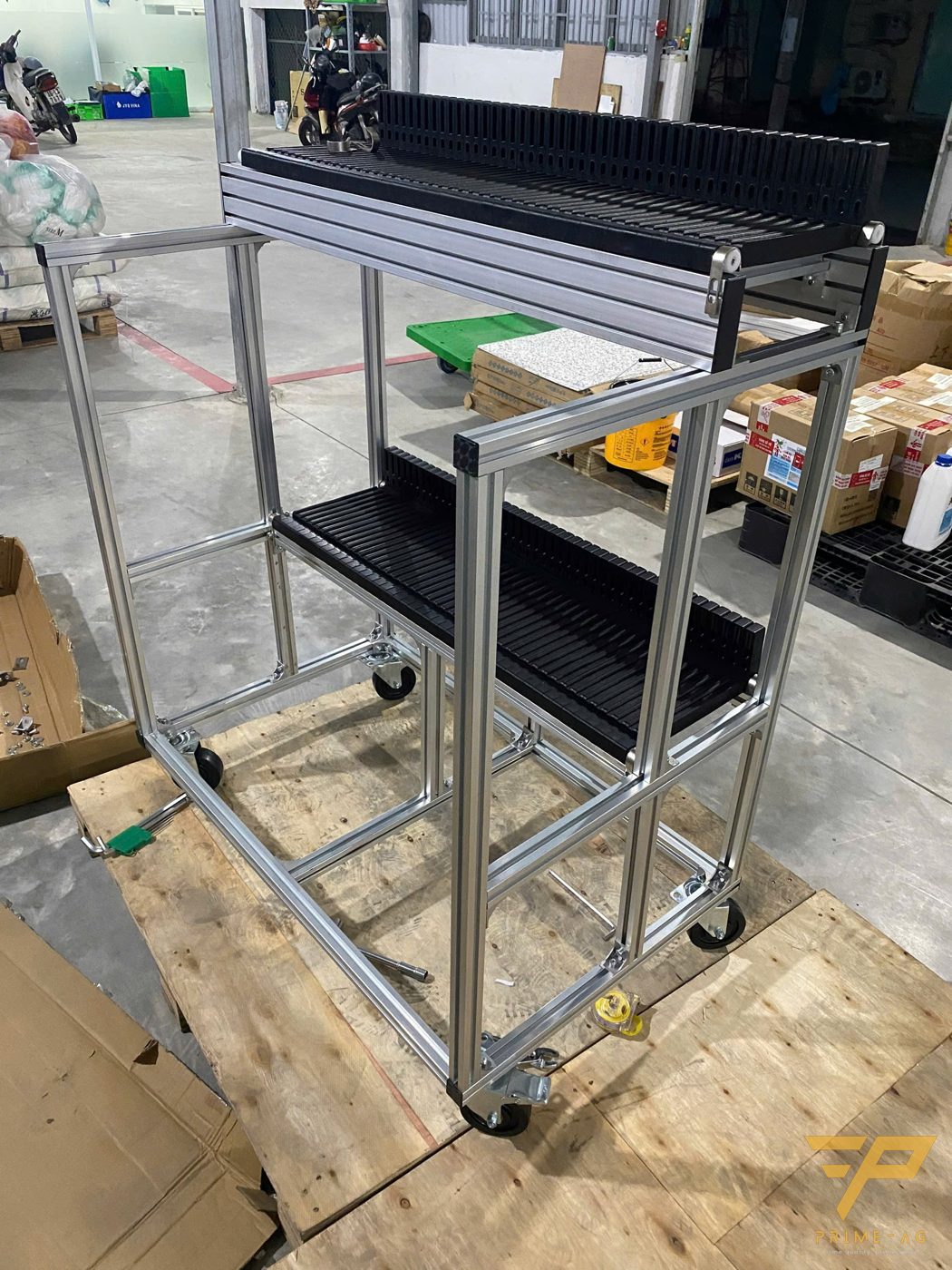
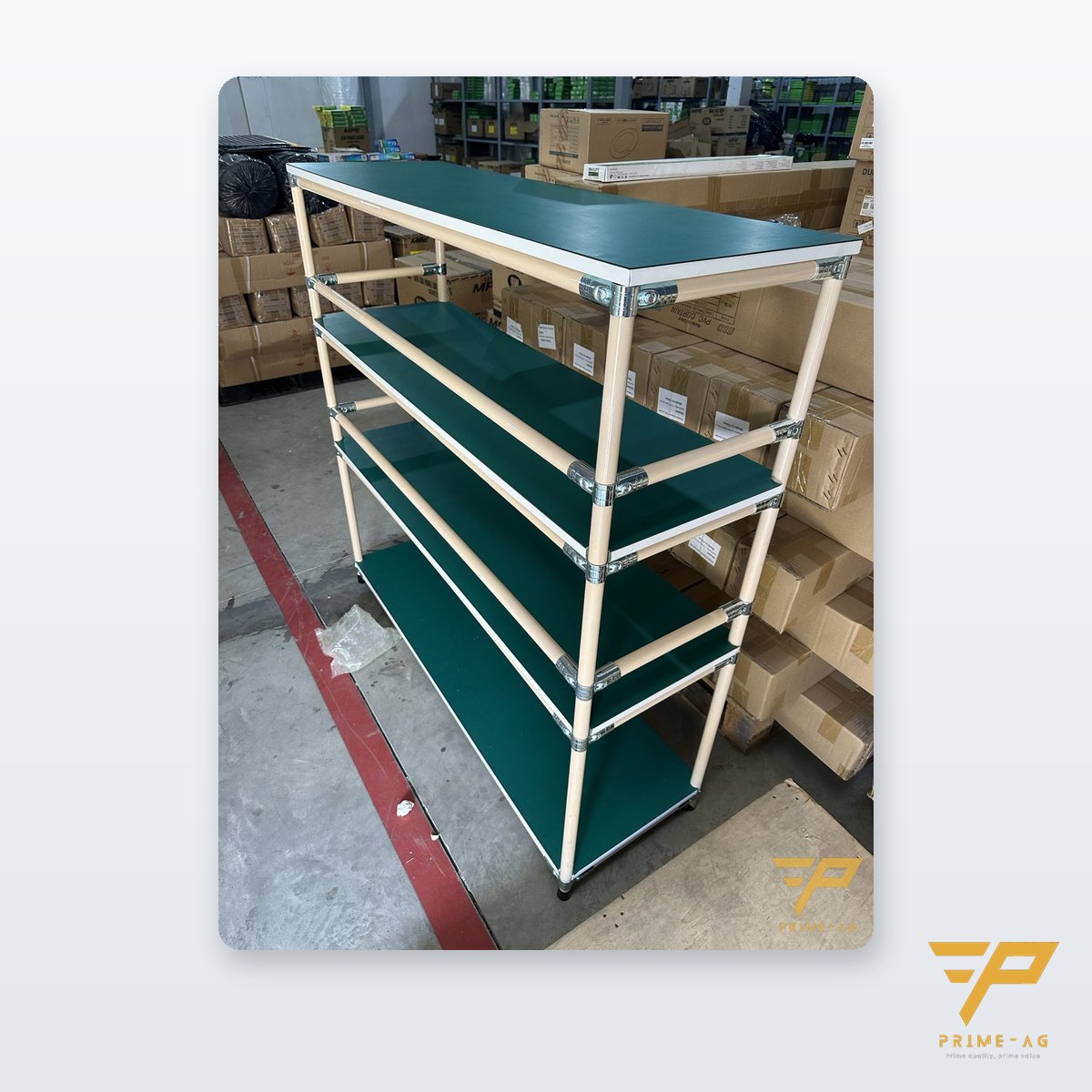
If feeders are loaded in the material preparation room, use a cart: prepare the full set for the next model and push it to the machine. The aluminum profile cart with ESD shelves uses 30×30 anodized profile, 5 mm aluminum shelves covered with 2-layer ESD rubber mat, 40 kg per level, 20 mm edge lips and an ESD A4 card pocket for the slot list; the top level takes slot divider bars as in the first photo. For many feeders carried together with reel bins, use the multi-level plastic-coated steel pipe cart: Φ28 pipe, 1.0 mm wall, 100 kg per level, optional ESD laminate shelves 10⁶–10⁹ Ω.
Fixed racks for spare feeders
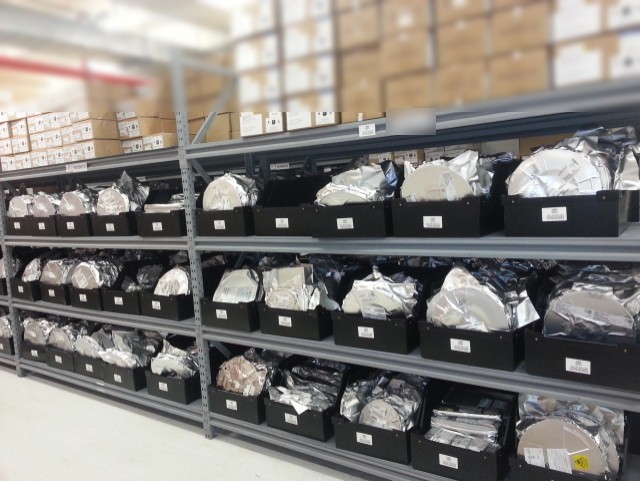
Spare feeders and those awaiting maintenance go on a standing rack near the material room, one tape width per level. Build the frame from lean pipe and aluminum profile components: T-nuts mount slot divider bars anywhere along the groove, and plated metal joints (not painted or plastic joints) keep the conductive path between ESD pipes; PRIMEAG sends the BOM and cutting list free of charge. Keep reels on a separate bin rack as in the second photo.
Grounding feeder racks and carts
Feeder storage is part of the EPA, so the cart or rack must measure below 1×10⁹ Ω to ground. Anodized aluminum frames have an insulating oxide layer, so each level needs serrated screws or its own ground wire. The path to the floor runs through ESD PU casters, swivel with brake and fixed, with all 4 casters conductive; a drag chain is only a secondary measure. Re-measure after replacing casters or adding levels. For feeder carts already in use, including carts from other suppliers, you can ask PRIMEAG for free ESD resistance measurement at your factory in Ho Chi Minh City, Binh Duong or Dong Nai: a technician brings a TR1800 meter and 5 lb electrodes, measures as many carts as you like, with no order required; the appointment (Mon–Sat) is confirmed the same day, measurement takes place within 3–5 working days, and a PDF of the readings with photos is sent within 3–5 working days afterwards for your maintenance team’s reference (not a substitute for audit records).
Quick comparison
| Situation | Recommended |
|---|---|
| Feeder set for the next model, clean area | Aluminum frame cart, ESD shelves, slot divider bars |
| Many feeders plus reel bins | Φ28 steel pipe cart, ESD laminate shelves |
| Spare feeders, awaiting maintenance | Standing rack built from pipe and joints or aluminum profile |
Where to start
- Count feeders by tape width and machine brand, and the number needed for one model changeover.
- Photograph each feeder type from the side and the bottom with a ruler alongside.
- Fix the zone rules: green for ready, red for awaiting maintenance, labels matching slot numbers.
- Send this information through the drawing request page; a new design takes 10–15 working days including drawing approval.
Frames carry a 3-year warranty; casters and ESD shelves 12 months. Export processing enterprises (EPEs) receive VAT 0% invoices, and PRIMEAG handles the on-the-spot import/export customs declaration free of charge for orders from 20 million VND. For ESD consumables by station, see ESD supplies for Panasonic, Fuji, Yamaha SMT lines; for reel splicing, see SMT splice tape and brass splice clips.
Frequently asked questions
Do we need to send feeder drawings to PRIMEAG for a feeder cart? No. Send the quantity and photos of the feeders with a ruler; PRIMEAG measures a sample, draws the slot divider bars and sends the drawing for approval.
Is an aluminum feeder cart automatically grounded through its frame? No. Anodized aluminum has an insulating oxide layer, so the shelves must be bonded to the frame with serrated screws or a separate ground wire, then down to the conductive casters; the cart must measure below 1×10⁹ Ω to ground.
Can one cart hold feeders for two machine brands, e.g. Fuji and Yamaha? Yes, if the slots are made for each feeder type and each zone is labeled separately; in practice it is better to separate carts by brand or by line.
Updated: 31 Oct 2026 — PRIMEAG engineering team
Email: info@primeag.vn · Phone/Zalo: +84 906 108 292
Written by the PRIMEAG engineering team
Updated: 2026-10-31